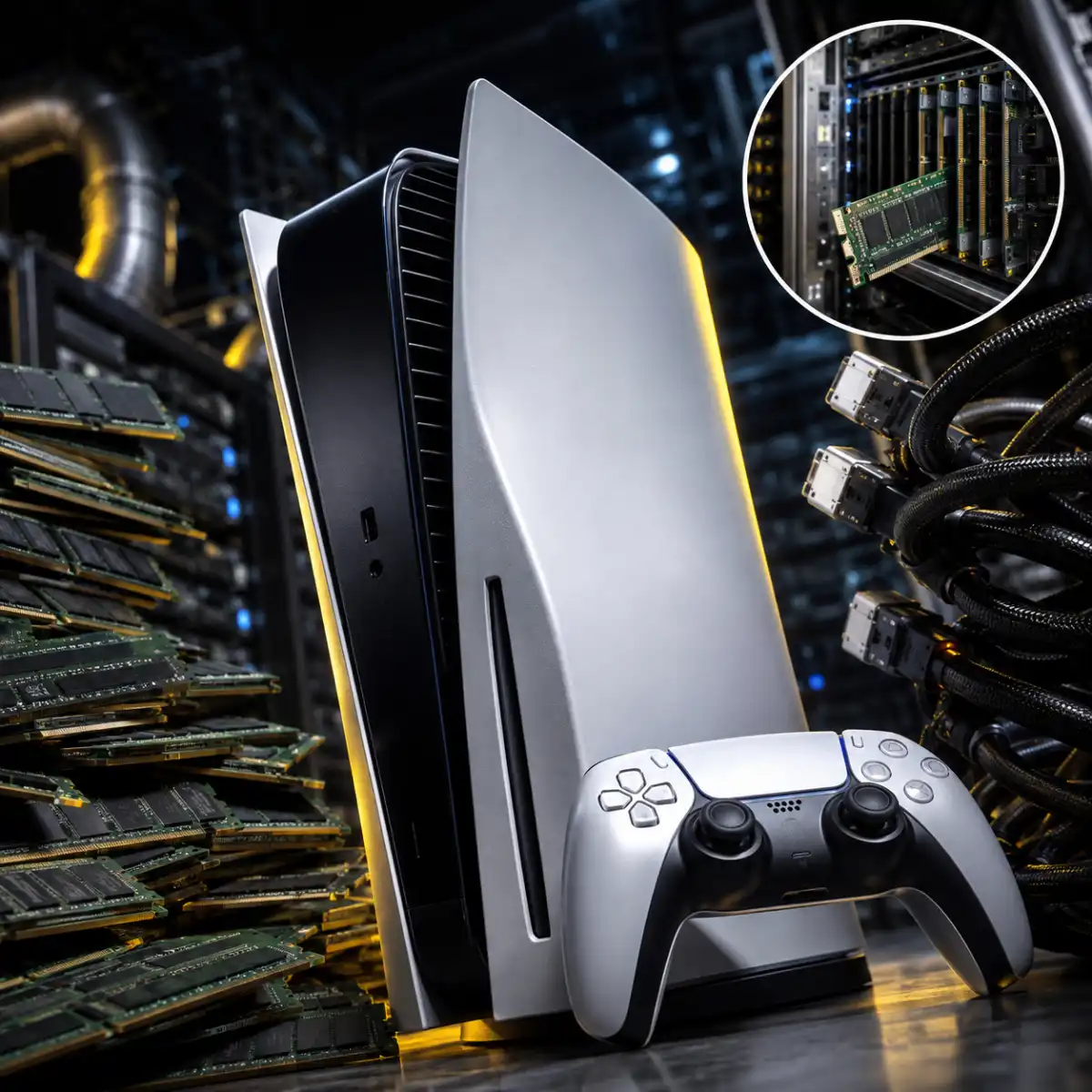
Sony is likely to stick with its current PS6 schedule, at least according to another hardware-focused insider, even as the wider tech industry deals with a memory shortage that is making new devices more expensive and harder to schedule. Sony has not announced the PlayStation 6, let alone a release window, so this remains a case of reading the hardware tea leaves. Unfortunately for anyone hoping for certainty, the tea leaves are apparently expensive RAM.
Why the PlayStation 6 timing is being questioned
The current expectation around the PlayStation 6 comes from the usual console-cycle maths. The PlayStation 5 launched in 2020, and a 2027 successor would fit Sony’s broad historical rhythm for new hardware generations.
That timeline has been complicated by a global memory shortage. RAM prices have risen sharply, and the squeeze has already had visible effects elsewhere in gaming hardware. Valve’s Steam Machine has reportedly been delayed because of the shortage, raising the obvious question: if Valve can be affected, could Sony and Microsoft be next?
Some analysts now believe Sony’s next console could slip beyond 2027, potentially into 2028 or even 2029. That would give component prices more time to settle, assuming they actually do. As ever with supply chains, optimism is not a substitute for inventory.
What insiders are saying about a delay
YouTuber Moore’s Law Is Dead previously pushed back on the idea that Sony would delay the PlayStation 6 over memory costs. His argument was that contracts are already in place to manufacture the console’s chip, and walking away from those agreements would be more expensive than simply absorbing inflated RAM prices.
Now another tech insider, KeplerL2, has appeared to reject the delay theory as well. In a NeoGaf thread discussing an Embracer Group financial report that raised the possibility of the PlayStation 6 slipping to 2028 or 2029, KeplerL2 responded with the well-known “nope” GIF of Danny DeVito from It’s Always Sunny In Philadelphia.
No detailed explanation came with the GIF, which is not exactly a peer-reviewed supply-chain document. Still, KeplerL2 has a strong track record in hardware leaks, and the response was taken by forum users as a clear dismissal of the delay speculation.
The contracts argument is doing a lot of work
KeplerL2 also reportedly liked a post from NeoGaf user Bojji, who argued that delaying the console would make little sense if the hardware is already largely complete.
Bojji wrote: “Delaying the console when it’s basically done doesn’t make any sense, they have TSMC contracts for production of APUs, maybe even GDDR7 contracts with memory makers, R&D done that costed them few hundred millions…”
The post also noted that PS5 sales are slowing and that there is “no guarantee that memory prices will drop between now and 2030.”
That point matters because a delay would not automatically solve Sony’s problem. If memory prices remain high for years, waiting could simply push the same cost issue further down the calendar while leaving Sony with aging hardware and a softer console market.
KeplerL2 made a similar point earlier in 2026. In April, the insider rejected the idea of a delay by arguing that AMD would not “waste resources doing validation on something they think will get delayed.” AMD is expected to be involved in the next PlayStation’s core hardware, as it was with the PlayStation 5.
This still is not confirmation from Sony
This is not an official announcement. Sony has not confirmed the PlayStation 6 name, specs, release year, or price. The company could still change its plans for reasons beyond memory costs, including software readiness, manufacturing capacity, market conditions, or competition from Microsoft’s next Xbox hardware.
What makes the latest discussion notable is the source profile. Both Moore’s Law Is Dead and KeplerL2 have been accurate before on technology and console hardware leaks. That does not make them Sony spokespeople, but it does mean their comments carry more weight than the average internet shrug.
For players, the bigger question may not be whether Sony can launch a new console in 2027. It is whether people will be ready to buy one.
Sony recently raised the price of the PlayStation 5 in the UK by £90, taking it to £519.99. If the current console is already getting more expensive late in its life cycle, a successor built during a memory crunch is unlikely to arrive as a bargain. A significantly higher launch price would test how much enthusiasm remains for another hardware generation, especially when many players are still weighing whether this one has fully delivered.
For now, the latest insider chatter suggests a delay is less likely. The official silence, however, remains very loud.