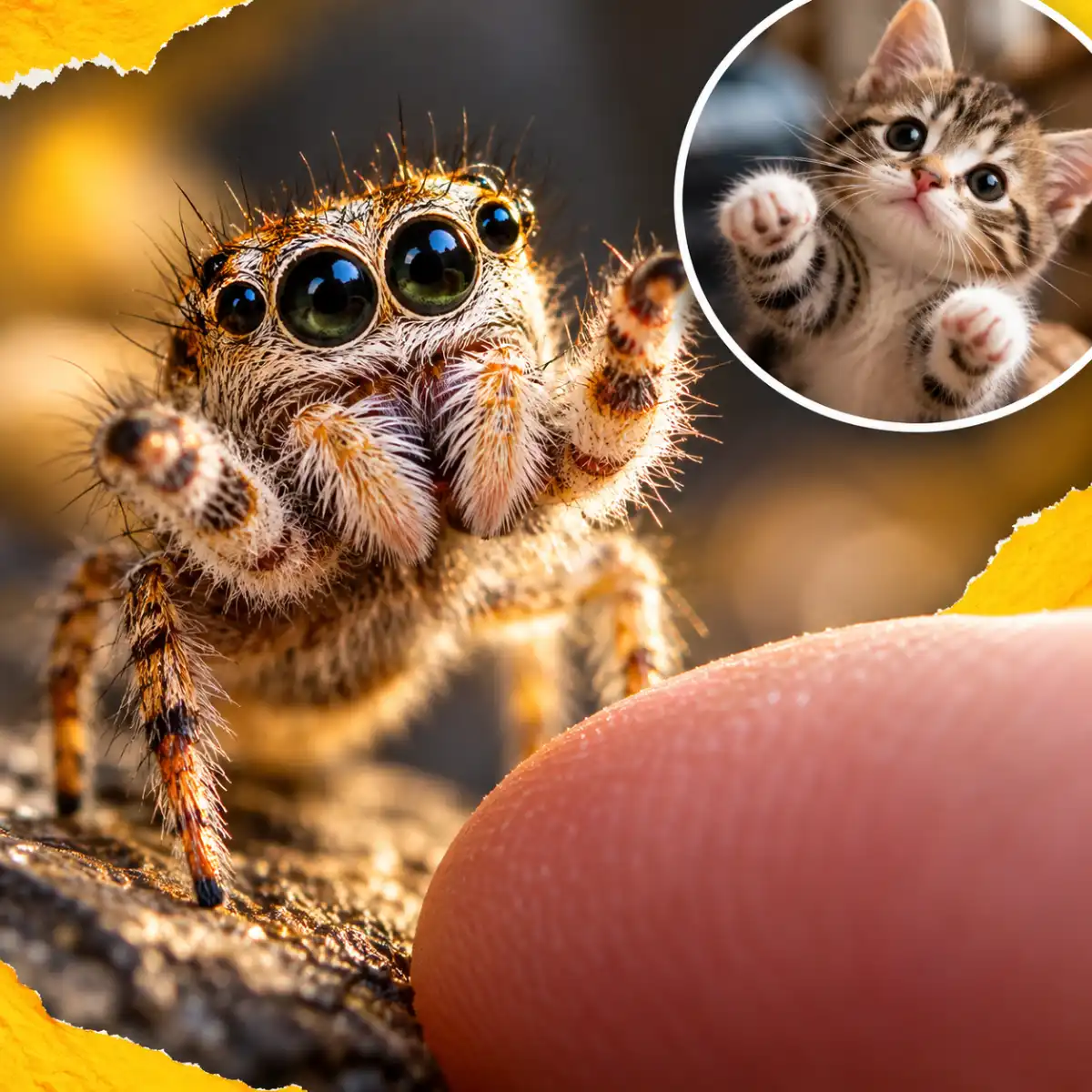
Spiders are not exactly famous for their cuddly personalities. Yet jumping spiders are becoming unlikely internet pet favourites, with owners comparing their tiny eight-legged companions to house cats.
The comparison sounds ridiculous until you hear the stories. According to enthusiasts, these miniature arachnids appear to settle into cat-like resting positions, raise their front legs towards their owners and stare back at humans with an expression that looks suspiciously like curiosity.
For anyone who has spent their life avoiding spiders, the idea of voluntarily keeping one as a roommate may require some adjustment.
Why jumping spiders are being compared to cats
The most entertaining part of the jumping spider phenomenon is how familiar some of their reported behaviours seem.
Owners describe their pets resting in compact positions reminiscent of the famous feline "loaf", when a cat tucks its paws beneath its body and settles into a neat little bundle.
Then there is the behaviour that has inspired an especially charming comparison: some owners say their jumping spiders lift their front legs towards them, almost as though asking to be picked up.
In internet language, that makes it the spider equivalent of requesting "uppies".
There is, however, an important distinction between what owners observe and what the animals actually intend. A spider raising its legs does not necessarily mean it wants affection or physical contact. The behaviour may look familiar to humans without carrying the same meaning as a cat reaching towards its owner.
Still, it is easy to understand why people find the resemblance entertaining. Apparently, having eight legs does not prevent an animal from developing an unexpectedly convincing feline impression.
Those enormous eyes are doing the heavy lifting
Much of the appeal comes down to the jumping spider's appearance.
Unlike the long-legged spiders that tend to send people running from bathrooms, jumping spiders have prominent, forward-facing eyes that give their faces an unusually expressive appearance.
Owners also describe them tilting their heads and appearing to study the humans around them.
Combined with their small size, these movements create an impression of alertness and curiosity that people readily recognise in more conventional pets.
The result is an animal that looks considerably less like a horror-film intruder and rather more like a tiny, watchful creature trying to understand what its enormous human roommate is doing.
That visual appeal helps explain why jumping spiders are attracting attention among people who might otherwise have little interest in keeping arachnids.
Are jumping spiders actually affectionate?
The comparison with cats raises a more complicated question: do jumping spiders genuinely seek human attention, or are owners interpreting ordinary spider behaviour through a familiar emotional lens?
The accounts provided by enthusiasts describe interactions that appear affectionate, particularly when spiders approach their owners or raise their front legs.
But those observations alone do not establish that the animals experience affection in the way people commonly understand it.
Nor do they prove that a jumping spider wants to be cuddled simply because it appears comfortable near a human.
That distinction matters. Humans are exceptionally good at recognising familiar expressions and intentions in animals, even when the behaviour may have a very different explanation.
The appeal of jumping spiders does not depend on proving that they love their owners. Their distinctive appearance and apparently inquisitive behaviour are interesting enough without giving them a complete feline personality.
Could jumping spiders change how people feel about arachnids?
Perhaps the most interesting aspect of this emerging pet fascination is the contrast between the animals' reputation and the reaction they are receiving.
Spiders are frequently treated as unwelcome household visitors. The jumping spider enthusiasts described here, however, see something worth observing, caring for and occasionally comparing to a miniature cat.
In my view, that shift in perception is more compelling than the claim that jumping spiders behave exactly like cats. The reported similarities are amusing, but the real appeal lies in discovering that an animal many people instinctively fear can also appear curious, delicate and surprisingly endearing. We do not need to assume these spiders experience human-like affection to appreciate them.
There is also a limit to what the available accounts establish. They offer an intriguing picture of how owners interact with jumping spiders, but they do not demonstrate how widespread the trend has become or whether the reported behaviours are typical of the animals generally.
The internet's most unexpected roommate
For now, jumping spiders occupy an unusual position in the pet conversation: small enough to seem almost toy-like, visually expressive enough to attract admirers and sufficiently spider-shaped to make some people reconsider the entire arrangement.
Whether their apparent requests for attention reflect curiosity, instinct or something else remains an open question in these accounts.
But the fascination itself is revealing. The same creature that might once have prompted someone to reach for a glass and a piece of cardboard is now being described as a potential household companion.
And if the internet can make people look at a spider and see a tiny cat asking for "uppies", perhaps the spider's biggest achievement is getting humans to look twice before running away.