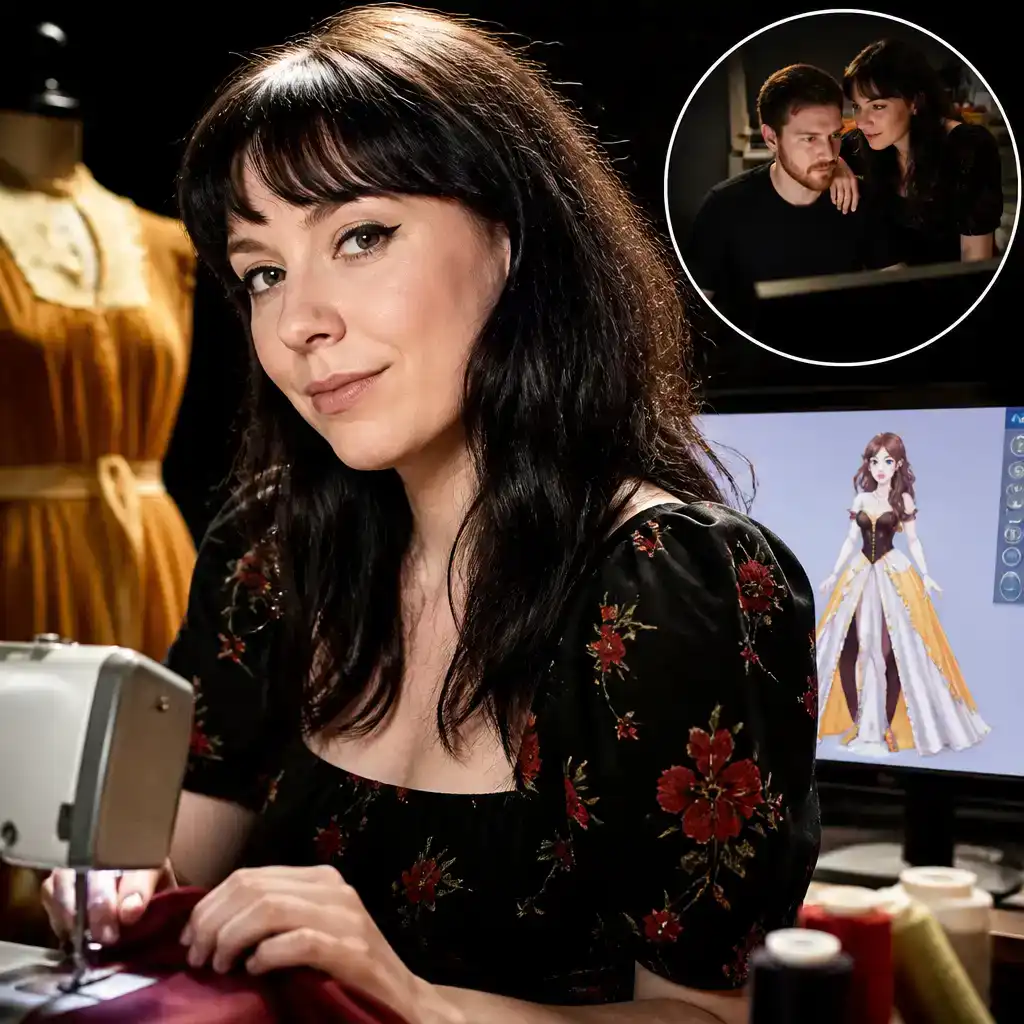
What happens when a creative career becomes physically difficult to pursue, but the urge to make things does not disappear? For Sabrina Becker, part of the answer became Dressmaker, a sewing game that has now turned into a viral Steam hit.
The project grew from something considerably more personal than an attempt to identify the next cosy gaming trend. Becker had loved sewing for years and hoped to pursue costume design, before hypermobile Ehlers-Danlos syndrome disrupted those plans.
She and her husband, Jonathan Hau-Yoon, eventually transformed that experience into a game, giving Becker a way to reconnect with dressmaking through a different medium. The idea clearly travelled: an early prototype attracted 100,000 downloads in just two months, before the finished game went viral.
Dressmaking was part of Sabrina Becker's life long before the game
Becker's connection to sewing predates Dressmaker by years. It was important enough that she wore a dress she had made herself on her first date with Hau-Yoon.
She had ambitions to move into costume design, turning that long-standing creative interest into something more substantial. Hypermobile Ehlers-Danlos syndrome, however, interfered with those plans.
Rather than leaving that part of her life entirely behind, Becker and Hau-Yoon found another way to engage with it: they began building a game around the process itself.
That distinction gives Dressmaker an unusual origin story. The game was not simply inspired by the general aesthetic of sewing; Becker's own practical experience helped shape its development.
Her real sewing experience helped shape Dressmaker
Becker worked on the game's designs and aesthetics, contributed her knowledge of dressmaking and took part in playtesting. In other words, the connection between the real craft and its virtual counterpart runs through the project itself.
For Becker, creating Dressmaker also provided a route back into a creative process that her condition had made harder to pursue in its original form.
That makes the game's success particularly striking. A project rooted in one person's attempt to reconnect with a craft turned out to have a much wider audience waiting for it.
The internet, apparently, had been suffering from a shortage of virtual sewing machines.
An early prototype found 100,000 players in two months
The first indication that Dressmaker might reach beyond its personal origins came before the finished game was released.
An early prototype recorded 100,000 downloads within two months. The completed game subsequently went viral on Steam, taking something that began with Becker's relationship to sewing and putting it in front of a much larger gaming audience.
There is an appealing reversal in that trajectory. Becker had once hoped to pursue costume design directly; instead, her experience with the craft became part of the foundation for a video game about making clothes.
In my view, that is what makes Dressmaker more interesting than its viral success alone. The numbers show that people wanted the game, but its origin explains why the project has substance beyond a clever niche. Becker was not recreating an imagined version of dressmaking from a distance; she was helping translate a creative process she already knew into a form she could continue participating in.
A personal project found an unexpectedly large audience
Dressmaker's rise is ultimately a story about adaptation as much as gaming. Becker's original plans changed, but the knowledge and enthusiasm behind them remained useful — just in a form she could not necessarily have predicted when she first became interested in sewing.
Hau-Yoon and Becker turned that experience into something other people could play, while Becker's involvement in the designs, aesthetics and testing kept the project connected to the craft that inspired it.
Its viral reception suggests that the personal motivation behind the game did not limit its appeal. Quite the opposite: a project created as a way back into one person's creative world ended up inviting 100,000 people through the door before it was even finished.
Sometimes the wholesome side quest really does become the main quest.