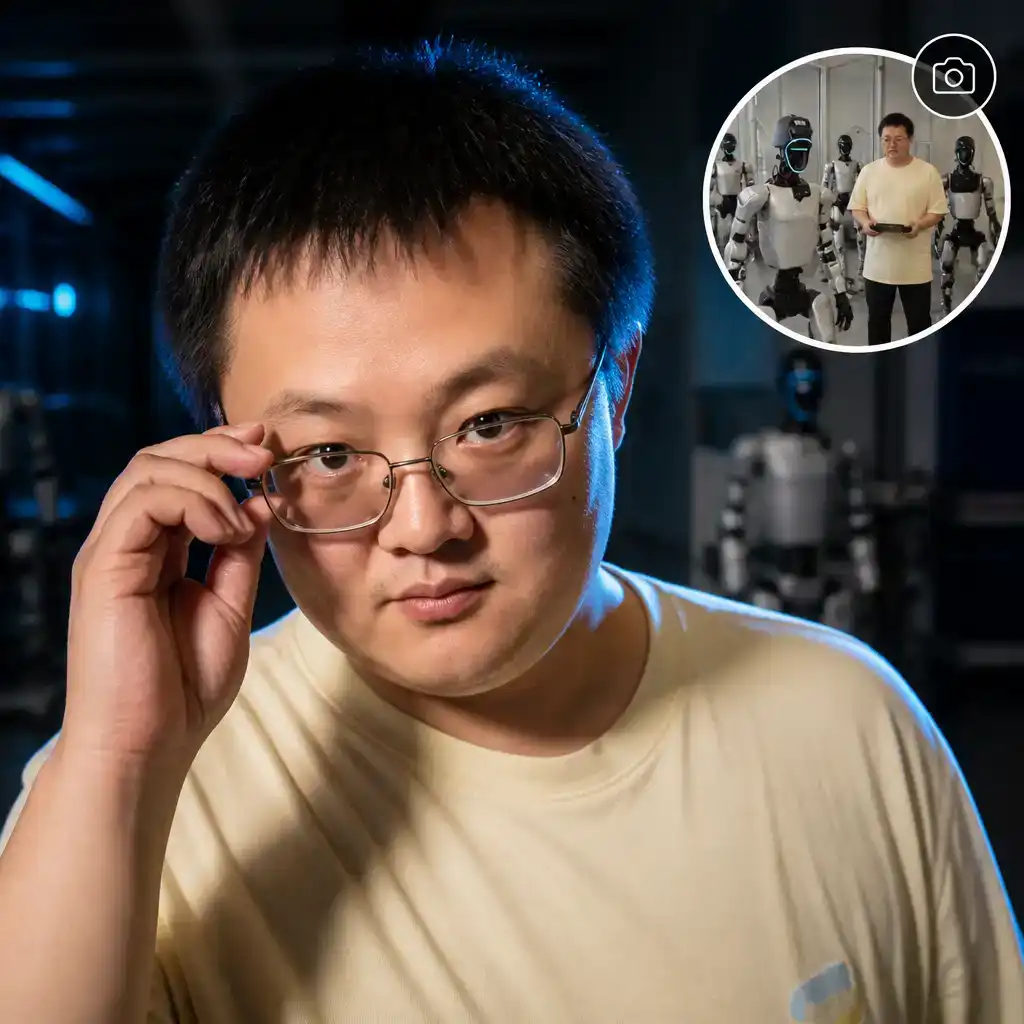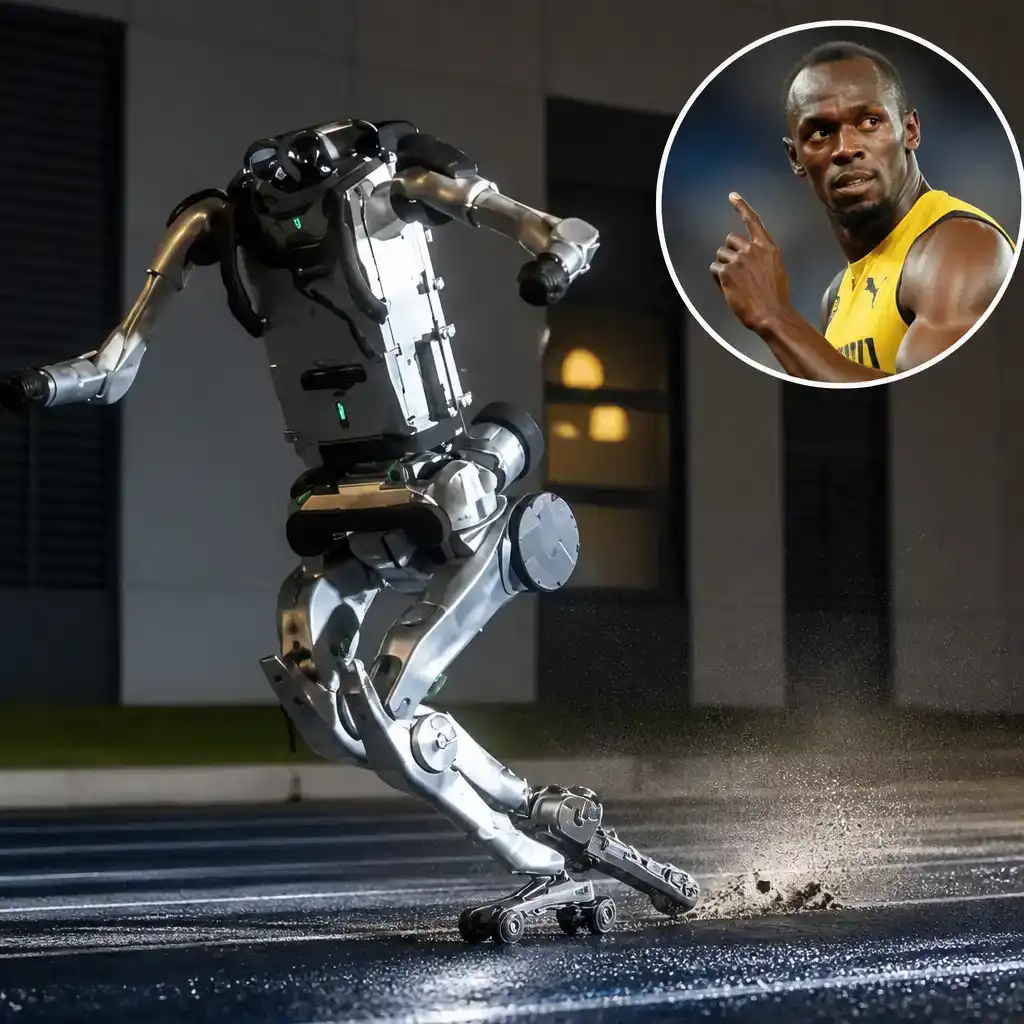
The Unitree Superman robot has been presented as faster than Usain Bolt, courtesy of a claimed top speed of 12.66 metres per second, or about 28.3 mph. That figure would narrowly exceed estimates of Bolt’s fastest pace. It does not, however, amount to a verified victory over the 100-metre world-record holder.
Unitree Robotics introduced the humanoid in a video carrying the slogan “Breaking the Limits of Humanity.” The company says the machine has legs measuring just 0.85 metres, can perform a two-metre standing high jump and reached its headline speed after slightly more than three months of development.
The footage also shows the robot accelerating rapidly through a test area before apparently crashing into an equipment cabinet. Human athletic records generally include a finish line. This demonstration added furniture.
Has the robot actually beaten Usain Bolt?
Usain Bolt set the men’s 100-metre world record at the 2009 World Championships, completing the distance in 9.58 seconds. His average speed across the race was about 10.44 m/s, but that includes his start and acceleration.
Biomechanical studies have estimated Bolt’s maximum speed at between 12.32 and 12.42 m/s, depending on the measurement method and the section of the race examined. Unitree’s claimed 12.66 m/s would therefore place the robot slightly above those estimates.
The comparison has an obvious limitation. Unitree has not released evidence of the humanoid completing an independently timed 100 metres in under 9.58 seconds. Nor has it disclosed enough detail about the timing system, acceleration distance, payload or repeated trials to establish a direct sporting record.
Interesting Engineering reported the speed figure but noted that it had not been independently verified. A short burst under controlled conditions is not the same test as a complete sprint, particularly when the machine’s braking performance concludes with an unscheduled cabinet inspection.
What about the two-metre standing jump?
The jumping claim is more straightforward, although it still relies on Unitree’s own demonstration rather than an independent record attempt.
Guinness World Records lists Sweden’s Rune Almén as the holder of the standing high jump record. Almén cleared 1.90 metres on May 3, 1980. Unitree says its humanoid reached two metres, which would exceed that mark by 10 centimetres.
Again, the company has not presented the attempt as a Guinness-certified event. Variables such as measurement, takeoff conditions and repeatability still matter. The video establishes that the machine can jump impressively. It does not automatically transfer a human record into the robotics column.
The performance nevertheless marks a large reported improvement over Unitree’s earlier H1 humanoid, which was advertised with a running speed of 3.3 m/s. The new claim is nearly four times faster. Unitree says the prototype still has “significant room for further improvement in the coming months,” a statement that sounds more credible when applied to braking than speed.
Why the timing matters for Unitree
The spectacular demonstration arrived close to a major financial event. Unitree completed its Shanghai stock-market debut on August 19, becoming mainland China’s first publicly traded humanoid-robot manufacturer.
The Associated Press reported that its shares climbed as much as 629% during the session before closing 460% above the offer price. The company raised about 6.1 billion yuan, or $904 million, and entered the market with a valuation of roughly 61 billion yuan.
Robots that jump two metres and appear to outrun elite athletes make useful promotional material before a flotation. Investors will eventually require less cinematic measures, including reliability, production costs and whether customers want large numbers of the machines.
Morningstar analyst Kangyuxiao Li told the Associated Press that “the real competitive test” is whether robotics companies can provide reliable performance and attractive returns through large-scale commercial and industrial deployment.
That standard is less dramatic than racing Bolt. It is also considerably more relevant to Unitree’s valuation.
Can Unitree turn demonstrations into a business?
Unitree already has substantial momentum. Reuters reported that its 2025 revenue more than quadrupled to 1.7 billion yuan. Humanoid robots generated 867.8 million yuan, overtaking the company’s quadruped machines as its largest business.
Omdia estimates cited by the Associated Press suggest Unitree shipped more than 5,000 of the approximately 15,000 humanoids delivered worldwide in 2025. That would give the company roughly one-third of global shipments in a young and still highly experimental market.
Expansion outside China may prove more complicated. Reuters reported that new foreign-made humanoids face authorization restrictions in the United States. The country accounted for 13.3% of Unitree’s 2025 revenue, making regulatory access more than a theoretical concern.
Safety questions will also follow increasingly fast machines into factories and other workplaces. Online responses to the Superman footage focused on missing test details and the robot’s apparent inability to stop cleanly. Speed is an impressive engineering benchmark. Commercial buyers may place a slightly higher value on not having equipment sprint into the nearest cabinet.