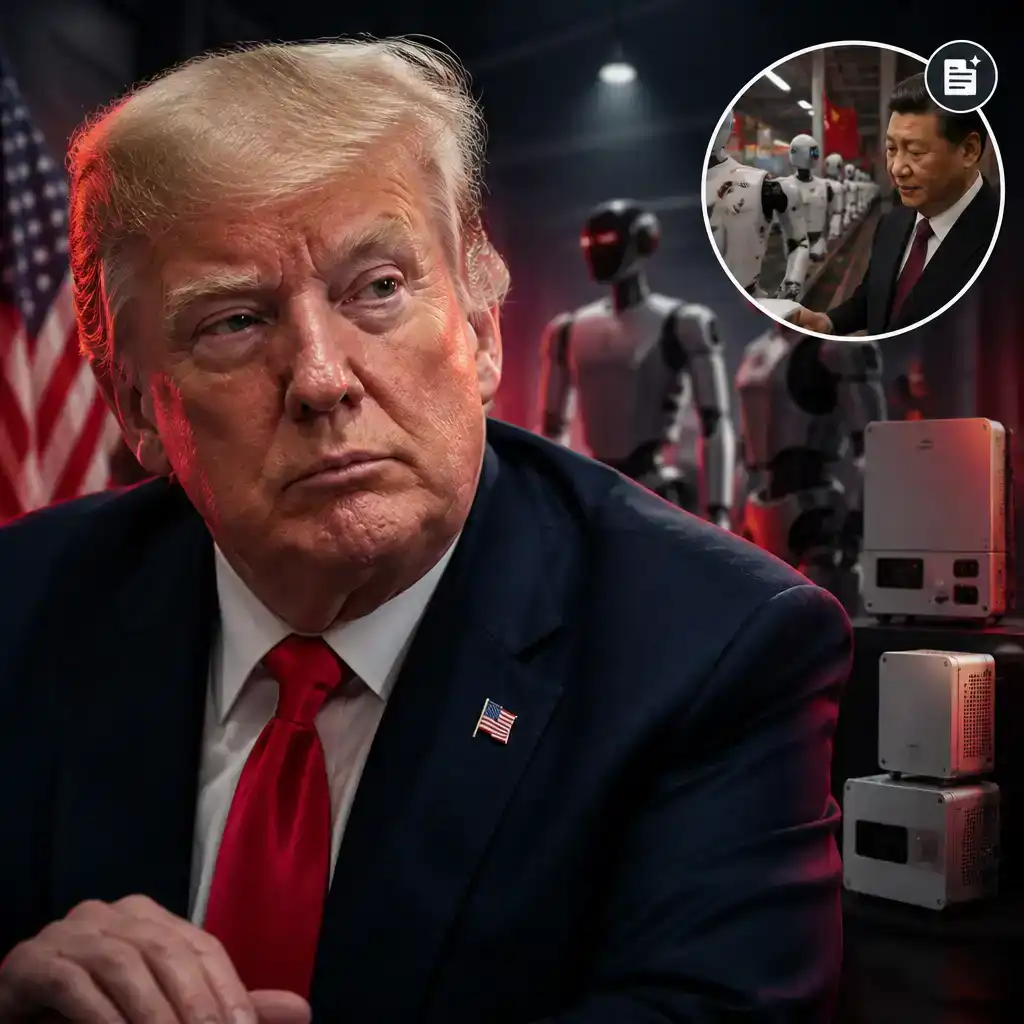
The US foreign robot ban may sound like a narrow strike against humanoid machines, but the Federal Communications Commission has drawn a much larger circle. Its restrictions cover newly introduced foreign-made connected robots and power inverters, potentially including wheeled devices and future robot vacuums, unless manufacturers obtain waivers.
The policy formally applies to foreign production regardless of a company’s nationality. In practice, China is the clear focus. Chinese manufacturers dominate humanoid robotics and power inverters, two industries Washington increasingly views as national security concerns rather than ordinary consumer technology.
Which robots fall under the restriction?
The FCC announced the restrictions on July 28, citing “unacceptable risks to the national security of the United States or the safety and security of United States persons.” Reuters, Axios and the Associated Press confirmed that they apply to newly introduced foreign-made connected robots and inverters.
Under the FCC’s technical definition, an “advanced robotic device” must:
- Be capable of locomotion, navigation, obstacle avoidance or movement on the ground
- Include a sensor that can perceive its surroundings
- Contain a chip used for network connectivity
- Weigh more than 4.4 pounds, including a docking station when applicable
That definition includes humanoid and quadruped robots, but it does not require legs. A sufficiently heavy connected robot vacuum could qualify. A robot does not need knees to become a national security issue, apparently.
The national security determination supporting the action specifically referenced reporting about weak security in DJI’s Romo robot vacuum. That helps explain why the policy extends beyond the humanoid machines that tend to attract attention through dance videos, staged fights and television appearances.
Why is China the practical target?
China has moved far ahead in both the production and deployment of robots. Research firm Omdia told the Associated Press that Chinese companies control roughly 85 percent of the humanoid market.
Around 15,000 humanoid robots were shipped worldwide in 2025. Unitree and AGIBOT each delivered more than 5,000, while Tesla and Figure AI each shipped no more than a few hundred. Axios separately reported that more than 2 million industrial robots are operating in Chinese factories, about five times the number in the United States.
American companies are trying to expand. Tesla has ended production of its Model S and Model X vehicles to create manufacturing capacity for its Optimus humanoid robot. Yet the broader supply chain remains difficult to separate from Asia. The Associated Press noted that Nvidia’s newest humanoid reference design uses a Unitree chassis, while IEEE Spectrum has reported that US robotics companies continue to rely on Asian, and potentially Chinese, components.
That dependence complicates the policy’s goal. Blocking finished products may protect domestic developers from cheaper competition, but it can also raise costs for American research teams that use Chinese hardware to build and test their own systems.
Why are power inverters included?
Power inverters convert electricity into the form needed by solar arrays, energy systems and increasingly power-hungry data centers. China leads this market through companies including Sungrow and Huawei, which is already subject to US restrictions.
Reuters reported that US inspectors discovered undocumented communications equipment in some Chinese-made inverters. The finding added to concerns that network-connected electricity hardware could be remotely accessed or disrupted.
Senator Tom Cotton told Reuters that reliance on Chinese inverters “puts our entire electrical grid at risk.” FCC Chairman Brendan Carr said the new restrictions would “secure America’s critical supply chains.” Reuters also reported that European restrictions on Chinese electricity technology helped renew the US effort, suggesting a wider Western attempt to reduce Beijing’s influence over energy infrastructure.
The stakes extend beyond household solar systems. Axios noted that inverters are essential to data centers, meaning the rule reaches into the infrastructure supporting artificial intelligence and cloud computing. The robots may be more visually dramatic, but the electricity equipment could have the broader immediate impact.
What happens to products already in the US?
The action is not retroactive. Previously authorized robot models and power inverters can remain available, and people or businesses that already own them may continue using them.
Manufacturers seeking approval for new foreign-made products can request waivers. Applicants must provide detailed plans for shifting manufacturing to the United States, reinforcing that the FCC is concerned not only with cybersecurity safeguards but also with where products are designed and built.
Reuters reported that the agency is expected to exempt many suppliers outside China. The waiver process itself does not require manufacturers to make specific security improvements, which leaves an obvious tension: a product’s production address may matter more than whether its software vulnerabilities have actually been fixed.
The FCC has also issued an additional waiver allowing covered robots and inverters to receive security and compatibility updates through January 1, 2029. Companies have not generally been required to notify the commission whenever they send security updates, however, so the announcement presents routine software maintenance as though it newly depends on agency permission.
How has China responded?
On July 29, China’s Foreign Ministry promised to take “all measures necessary” to defend Chinese companies. Spokesperson Mao Ning said protectionism would not make the United States more competitive and would instead hurt American businesses and consumers, according to the Associated Press.
The response comes ahead of a planned September meeting between President Donald Trump and Chinese President Xi Jinping, adding another technology dispute to an already crowded economic agenda.
Morningstar analyst Kangyuxiao Li told the Associated Press that excluding Chinese manufacturers could shield American robotics developers from price competition. Li said it was unlikely, however, to meaningfully slow China’s industry. With Chinese companies already holding most of the humanoid market and operating at far greater scale, the policy may change what American buyers and researchers can access more quickly than it changes China’s trajectory.
For consumers, the immediate effect should be limited because existing approved products remain usable. Over time, though, fewer low-cost imported options and pressure to relocate production could raise prices. The FCC is presenting the measure as supply-chain security. Whether it produces safer technology, rather than simply less foreign technology, will depend heavily on how those waivers are granted.