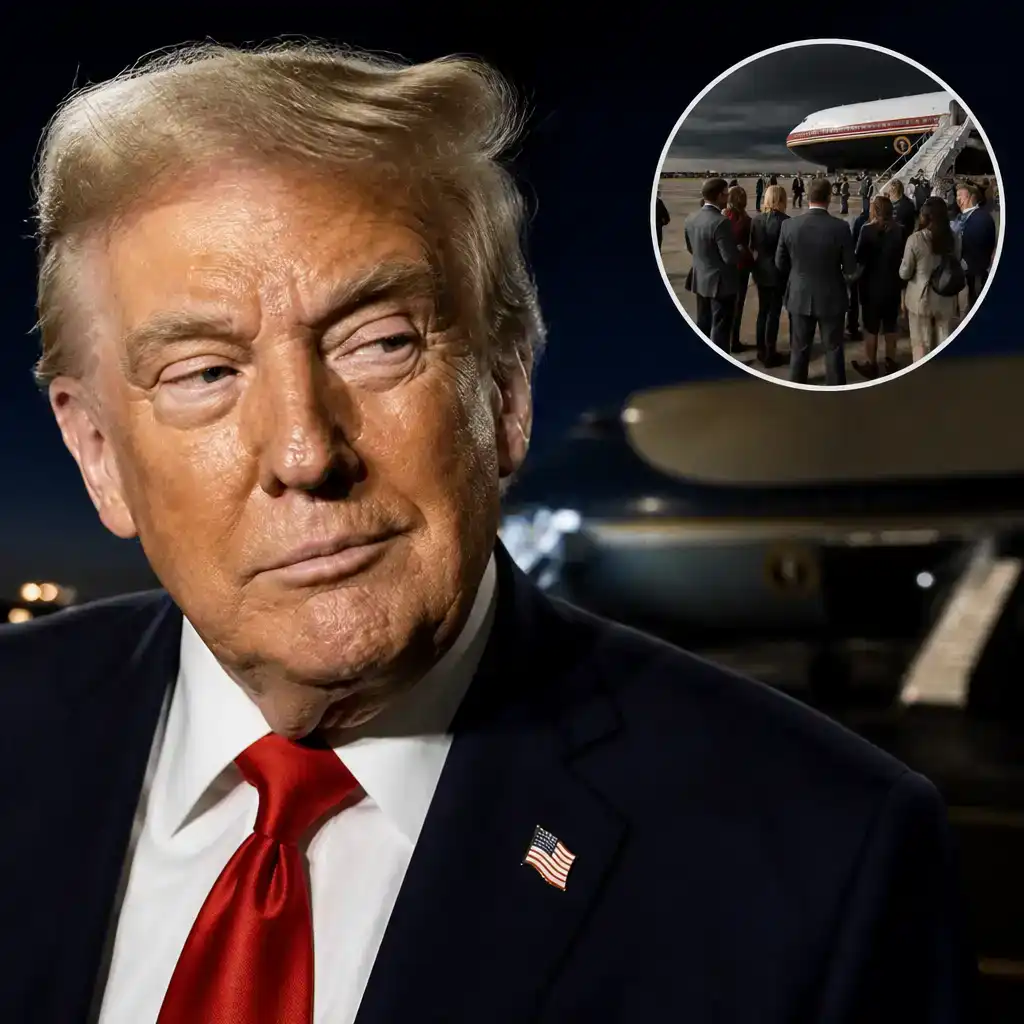
President Donald Trump has confirmed the Trump plane switch that quietly moved him onto a military aircraft after the NATO summit in Turkey on 8 July. US officials reportedly feared Iran or one of its proxies could target his plane with a missile. The security precaution may have protected the president, but it also left journalists, cabinet officials and White House staff unknowingly travelling aboard a decoy.
“I go by Secret Service and the military,” Trump told reporters during a visit to Ohio. “They wanted me to go in a different flight, different plane. I just have to do what they say.”
Why was Trump moved to another aircraft?
CBS News reported that US intelligence had identified a credible Iranian or proxy plot to fire a missile at Trump’s plane. The New York Times separately reported intelligence suggesting someone near the summit had been seen with a shoulder-fired missile.
No Iranian acknowledgment of an alleged plot has emerged, and the US government has not released further public evidence. The Associated Press said it had not independently confirmed the operation.
Trump said he did not ask for many details. “I guess there was a threat out there,” he told reporters. “I get a lot of threats.” He had previously described himself as Iran’s “number one target.”
The operation came one day after the United States renewed military strikes on Iran following the collapse of negotiations between Washington and Tehran aimed at ending the war. That timing gave security officials little reason to assume the return journey would be uneventful.
Trump later suggested the substitute aircraft might have faced the greater danger because attackers could have anticipated a switch. That remains speculation, though it neatly illustrates the central problem with decoys: everyone involved has to guess what the other side knows.
How did the catering-truck transfer work?
Trump had arrived in Turkey aboard a newer Boeing 747-8 donated by Qatar. Before leaving, he publicly announced that he would use the older presidential Boeing 747 “for old time’s sake.” Television footage then showed him boarding that aircraft at Ankara airport.
According to The Washington Post, Trump subsequently left through the opposite side of the plane and entered an elevated catering truck. The vehicle carried him to a smaller C-32A, a modified Boeing 757 commonly used by the vice president and other senior officials.
The newspaper reconstructed the transfer using accounts from officials, video, photographs and flight-tracking information. Defense Secretary Pete Hegseth reportedly boarded the C-32A separately using exterior stairs, helping the departure resemble an ordinary military flight.
The aircraft carrying Trump and Hegseth used the call sign “Reach 18.” Meanwhile, the larger jet carrying the press and officials continued to display “AF1,” sustaining the impression that the president remained aboard. Technically, Air Force One is not a particular plane. It is the call sign assigned to any US Air Force aircraft carrying the president. On this flight, the label was apparently doing some unusually creative work.
Who remained aboard the decoy plane?
About a dozen journalists boarded the original aircraft alongside White House personnel. NBC News reported that Secretary of State Marco Rubio, Treasury Secretary Scott Bessent and other senior staff also remained on the decoy.
Those passengers were not told Trump had left. Members of the press pool were instructed to close their window shades, and a photographer who briefly opened one was quickly told to shut it again. A pool producer later said the arrangement appeared unusual, with catering trucks positioned near both ends of the plane and the press van held too far back in the motorcade to obtain a clear picture of Trump boarding.
Trump argued that the aircraft carrying him might have been more likely to face an attack. That did not settle the separate question of whether everyone on the decoy should have known they were participating in a military deception.
Former CNN Pentagon correspondent Barbara Starr said reporters may have been exposed to danger without being given the option to take another route. Jose Zamora of the Committee to Protect Journalists said the administration had a responsibility to ensure journalists covering the president were not “unnecessarily exposed to danger.”
“Reporters should be informed of credible security threats so they can make informed decisions about their safety,” Zamora said.
Why does the press pool dispute matter?
The White House press-pool system dates to 1937 and is intended to maintain an independent record of the president’s movements, especially when access is restricted. That function becomes particularly important during emergencies, when uncertainty over the president’s location can have consequences beyond an awkward travel schedule.
White House Correspondents’ Association president Jacqui Heinrich later held what she described as a “candid and productive meeting” with senior administration officials about safety and transparency. Heinrich said reporters must be able to correct misleading information once a security concern has passed. Otherwise, uncertainty over whether independent reporting can be trusted creates an opening for “bad actors.”
Journalist and historian Garrett Graff described misleading the full press corps about the president’s location as “a new Rubicon.” The concern is not that security services used a decoy. Governments have done that before. The issue is that reporters charged with documenting presidential movements became unwitting components of the deception and continued reporting information that officials knew was false.
A precedent exists, but with one important difference. President Bill Clinton used a decoy during a March 2000 visit to Pakistan. Susan Page, now Washington bureau chief for USA Today and then travelling with Clinton, said she was privately briefed about the operation. Secrecy, it turns out, can include a limited number of informed adults.
How did Trump complete the journey home?
Trump flew aboard the C-32A to the United Kingdom, where he later rejoined the older presidential aircraft at RAF Mildenhall. He was seen descending from that jet after it landed, although officials have not explained publicly how he transferred back to it.
The president then moved to the newer Qatari-donated Boeing 747-8 for the flight to Washington. While speaking to reporters aboard that aircraft, he discussed threats from Iran but did not disclose the earlier substitution.
Asked why reporters had been ordered to lower their shades on the flight from Turkey, Trump replied: “Because you’re probably on a dangerous flight because of the sleazebags we have to deal with.” He again said he faced threats “all the time” and was first on Iran’s target list.
The White House had publicly represented Trump as leaving Turkey aboard the older Air Force One. His later confirmation established that the account was deliberately false for security reasons. Officials may regard that as a successful protective operation. Reporters left aboard the decoy are also entitled to regard it as a warning about what happens when presidential security treats the independent record as another prop.