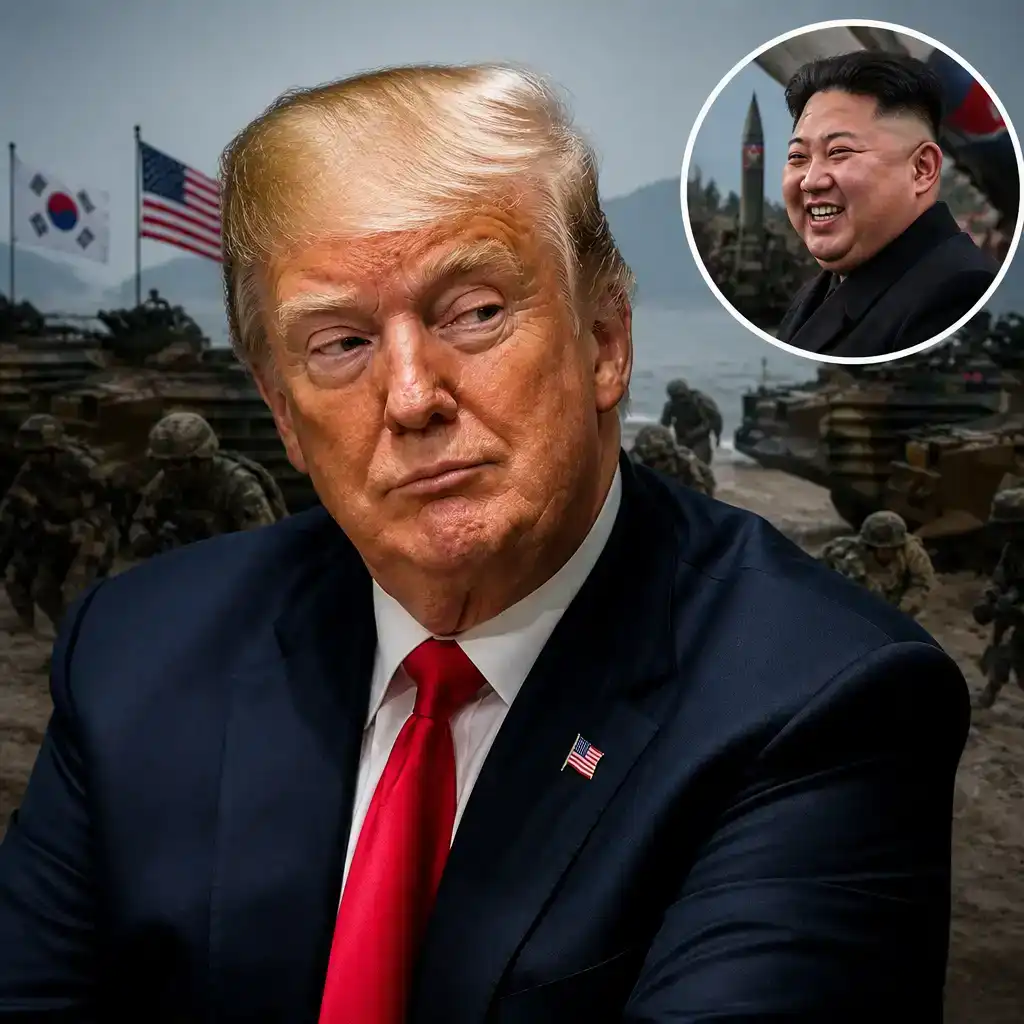
President Donald Trump has ordered the Pentagon to substantially reduce US participation in South Korea military drills, linking the decision to his relationship with North Korean leader Kim Jong Un and Seoul’s refusal to support the American war effort in Iran. The exercise itself began on August 17 as planned, because military schedules do not always reorganize themselves around presidential remarks.
Trump said South Korea had rejected his request to participate in what he called Iran’s “denuclearization.” The Associated Press, Reuters and Axios corroborated his instruction to reduce the American role, although no outlet independently verified his account of what he asked South Korean President Lee Jae Myung.
South Korea’s presidential office said the allies were coordinating over military readiness and would maintain a “solid joint defense posture.” It did not announce any immediate change to the exercise.
What is happening during Ulchi Freedom Shield?
The annual Ulchi Freedom Shield exercise is scheduled to run for 11 days and involves about 18,000 South Korean troops. Training includes precision targeting, military maneuvers, river crossings and the distribution of equipment.
The United States maintains roughly 28,500 troops in South Korea, with Camp Humphreys hosting a substantial part of that force. Washington’s participation is intended to test how the two militaries would coordinate during a crisis or conflict on the Korean Peninsula.
Trump’s order therefore affects more than the size of a training event. Reduced American involvement could limit opportunities to rehearse command decisions, logistics and battlefield coordination between forces that would be expected to operate together during an emergency.
Leif-Eric Easley, a professor at Ewha Womans University, warned that reductions could weaken alliance coordination and deterrence. Democratic Senator Mark Kelly was more direct, calling the decision “shortsighted and a mistake.”
North Korea, which routinely condemns allied exercises as preparations for invasion, fired two ballistic missiles before the drills and threatened “a new level of a deterrent.” Pyongyang has not indicated that Trump’s reduction is enough to change its broader policy.
Is Trump trying to restart talks with Kim Jong Un?
Seoul said it hoped Trump’s relationship with Kim could produce meaningful negotiations between the United States and North Korea. That offers the decision a possible diplomatic purpose, although recent history supplies a fairly large caution label.
After meeting Kim at the Singapore summit in 2018, Trump suspended major joint exercises with South Korea. The nuclear negotiations later collapsed in 2019 without an agreement on sanctions relief or North Korea’s weapons programme.
Kim has since made future talks conditional on Washington abandoning its demand for North Korean denuclearisation. That leaves the two governments divided over the central issue before anyone has selected a meeting room.
Kim Dong-yub, a professor at the University of North Korean Studies, said Pyongyang would probably wait for further US action before deciding whether Trump’s latest overture represents a meaningful change. A smaller exercise may attract attention, but North Korea is likely to assess policy on sanctions, military deployments and nuclear demands rather than one training schedule.
Why does the wider US military posture matter?
The reduction comes as American forces face competing demands beyond the Korean Peninsula. Axios reported that the aircraft carrier USS George Washington is leaving the Pacific for the Middle East, temporarily leaving the region without a US carrier.
That movement gives Trump’s decision wider significance. With fewer visible American assets in the Pacific and reduced participation in the exercise, allies and adversaries will be watching for signs that Washington is shifting military attention away from East Asia.
South Korea and the United States are also separately discussing practical and military contributions intended to restore freedom of navigation in the Strait of Hormuz, according to the Associated Press. Seoul has not said it will join the wider US war in Iran, despite Trump’s public criticism.
For President Lee, the immediate task is to preserve military coordination while leaving space for diplomacy with Pyongyang. For Washington, the challenge is explaining how a thinner exercise strengthens deterrence while a carrier departs the region. North Korea, meanwhile, can simply watch what happens next, which requires considerably less coordination.