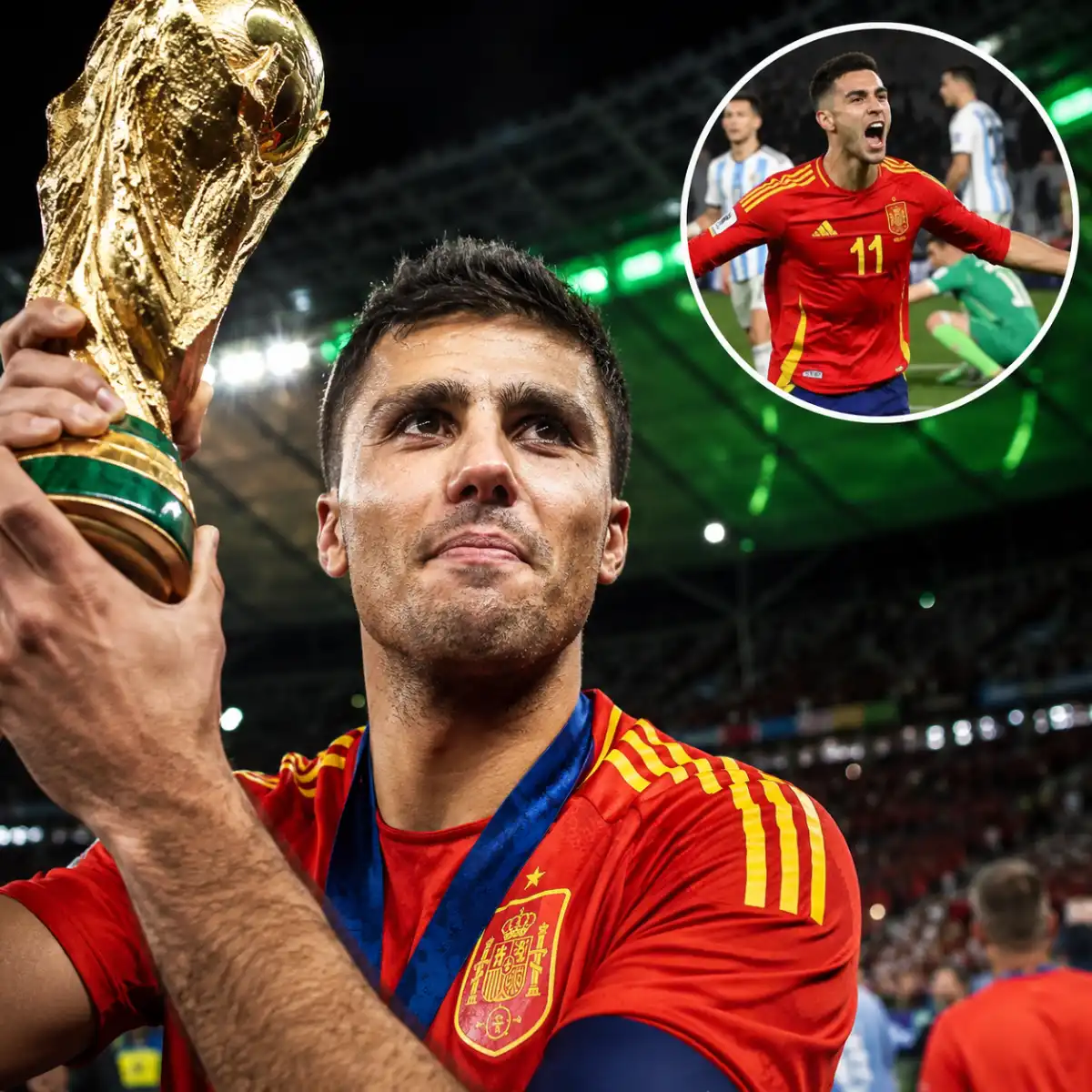
Spain beat Argentina in extra time in New Jersey to win their second men’s World Cup, with Ferran Torres scoring the decisive goal in the 106th minute before Rodri lifted the trophy. It was a long, attritional final, but not a particularly ambiguous one: Spain controlled the ball, created the chances and left Argentina defending their way to penalties that never arrived.
Former England captain Alan Shearer put it plainly on BBC One: “There is no doubt that the right team won. From start to finish, Spain controlled possession. They were the ones looking to play football, create chances and get in behind.
“This is a result for football because of the way that they have played. Spain deserve it.”
The numbers support that view, which is helpful because vibes have a habit of getting over-promoted at World Cups. Spain finished with 65% possession, an expected goals figure of 1.94 and 20 shots, 11 of them on target.
At the other end, goalkeeper Unai Simón completed his seventh clean sheet in eight matches and won the Golden Glove as the tournament’s best goalkeeper. Spain conceded only one goal across the entire 2026 World Cup, the fewest ever by a winning team.
How Spain controlled the final
Spain’s win was not just a matter of having more of the ball. It was what they did with it, and how little Argentina managed in response.
Argentina completed 464 passes. Spain completed 852. That gap reflected the rhythm of the match: Spain circulated possession, pushed Argentina back and repeatedly found ways into dangerous areas. Argentina, by contrast, spent long spells trying to break up play rather than build any of their own.
Emiliano Martínez had to work harder than any goalkeeper previously recorded in a World Cup final, making 11 saves. Without him, Spain would almost certainly have avoided the extra 30 minutes altogether.
Argentina’s attacking output was historically thin. The defending champions became the first team in World Cup history not to register a shot during the opening 90 minutes of a final. Their first attempt came from Lionel Messi in the 117th minute, by which point Spain were already close to closing the case.
That Torres’ winner arrived in extra time should not be mistaken for a narrow contest in performance terms. The scoreboard stayed level for a long time. The match itself did not.
Spain’s tournament record now looks historic
Spain are now the world, Olympic and European champions, while the country also holds the women’s World Cup title. In the hard-to-measure world of international football, that is about as close to a hierarchy as the sport allows.
The men’s side are unbeaten in 38 matches in all competitions, the longest run ever recorded by a European team. Their campaign did not begin smoothly, with a 0-0 draw against Cape Verde, but that now sits in a familiar pattern. When Spain won the World Cup in 2010, they also failed to win their opening match, losing 1-0 to Switzerland.
The final added more statistical weight to their argument. Only three players on record have completed 100 or more passes in a World Cup final. Two did it for Spain on Sunday:
- Rodri completed 101 passes.
- Pau Cubarsí completed 121 passes.
Cubarsí, still only 19, was named young player of the tournament. His Barcelona team-mate Lamine Yamal also reinforced the sense that this group may not be near its limit.
At 19 years and six days old, Lamine Yamal became the third-youngest player to appear in a World Cup final, behind Pelé in 1958 and Giuseppe Bergomi in 1982. He is now also the third-youngest winner.
Argentina’s spoiling plan ran out of road
Argentina have often been cast as international football’s recurring antagonists, particularly by England supporters. In this final, the reputation did not exactly suffer from lack of evidence.
As in the semi-final against England, Argentina’s first-half approach appeared to prioritise stopping Spain’s football over developing much of their own. Leandro Paredes was central to that work, with Enzo Fernández close behind.
Four Argentina players were booked. For critics who felt they had received generous treatment from officials throughout the tournament, that disciplinary total will not have changed many minds.
The difference from the semi-final was that Spain did not fade after the interval. They kept the ball, kept probing and kept forcing Argentina to defend deeper. Had Spain settled the match before extra time, the complaint department would likely have had a quiet evening.
Fernández’s dismissal became the main talking point after the match. He was first booked for dissent, then shown a second yellow card for a late challenge that sent Cubarsí tumbling through the air. It was not subtly late.
Argentina still dragged the final into extra time, making it the fifth of the past six World Cup finals to require an additional period. That endurance, however, did not disguise the balance of play.
What happened after the final whistle
The closing scenes did little to improve Argentina’s night. After the whistle, Paredes was involved in confrontations with Rodri, Gavi and Borja Iglesias. Nahuel Molina was also seen throwing a punch at a passing Spain player.
BBC pundit Wayne Rooney was blunt in his assessment: “Embarrassing, seeing that sort of stuff after the game has been played. Someone has been crowned World Cup champions. It is not good enough.
“Paredes is better than that. It doesn’t stop there. He keeps going and going.”
Former England goalkeeper Joe Hart was similarly critical on BBC One: “Argentina can have absolutely no complaints about what happened. Disgusting behaviour.
“I don’t think Rodri needed to get in their faces but you understand that after 120 minutes where you have been wound up and you thought you’ve been wronged, and the referee has been on your back.”
Argentina manager Lionel Scaloni, speaking through tears at his post-match media conference, tried to defend his side’s performance but accepted the main point.
“Even though they were out-playing us until the 85th minute, I would love to know what would have happened had we still had 11 men on the pitch,” he said, referring to Fernández’s red card.
“We managed to go all the way to the end when the match was so open and it just couldn’t be. They deserved the victory, that is the reality.”
That was as clear a summary as anyone offered. Argentina survived for a long time. Spain played the football, made the chances and won the trophy.