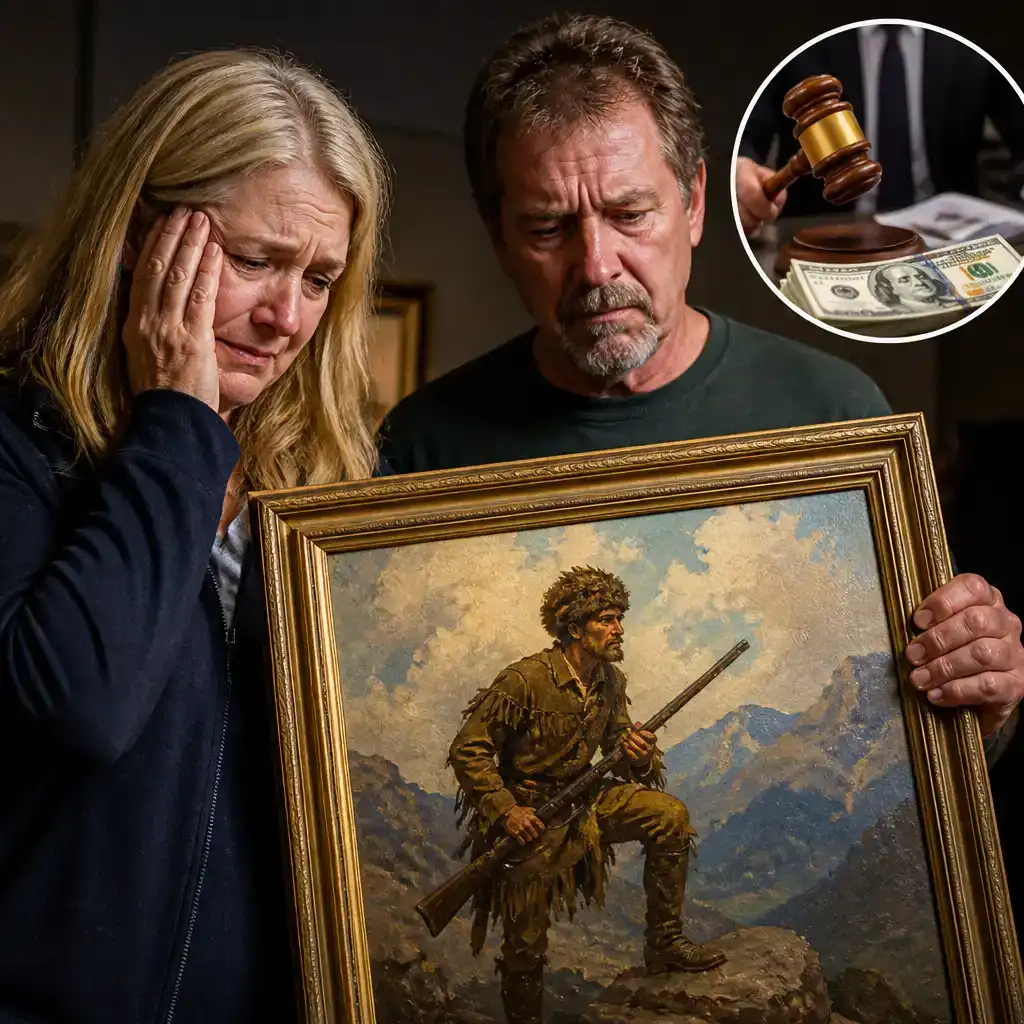
A thrift store painting bought for $4 and auctioned for $191,000 appeared to offer Tracy and Tom Donahue the sort of windfall that makes second-hand shoppers inspect every dusty frame twice. Then the winning bidder failed to pay.
The New Hampshire couple had watched N.C. Wyeth’s 1939 illustration “Ramona” sell at Bonhams Skinner on September 19, after the auction house estimated it could fetch between $150,000 and $250,000. The hammer price landed comfortably within that range, but the money never arrived.
Bonhams Skinner eventually told the Donahues that the Australia-based purchaser had refused to complete the transaction, according to the New York Times. The painting has since been returned to the couple, who called the experience the “biggest disappointment ever.”
A $4 painting becomes a six-figure discovery
Tracy Donahue found the oil-on-panel work in 2017 at a Savers thrift store in Manchester, New Hampshire. It was sitting among a stack of paintings and cost four dollars.
She took it home and hung it on her bedroom wall, initially unable to find useful information about the image online. Its route to the thrift store remains unknown.
The work depicts Ramona, the central character in Helen Hunt Jackson’s 1884 novel, alongside her stepmother. Wyeth created the illustration for a 1939 edition of the book.
N.C. Wyeth was a prominent American illustrator and the father of painter Andrew Wyeth. His images appeared in numerous illustrated books, giving literary adventures and historical scenes a cinematic scale long before cinema became particularly subtle about such things.
Years after buying the painting, Donahue posted it in a Facebook group and was connected with conservator Lauren Lewis. Lewis had encountered Wyeth’s work during her time at the Wyeth Study Center at Maine’s Farnsworth Art Museum.
Lewis told Hyperallergic that the painting was in “excellent condition” and that she was “99% sure it was authentic.” Bonhams Skinner subsequently accepted the work for its American Art sale.
The auction result existed mostly on paper
Interest in the discovery spread online in late August, helped by the almost implausibly neat mathematics of the story: four dollars spent at a thrift store, followed by a possible quarter-million-dollar return.
When the painting sold for $191,000 on September 19, the result seemed to complete that transformation. An auction result, however, is not the same thing as cleared funds.
The purchaser had 35 days to pay. By mid-October, the Donahues still had not received the proceeds, and Bonhams Skinner later informed them that the buyer would not honour the sale.
The episode turned an extraordinary profit into an extraordinary hypothetical. On paper, the couple’s four-dollar purchase had increased in value nearly 48,000-fold. Their bank account proved less impressed.
What happens when an auction buyer refuses to pay
The failed payment raises a less romantic question about the auction business: how much protection does a seller have when a winning bidder simply walks away?
Auctions typically treat successful bids as binding commitments, but the practical outcome of a default can depend on the auction house’s terms and its ability to pursue the purchaser. The supplied accounts do not establish whether Bonhams Skinner sought legal action or imposed any penalty on the bidder.
Hyperallergic contacted Bonhams to ask how frequently buyers renege on sales. No response was included in the available reporting.
For the Donahues, the immediate consequence is straightforward. They again possess an authenticated Wyeth painting, but they do not possess the $191,000 attached to its brief moment under the hammer.
“Ramona” still has value, but no completed sale
The unpaid bid does not erase the painting’s attribution, condition or unusual rediscovery. It does, however, complicate any claim about its market value.
A hammer price records what someone offered during an auction. A completed sale shows what someone was actually willing and able to pay. In this case, only the first part happened.
The work could be offered again, sold privately or retained by the Donahues. None of those outcomes was confirmed in the supplied reporting, and a future buyer would not necessarily match the defaulted $191,000 bid.
For now, “Ramona” has completed a round trip almost as unusual as its original discovery: from a Manchester thrift store to a major auction and back to the couple who recognised that a four-dollar painting might be something more. The treasure was real. The cheque was not.