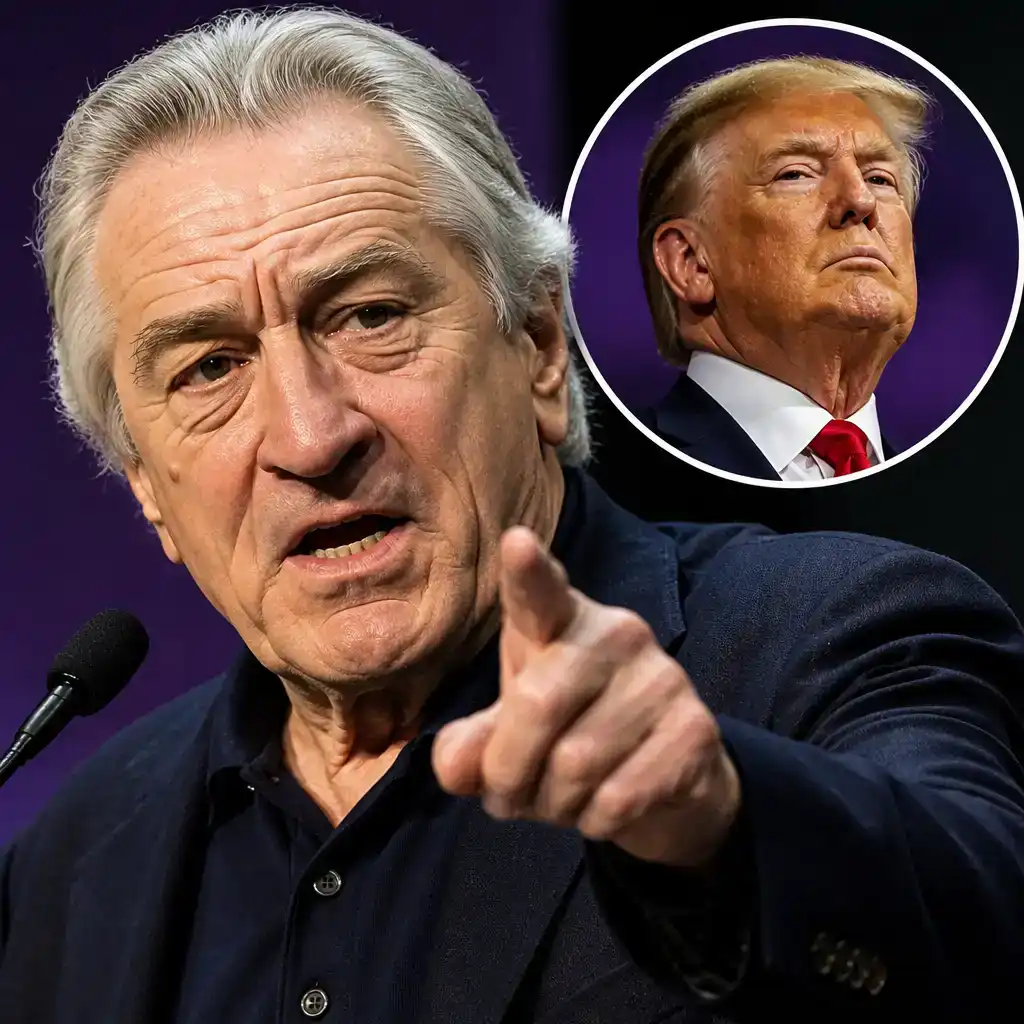
Robert De Niro has delivered a blistering attack on Donald Trump, calling him "stupid", a "punk" and an "embarrassment" to the United States in a video campaign released through The Guardian. The Oscar-winning actor made little attempt to soften his language, adding another explosive chapter to his long-running public criticism of the political figure.
Speaking directly to the camera, the Taxi Driver star unleashed a string of insults that left virtually no room for diplomatic interpretation. His comments quickly became a source of online division, with supporters applauding his candour and critics questioning whether another furious intervention from Hollywood would persuade anyone.
The controversy highlights a familiar tension in American political culture: celebrities can attract enormous attention to political arguments, but attention and persuasion are not necessarily the same thing.
Robert De Niro calls Trump a "punk", a "pig" and a "bullshit artist"
De Niro's remarks were striking even by the standards of his established hostility towards Trump.
In the video, the actor declared:
"He's so blatantly stupid. He's a punk, he's a dog, he's a pig, he's a con, a bullshit artist, a mutt who doesn't know what he's talking about."
The criticism was not framed as a disagreement over a particular policy or political decision. Instead, De Niro attacked Trump's character, credibility and suitability for public office.
He continued:
"He's an embarrassment to this country. It makes me so angry that this country has gotten to this point that this fool, this bozo, has wound up where he has."
The second statement offered a clearer indication of what was driving the actor's anger. Beyond his personal contempt for Trump, De Niro expressed frustration with the political circumstances that had allowed someone he regards so negatively to attain such prominence.
There was no carefully worded appeal for unity, no attempt to acknowledge Trump's supporters and certainly no effort to disguise the actor's feelings. De Niro appeared determined to make his position unmistakable.
Why De Niro's furious attack divided the internet
The video prompted sharply contrasting reactions online, reflecting the broader political divisions surrounding Trump.
Supporters of De Niro welcomed his willingness to speak without restraint, interpreting the comments as an unusually direct expression of anger towards a political figure they also oppose.
For those viewers, the actor's blunt delivery was part of the appeal. Rather than relying on cautious political language, he articulated his frustration in terms that were immediate, emotional and impossible to misunderstand.
Critics, however, took a very different view.
Some condemned the intervention as unnecessarily aggressive, while others characterised it as another example of wealthy Hollywood personalities lecturing ordinary Americans about politics.
Those competing reactions expose the central problem with celebrity political commentary. A famous actor can command attention simply by speaking, but that prominence does not automatically make the argument more convincing.
De Niro's language was forceful enough to generate a reaction. Whether it encouraged anyone to reconsider their opinion of Trump is a separate question, and the available information offers no evidence of such an effect.
Hollywood celebrity meets America's political divide
De Niro is one of the most recognisable actors of his generation, with an acclaimed career that includes Taxi Driver, Raging Bull and The Godfather Part II.
His professional reputation gives his political interventions a visibility that most private citizens could never expect. When someone with his cultural standing delivers a direct-to-camera denunciation of a major political figure, the remarks can travel far beyond the audience of a conventional political speech.
But fame creates its own complications.
For audiences already sympathetic to De Niro's position, his status may reinforce the message. For those who distrust celebrity involvement in politics, that same status can become a reason to dismiss it.
The actor's choice of language also matters. His remarks offered a clear moral and personal judgment of Trump, but they did not present a detailed argument about policy, governance or specific decisions.
That distinction does not make the criticism meaningless. It does, however, help explain why the response has focused as heavily on De Niro's tone as on the substance of his objections.
Does an angry celebrity intervention actually change minds?
In my view, De Niro's frustration comes across as genuine, and there is nothing inherently wrong with a prominent actor expressing a strongly held political opinion. The difficulty is that his attack relies almost entirely on insults rather than evidence or a developed argument. That may resonate powerfully with people who already agree with him, but I doubt it offers much to viewers who are undecided or sympathetic to Trump. Political anger can be understandable without necessarily being persuasive.
There is also an important difference between expressing an opinion and attempting to influence public debate.
De Niro has every right to describe Trump in the harshest terms he considers appropriate. Viewers have an equal right to challenge his reasoning, question his language or reject the idea that celebrity status gives political opinions any special authority.
The resulting disagreement is not simply about whether Trump deserves criticism. It concerns how that criticism is delivered, who delivers it and what purpose it ultimately serves.
In this instance, the actor's message was memorable largely because of its intensity. The political argument beneath it received considerably less attention in the supplied account of the controversy.
De Niro's Trump tirade raises a bigger question about political influence
The video has succeeded in provoking discussion, but the available account does not establish when it was originally recorded or released, nor does it provide verified audience figures or evidence of a direct response from Trump.
Those details matter when assessing the reach and consequences of a political intervention, particularly when older footage can circulate again and acquire a fresh audience.
For now, the clearest takeaway is the contrast between De Niro's unmistakable hostility towards Trump and the divided response to his decision to express it so aggressively.
His supporters see an actor refusing to remain silent. His detractors see a celebrity whose anger does little to advance political discussion.
Both reactions underline the same uncomfortable reality: in a deeply polarised political environment, even a Hollywood legend can find it easier to generate outrage than agreement.
De Niro has made his opinion of Trump abundantly clear. The more difficult question is whether anyone who disagrees with him was listening.