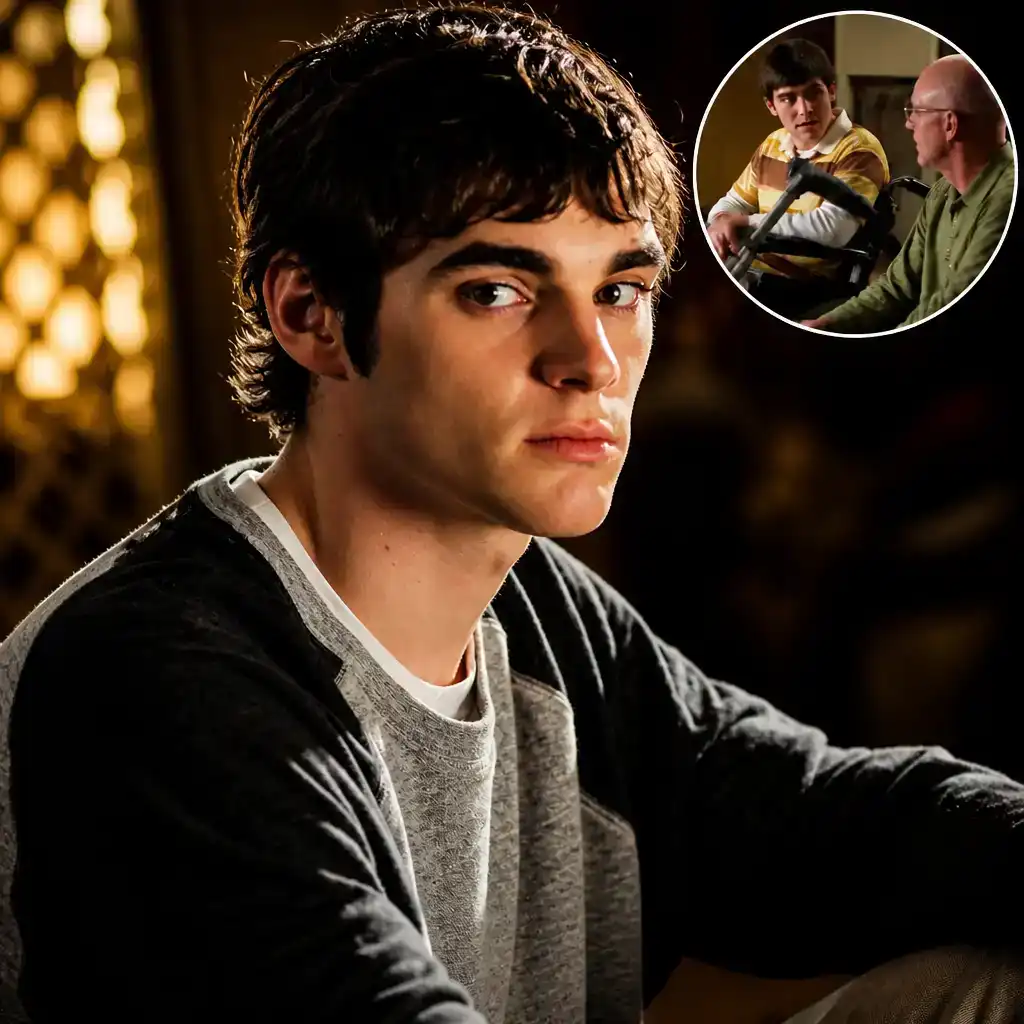
RJ Mitte helped push disability representation forward before Hollywood had learned to discuss the subject without congratulating itself. The actor, who died on October 12 at 34, joined Breaking Bad at 14 and appeared in 56 episodes as Walter White Jr., giving the character a full emotional life that was never reduced to cerebral palsy.
His performance also supplied the series with much of its underlying sadness. While Walter White built a drug empire and destroyed his family, his son moved from admiration to confusion and finally rejection. Mitte made every stage believable.
What is known about RJ Mitte’s death?
Mitte’s representative told People that the actor died by suicide, according to reporting by Variety. Authorities had not yet made that the official finding.
The Brownsville Police Department said the cause and manner of death remained pending during an active investigation. Justice of the Peace Cyndi Hinojosa told the Associated Press that an autopsy would be conducted.
Police received a call at 12:50 p.m. on October 12. Mitte was pronounced dead at about 1:30 p.m. at his home in Brownsville, Texas.
That distinction matters. A representative has provided an account, but the formal ruling still belongs to investigators and the medical authorities. Early reporting sometimes treats those as interchangeable. They are not.
CBS News, the Los Angeles Times, Variety and the Associated Press all confirmed Mitte’s death and his representatives’ description of him as an actor and disability-rights advocate.
Why did Walter White Jr. feel so real?
When Breaking Bad began in 2008, Walter White Jr. could easily have become a familiar television device: the innocent son whose main purpose was to make the troubled father appear sympathetic. Mitte and series creator Vince Gilligan’s writing team gave him considerably more than that.
Early in the story, Walt Jr. adored his father, played by Bryan Cranston. He supported Walter through cancer treatment and struggled to understand why his mother, Skyler White, played by Anna Gunn, seemed to stand between the family and happiness.
As Walter’s lies and violence became impossible to hide, that loyalty collapsed. By the final season, Walt Jr. wanted nothing from his father and wished him dead, a devastating reversal from the boy who had once desperately hoped he would survive.
Mitte handled that progression without turning the character into a symbol or moral ornament. Walt Jr. could be loyal, angry, funny, impulsive and deeply hurt. He took the bus, tried to obtain beer and behaved like a teenager rather than a lesson written for viewers.
His final rejection also struck Walter where little else still could. The man who had conquered much of the Southwest drug trade could not force his son to admire him. Apparently, intimidation has limits after all.
Why did Mitte’s casting matter?
Mitte had cerebral palsy, as did Walter White Jr., although the character’s symptoms were more pronounced. Walt Jr. used crutches, while Mitte did not ordinarily need them. The actor adjusted his movement and speech for the role without allowing those details to consume the performance.
A 2008 Los Angeles Times profile observed that the series had not even used the words “cerebral palsy” at that point. Nor did Walter and Skyler constantly discuss their son’s condition or frame him through hardship. His disability was visible and relevant, but it was not his entire identity.
That approach was unusual when Breaking Bad premiered and remains less common than it should be. Casting a disabled actor as a disabled character gave Mitte room to bring lived experience to the part. More importantly, he received the same opportunity to play contradiction, growth and emotional complexity that nondisabled actors routinely get without anyone calling it revolutionary.
Later shows such as ABC’s Speechless, which ran from 2016 to 2019 and starred actor Micah Fowler, continued that movement toward more authentic casting. Mitte’s success did not single-handedly create those opportunities, but it demonstrated that audiences would embrace a disabled performer in a major dramatic role.
Did Hollywood actually learn from the breakthrough?
Only partially. Mitte’s performance became widely admired, while the industry’s broader numbers remained stubbornly low. Hollywood does enjoy celebrating progress more than measuring it.
A Geena Davis Institute study covering television from 2016 through 2023 found that disabled characters accounted for:
- 3.3% of characters on broadcast and cable television
- 4.7% of characters on streaming services
- 28.7% of the population benchmark used in the study
Nielsen also found that 52% of disabled viewers wanted more representation, while 50% believed disability was often portrayed inaccurately.
Those figures show the limits of treating one acclaimed performance as evidence that a structural problem has been solved. Mitte proved that authentic casting could work at the highest level of television. The industry responded with some progress, plenty of praise and nowhere near enough jobs.
His achievement matters partly because the gap remains so large. Walt Jr. was not memorable because he represented every person with cerebral palsy. He was memorable because Mitte was allowed to portray one specific person in full.
What did Mitte do after Breaking Bad?
Mitte continued acting after the series ended in 2013. His later credits included Switched at Birth, The Guardians of Justice, The Recall and The Oak Room. Shortly before his death, he had been promoting the film Talking to Strangers, which was released on video on demand.
Away from acting, he became an ambassador for United Cerebral Palsy and Shriners Children’s. He also led the Mitte Foundation and regularly argued for better access and more substantial roles for disabled performers.
His advocacy carried weight because his best argument was already on screen. Across five seasons, he showed that disability did not need to be ignored, exaggerated into inspiration or used as shorthand for tragedy. It could simply exist as one element of a character’s life.
During a podcast appearance in the week before his death, Mitte addressed speculation about a possible Breaking Bad revival. He said any return would have to exceed the original series, which a recent New York Times survey ranked as the best television show of the century.
“If we came back, I would want it better than Breaking Bad,” he said. “I would really hope that if the show does come back for a sequel, it would raise the bar on a higher level.”
How did his Breaking Bad colleagues remember him?
Bryan Cranston recalled that Mitte had joined the series at 14 and said they had discussed meeting for lunch only weeks earlier. His tribute ended with the words, “I’ll miss you, son.”
Aaron Paul, who played Jesse Pinkman, wrote, “RJ, I love you my friend. You will be missed.” Dean Norris, who played Hank Schrader, described Mitte as “a sweetheart of a young man.”
The affection reflects what Mitte contributed beyond a successful supporting role. He arrived on a promising but imperfect new drama and grew with it as the series became a cultural phenomenon. Yet he was never merely present for the rise.
Walter White Jr.’s heartbreak helped expose the damage behind his father’s grand criminal mythology. Mitte made that pain specific, restrained and human. He also left the industry with a standard it still has not consistently met: cast disabled actors, write them as complete people and let talent do the rest.