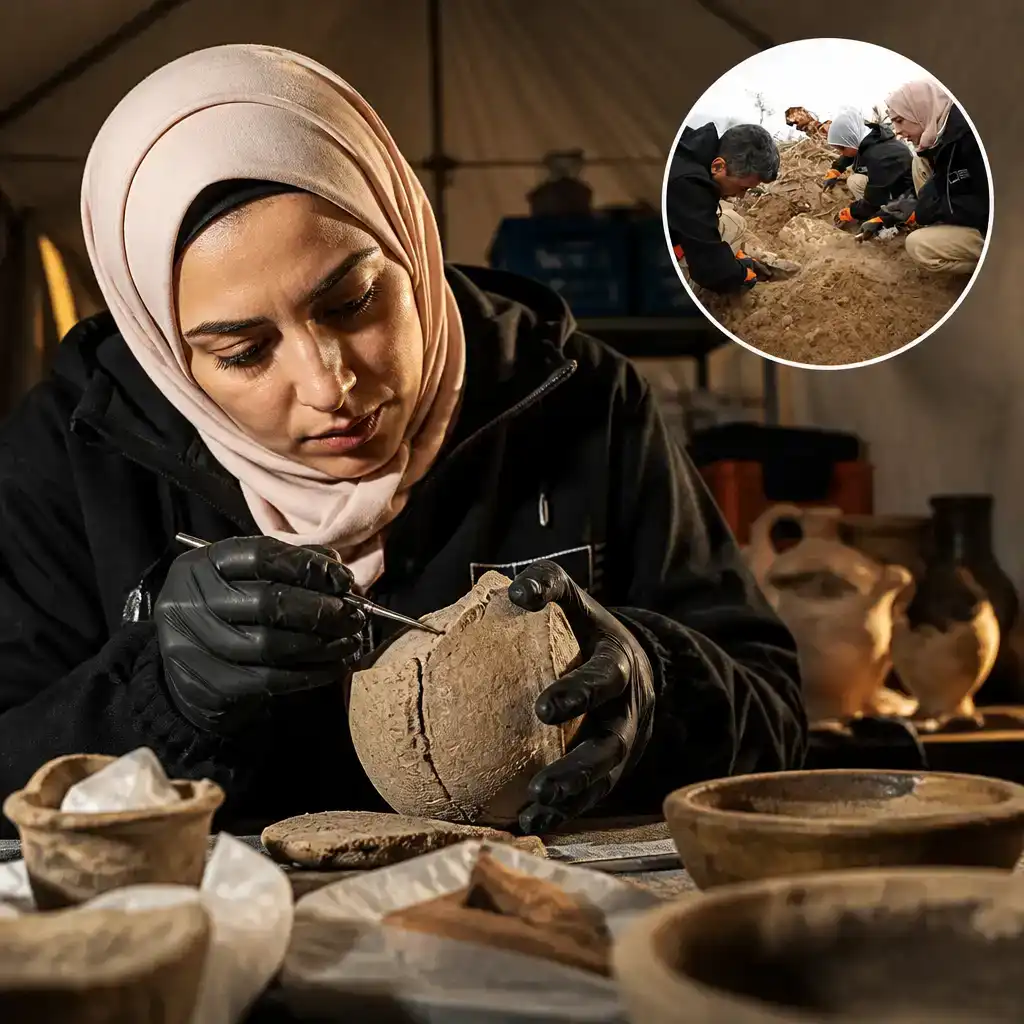
Gaza’s cultural heritage is disappearing beneath rubble, alongside the enormous human cost of Israel’s war on the enclave. Palestinian archaeologists are now trying to recover thousands of years of history using mobile phones, wooden crates and a tent for storage. It is not exactly the conservation setup any museum would request.
UNESCO recorded damage to at least 164 cultural sites between October 2023 and March 2026. The affected landmarks include the Great Omari Mosque, Hamam al-Sammara and Qasr al-Basha in Gaza’s Old City, as well as the al-Qarara Cultural Museum near Khan Younis.
These sites contain evidence of Gaza’s 5,000-year history at the meeting point of successive empires, cultures and trading routes. As buildings have collapsed, pottery, glassware and other antiquities have been broken, scattered, exposed to the weather or left vulnerable to theft.
The destruction has unfolded during a military campaign described by the article as genocidal, which has killed at least 74,022 Palestinians according to the figures cited. Meanwhile, 84 percent of structures across Gaza have been damaged or destroyed.
How are Palestinian archaeologists rescuing artefacts?
The Mayasem Association for Culture and Arts formed the Guardians of Heritage team to locate and protect items from private and public museum collections. What began as a voluntary initiative has developed into the first organised local effort to document and respond to wartime damage to Gaza’s historical collections.
Shaimaa Mohammad al-Natour, the programme’s assistant coordinator, said the team has recovered more than 1,700 pieces from four museum collections since the operation began.
Members conduct field surveys across central and southern Gaza, often relying on residents and displaced families who spot objects among the debris. Each report starts with a survey recording the informant’s details, the artefact’s location and its apparent condition.
“The team then heads to the site to rescue the items, after which the processing stages begin: cleaning, archiving and photography,” al-Natour said.
Every recovered object receives its own record. Staff note where and how it was found, photograph it from several angles and assign a unique identification number. That code connects the physical object with its images and known origin, reducing the risk of collections becoming mixed together during repeated displacement.
The process may sound administrative, but without those records an ancient object can quickly become just an unidentified fragment in a box. History is rather dependent on labels.
Why is the Yellow Line blocking recovery work?
Some collections remain close to or beyond the so-called Yellow Line, a dividing zone under full Israeli military control. Reaching those areas can be deadly.
By April 2026, 196 Palestinians had reportedly been killed near the zone since a ceasefire took effect in October 2025. That danger has forced the team to leave some known artefacts where they are.
“The nature of the areas used to be manageable, but their current locations are completely inaccessible,” al-Natour said.
“The main difficulty in continuing our work with these collections is their location behind the ‘Yellow Line,’ which poses a grave risk to the team. One of our core principles is: human life comes first.”
Continued displacement creates further problems. The rescuers themselves have no permanent base and currently operate from a tent in al-Mawasi, near Khan Younis. Transporting fragile objects through crowded areas where large numbers of displaced people are living makes routine conservation work considerably less routine.
Military restrictions also limit access to damaged sites and make it difficult to bring specialised restoration equipment into Gaza. The result is an emergency operation focused less on repairing objects than on stopping them from deteriorating before proper treatment becomes possible.
What happens after an artefact is recovered?
Explosions, collapsed masonry and rough transport place pottery and glass under severe physical stress. Many pieces arrive fractured or already unstable, meaning an enthusiastic attempt at repair could cause more harm than leaving them alone.
The team therefore follows a policy of minimal intervention. Members inspect each object, record its condition and photograph visible damage before carrying out basic conservation first aid. Soft brushes remove loose dust from pottery without disturbing original markings.
Available equipment remains basic:
- Mobile phones provide high-resolution photographs.
- Excel sheets hold the main digital records.
- Paper files provide a backup if digital data is lost.
- Numbered tags identify individual objects.
- Basic wrapping materials and wooden crates protect items in storage.
Permanent restoration must wait until trained specialists have suitable equipment and a controlled workspace. For now, stabilisation counts as success.
“In times of war, sometimes the greatest achievement is simply halting the deterioration of an artefact and keeping it intact as much as possible until suitable conditions for specialised treatment become available,” al-Natour said.
That approach also protects original features. Poorly chosen adhesives, cleaning methods or reconstruction work can permanently alter an object, replacing one form of damage with another that happens to look more organised.
Can ancient objects survive storage in a tent?
A coastal tent offers little protection from humidity, mould, insects, rodents and abrupt temperature changes. Vibrations from nearby activity and the repeated movement of crates create additional risks, especially for broken pottery and delicate glass.
Even the wooden storage boxes require attention. Moisture can rot the timber or encourage mould, which may then spread to the objects inside.
“Constant movement and transporting crates from one spot to another expose the items to shocks and vibration, particularly fragile or broken pieces,” al-Natour said. She added that overcrowding in an area sheltering displaced families makes transport harder, while storage space remains extremely limited.
The team needs a secure facility where temperature, humidity, ventilation and lighting can be controlled. Different kinds of artefacts also require specialised packaging, along with monitoring devices that can warn staff when environmental conditions become dangerous.
“Our greatest need is to transition from emergency rescue to long-term professional conservation,” al-Natour said.
She said staff also need training in preventive conservation, emergency collection management, handling damaged objects, assessing damage and maintaining databases.
Moving the collection out of tents will itself be a major operation. Records must be reviewed, item numbers checked against crate contents and each object photographed before and after transfer. The collection will then need to be reorganised so individual pieces remain easy to locate and track.
How are residents helping protect Gaza’s history?
The project is not limited to recovering stone fragments and ancient vessels. Organisers also want residents to recognise that local history belongs to them and can be protected by them, even during mass displacement.
The association runs educational activities for children, young people, women and displaced residents. Workshops cover antiquities, traditional crafts and oral history, while participants are encouraged to document stories connected to particular places and objects.
That community role matters because professional archaeologists cannot inspect every damaged building or monitor every piece uncovered in the rubble. Residents often provide the first warning that an object has been exposed.
Al-Natour said the rescue work has itself become a form of public education. When people see a team extracting and documenting a historical object under dangerous conditions, they are more likely to treat heritage as something that still matters during war, rather than an optional concern to be postponed indefinitely.
“We firmly believe that community awareness is one of the most vital lines of defence,” she said.
For the Guardians of Heritage, preserving an artefact also preserves the information surrounding it: where it came from, who found it and what it reveals about the people who lived in Gaza before the latest destruction. Without that context, an object survives physically but loses much of its meaning.
The team’s immediate goal is modest because circumstances have made modest goals ambitious: recover what can be reached, document it properly and keep it intact until professional conservation becomes possible.