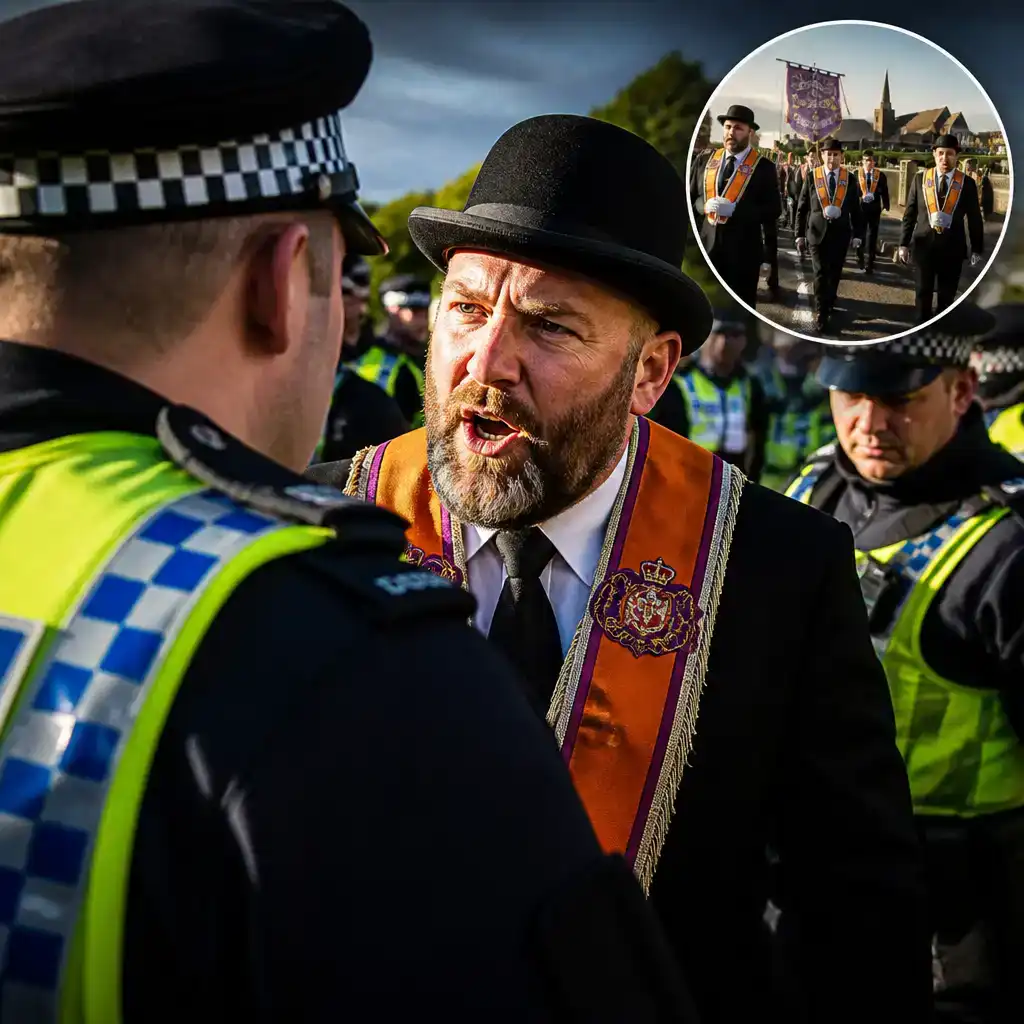
Police blocked an early-morning attempt to complete the Drumcree parade, placing three Land Rovers across the route as Orange Order members tried to leave Drumcree Church and head towards Garvaghy Road in Portadown.
The group set off shortly before 04:00 BST on Monday after spending much of Sunday waiting near the church. Although the march had received legal approval, protesters occupied the mainly nationalist road where the final section was due to take place. Legal permission, as Sunday demonstrated, does not necessarily make a road available.
The stand-off revived a dispute that caused riots, roadblocks and killings during the 1990s. It also brought senior politicians, party leaders, church figures and Northern Ireland’s chief constable into an argument over policing, protest rights and the rule of law.
Why did police stop the Orange Order?
The Orange Order had permission to parade along Garvaghy Road on Sunday morning under restrictions imposed by the Parades Commission. Protesters began gathering there during the early hours and remained until around midnight.
Police created a sterile zone between residents and the marchers, repeatedly instructing protesters to disperse. Orange Order members walked down Drumcree Road several times during the day but stopped and returned to the church area.
A larger crowd later joined them. Police then blocked the road with vehicles and warned the Order that having more than 35 people present breached the commission’s determination. Loyalist activists responded that they had not invited the additional crowd.
The Orangemen remained about a mile from Garvaghy Road while officers tried to prevent direct contact between the two groups. When members attempted to move again shortly before 04:00 on Monday, police vehicles stopped them.
Nigel Dawson, the Orange Order’s Portadown district master, said members were frustrated. He argued that they had a legal right to use the route and that the Police Service of Northern Ireland should facilitate the march.
Democratic Unionist Party MP Carla Lockhart returned to Drumcree in the early hours and said Chief Constable Jon Boutcher needed to “take a grip of this very quickly or his position will become untenable”.
What did protesters and political leaders say?
Members of Sinn Féin and the Social Democratic and Labour Party joined residents on Garvaghy Road during Sunday’s protest.
Shortly after midnight, Sinn Féin First Minister Michelle O’Neill described the outcome as a “victory” for the local community.
“This community do not want this, they do not want this march,” she said. “And tonight, I believe, is another victory for this community in standing steadfast for the right to live free from sectarian harassment and intimidation.”
Earlier, O’Neill said the decision to approve the parade raised questions about how the peace process operated.
Breandán Mac Cionnaith of the Garvaghy Road Residents Coalition addressed protesters at midnight, telling them: “We’ve stopped them once. The process now is to ensure we stop them permanently.”
Mac Cionnaith said he was due to meet the Northern Ireland secretary and chief constable on Monday. He said he would not prejudge those discussions.
Democratic Unionist Party leader Gavin Robinson accused O’Neill and other Sinn Féin representatives at the protest of being “lawmakers acting as lawbreakers”. Following talks at Hillsborough Castle, he warned that the political stakes for Stormont were already high and could rise further if the Order remained unable to complete the route.
Robinson also called for consequences for politicians he believed had broken the law.
SDLP leader Claire Hanna, who attended the protest, urged de-escalation. “Whatever the legalities, it was never politically right or morally right to do this,” she said.
Her party later called for an international mediator to help settle the dispute.
How did the authorities respond?
Northern Ireland Secretary Sir Chris Bryant returned from the Labour Party conference for talks on Sunday and urged both sides to “double down on compromise”.
He said nobody should attend an unlawful protest, while adding that it was not his role “to decide whether somebody has or hasn’t broken the law”. Bryant said he would consider proposals for mediation.
Ulster Unionist Party leader Jon Burrows said the law had to apply to “everyone” and warned that the stand-off had placed Stormont under threat.
Justice Minister Naomi Long called the confrontation an “entirely avoidable conflict”. She said political leaders risked bringing further “misery” to people across Northern Ireland.
Chief Constable Jon Boutcher said officers had gathered evidence from the beginning of the operation, regardless of which group was involved.
“So whatever’s been happening, by whatever party, we’ve been gathering the evidence of what they’ve been doing,” he said. “So we’ll deal with that at the right time.”
Boutcher said police wanted a peaceful conclusion that allowed everyone to leave with dignity. His measure of success was direct: “not one hair on one head gets harmed”.
Catholic Archbishop of Armagh Eamon Martin and Church of Ireland Archbishop of Armagh John McDowell called for an urgent, inclusive initiative to resolve the crisis, warning that “too much is at stake”.
Two local schools announced they would close on Monday because of the continuing disruption and concerns about the safety and wellbeing of pupils, families and staff.
Why was the march approved after 30 years?
The Orange Order is a Protestant, pro-British organisation and the largest of Northern Ireland’s loyal orders. It holds thousands of parades each year, most without trouble. Some Catholics, however, regard marches through or near nationalist communities as sectarian and intimidating.
Garvaghy Road is largely Catholic and predominantly home to Irish nationalists. It once formed part of the traditional Drumcree route, but residents began organised protests against the march in the mid-1990s.
The resulting confrontations became among the most serious parading disputes in Northern Ireland’s recent history. Police stopped the Order from using the road in July 1995, triggering a tense stand-off. Similar confrontations followed over the next three years, accompanied by disorder across Northern Ireland.
Violence associated with the dispute included riots, roadblocks and several murders. In 1998, the newly established Parades Commission ruled that the Orange Order could not march along Garvaghy Road. The prohibition remained in place for decades.
This year’s dispute followed a court case that overturned a Parades Commission ruling. On Friday, after 28 years of unsuccessful applications, the commission approved the route with strict conditions.
The Order had requested a 13:00 start and 60 participants. Instead, the commission required the march to begin no later than 08:00 and limited participation to 35 people.
Opponents challenged that decision in several Belfast courts on Saturday. Judges ultimately allowed the parade to proceed only hours before its scheduled start. The court process settled whether the march could legally take place, but not whether police could safely move it through a crowd of protesters.
That distinction left both sides claiming the rule of law supported their position, while police spent Sunday keeping them apart. After three decades, Drumcree had returned to familiar territory: a permitted parade, a blocked road and no shortage of political consequences.