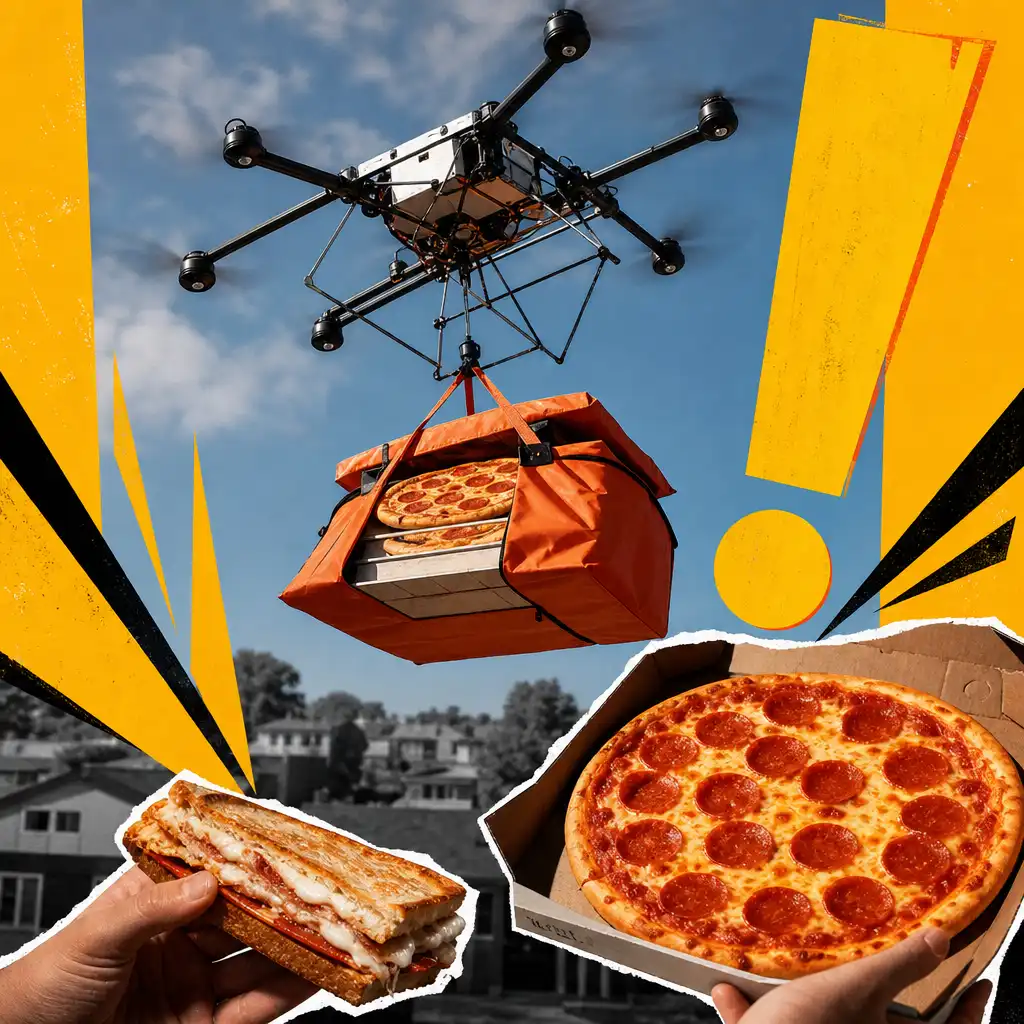
Pizza drone delivery has moved from futuristic retail theater to actual dinner logistics, at least if you live in the right neighborhood and your order is not too ambitious. In mid-May, Little Caesars and Papa Johns both stepped into drone delivery, though only one of them is currently sending pizza through the air.
The two chains are taking different routes into autonomous delivery. Little Caesars is working with Flytrex in Wylie, Texas, where customers can receive pizza orders in roughly four and a half minutes. Papa Johns, meanwhile, has partnered with Wing in the Charlotte, North Carolina area, but its pilot program is starting with toasted sandwiches rather than pizza.
How Little Caesars is delivering pizza by drone in Texas
Little Caesars customers in Wylie can now place qualifying orders through the Flytrex app. The process begins much like any other delivery order, with one extra question: are you inside the drone zone?
Customers first check whether their home falls within the four-mile delivery area. If it does, they can build an order that fits the aircraft’s limits. The current rules allow:
- Up to two large 16-inch pizzas
- Sides and drinks
- A total order weight under 8.8 pounds
Once checkout is complete, the order goes directly into the Little Caesars system. The restaurant prepares the food as usual, because the robots have not yet been trusted with sauce distribution, a wise boundary for civilization.
Instead of handing the order to a driver, the store loads it for drone pickup at the curb. The drone then flies to the customer’s home, hovers over the yard, and lowers the food by wire.
Why the four-and-a-half-minute flight matters
The most obvious appeal is speed. Flytrex and Little Caesars say the delivery flight takes about four and a half minutes, which is not much time for a pizza to lose heat or for a customer to reconsider ordering extra breadsticks.
The system also avoids one of the least glamorous parts of food delivery: traffic. By flying over roads rather than sitting on them, the drone can keep delivery times more predictable and help the food arrive closer to the temperature the chain wants customers to experience.
For Little Caesars, that fits neatly with its long-running emphasis on quick service. The drone program does not change how the food is made, but it changes the last stretch of the trip, where delays often do the most damage.
For customers, the emotional math is simpler. Hot food arriving fast is a small luxury. Hot food arriving fast by drone is that same luxury with a brief moment of looking up at the sky and wondering whether dinner has become a logistics demo.
What Papa Johns is testing with Wing
Papa Johns is also entering the drone delivery space, but its first offering is not pizza. The company has teamed with Wing for a pilot program in the Charlotte area focused on its new Oven Toasted Sandwiches.
In a press release, the companies said: “Wing and Papa Johns are partnering to redefine autonomous quick service restaurant delivery. Today, this collaboration takes off with an initial pilot program in Charlotte, North Carolina to deliver new Oven Toasted Sandwiches, alongside a joint research and development initiative to transform the future of the industry.”
For now, the drone menu is limited to three sandwich options:
- Philly Cheesesteak
- Chicken Bacon Ranch
- Steak and Mushroom
That means anyone hoping for a Papa Johns pizza to descend gently into the yard will need to wait. The company is using the sandwich pilot as a first step while it works with Wing on broader research and development.
What this says about fast food delivery
Drone delivery is no longer just an Amazon talking point. Restaurants are now testing whether autonomous systems can make fast food even faster, especially in suburban areas where yards, short distances, and predictable routes may help the technology make practical sense.
The Little Caesars and Papa Johns programs are still limited by geography, menu size, order weight, and partner technology. They are not replacing traditional delivery across the country tomorrow morning.
Still, the direction is clear. Chains are looking for ways to cut delivery time, reduce dependence on traffic conditions, and turn speed into a selling point. Little Caesars is doing that with actual pizzas in Texas. Papa Johns is starting with sandwiches in North Carolina.
For now, the future of dinner is arriving unevenly: one neighborhood, one pilot program, and one carefully lowered order at a time.