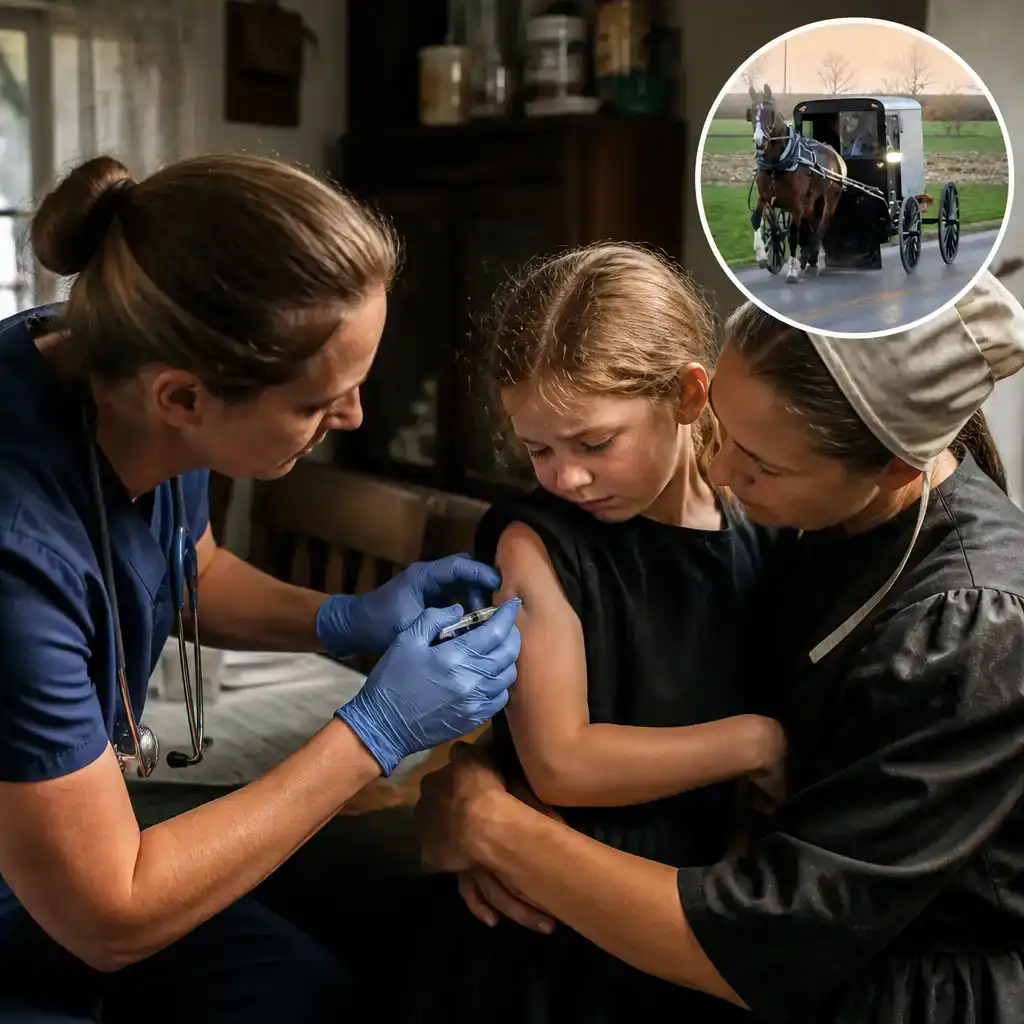
For several months, nurse Dale Weiser has driven about 30 miles, sometimes every day, to help contain the Pennsylvania measles outbreak. Her destination is a rural part of the state where many Amish families live and routine contact with healthcare services is limited.
Weiser, a clinical supervisor with the Chester County Health Department, enters strangers’ homes carefully and offers measles vaccinations to entire families. Some receive their shots around the kitchen table, a more practical setting than a clinic for people without cars, health insurance or much experience with the medical system.
“A lot of people that I encounter, they don’t have health insurance,” she said. “They don’t have a lot of interaction with the health system, and they just haven’t seen the need to get these vaccines.”
Answering questions face to face can change that. “When you start talking and you answer their questions, and build that trust, a lot of times they will make a different decision,” Weiser said.
Why are vaccination rates low in Amish communities?
The home visits form part of a wider county and state effort to increase immunisation during the deadliest measles outbreak Pennsylvania has faced in recent history.
Amish communities first settled in the United States in the early 1700s, beginning in Lancaster, Pennsylvania. Sometimes called the Plain People because of their simple clothing, the Amish are a devout Christian population whose members generally limit their use of modern technology. Many travel by horse and buggy rather than car.
About 90,000 Amish people live in Pennsylvania. Estimates suggest only around a quarter of Amish residents in the Lancaster area have received the measles, mumps and rubella vaccine, known as MMR.
No specific Amish religious teaching prohibits vaccination. The more common obstacles are limited contact with conventional healthcare, lack of transport and the inconvenience of reaching clinics. Medicine, rather unhelpfully, still tends to expect patients to come to it.
Braxton Mitchell, a genetic epidemiologist at the University of Maryland School of Medicine, runs a Lancaster research clinic studying Amish communities. He said many unvaccinated people do not hold firm objections to the measles shot.
“It’s just that they haven’t gotten around to it. It’s not convenient,” Mitchell said.
How quickly is measles spreading?
Amish communities are highly social, Mitchell said, which allows the virus to move rapidly through church groups when many members are unvaccinated.
“Measles is rampant in the Amish community,” he said. “People are concerned about it.”
Families have been particularly worried about babies. According to state officials, two newborns have died from complications linked to measles. An 18-year-old and a 40-year-old woman have also died.
Chester County borders Lancaster County, the centre of the outbreak. Public health officials began responding early, using tactics familiar from the Covid pandemic: knocking on doors, explaining the risks and offering vaccinations in private settings.
Since the outbreak began, Chester County has administered 538 MMR doses. Of those, 340 were given privately rather than at a public clinic.
Jeanne Franklin, director of the Chester County Health Department, said some residents cannot travel to vaccination sites. Others want discretion after changing their minds.
“People have called up and said, ‘I can’t get to your clinic,’ or, ‘I don’t want people to know I’ve changed my mind,’” Franklin said. “‘If you can come to us, that’s a lot easier.’”
What misinformation are nurses hearing?
Door-to-door work gives health officials a chance to correct false claims while building trust. That matters as childhood vaccination rates have fallen across the United States and social media has helped revive long-discredited theories about vaccine safety.
Even Amish communities with limited internet and computer access have encountered those claims. Weiser said residents have asked whether the vaccine contains heavy metals that could make people magnetic or whether the injection includes a computer chip. Neither claim is true, though factual accuracy has rarely been the main business model of vaccine conspiracy networks.
“You’re clearly getting information from that hard-core group that is promoting that misinformation and disinformation,” she said.
Officials acknowledge that people firmly opposed to vaccination are unlikely to change their views. Many families affected by this outbreak, however, fall into a different category. They are watching neighbours become seriously ill and asking detailed questions about shots they previously knew little about.
Parents often fear making the wrong decision for their children, Weiser said. That uncertainty is not the same as ideological opposition.
“There is the classically defined anti-vaxxer, versus people who are unaware or their culture feels differently,” Franklin said. “The thinking and the willingness to discuss and possibly change your mind is different between those two bookends.”
Why have the infant deaths become political?
The outbreak has also renewed a national argument over vaccines and public health. After Pennsylvania’s health department announced the first two deaths, both involving infants, US health secretary Robert F. Kennedy Jr. disputed whether measles caused at least one of them.
Democratic Pennsylvania Governor Josh Shapiro accused Kennedy of spreading misinformation that was making the outbreak worse.
Lancaster County coroner Stephen Diamantoni, a Republican, said one infant died from a ruptured spleen rather than directly from measles. The infection can enlarge the spleen, however, increasing the risk of rupture. Several doctors said measles left the child vulnerable to the fatal injury.
“I think the measles very much contributed to that child’s demise,” said William Moss, a paediatric infectious disease specialist at the Johns Hopkins Bloomberg School of Public Health.
Public health specialists have also criticised actions by Kennedy and the Trump administration, arguing that they have encouraged doubts about vaccine safety. The previous month, President Donald Trump signed an executive order recommending that the combined MMR vaccine be separated into three shots. Doctors described that approach as unnecessary and more expensive because the existing combined vaccine is considered safe.
“What he’s doing is casting doubt,” Moss said. “He basically said the vaccine could be dangerous in its current combined form.”
How long could the outbreak continue?
The political dispute is complicating work already made difficult by poor access, low vaccination coverage and persistent false claims. Health experts are particularly concerned about the start of the school year, when children will have more opportunities to spread one of the world’s most contagious viruses.
Measles travels through the air and can remain infectious in a room after an infected person has left. In a community with substantial immunity gaps, routine gatherings can quickly produce new chains of infection.
Officials now describe the situation as community transmission, meaning cases can no longer be linked only to isolated introductions or a small number of known contacts. Stopping the outbreak becomes much harder at that stage.
Weiser expects the response to continue well beyond the current round of home visits.
“I think we’re in this for six to 12 months,” she said. “It does feel like it’s spreading and accelerating. We’re in community transmission now. We can’t stop it easily.”
For county nurses, that means more long drives, more kitchen-table conversations and more attempts to reach families before the virus does.