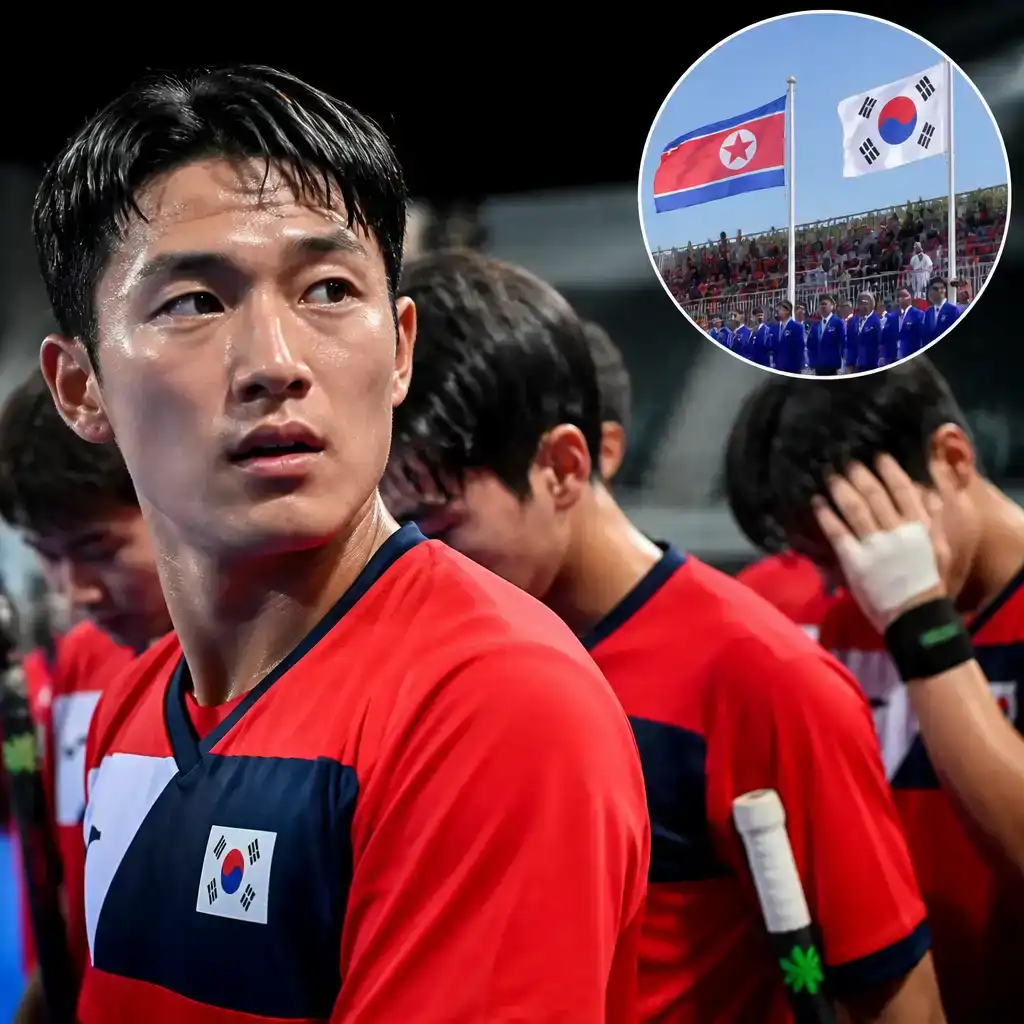
The North Korean anthem greeted South Korea’s men’s hockey team before its Asian Games match against Bangladesh on Friday, leaving players visibly confused as they stood on the field at Green Stadium in Gifu, Japan.
The stadium announcer apologised after the wrong music was played. SBS quoted the announcement as saying: “We are deeply sorry. We played the national anthem of another country instead of the national anthem of the Republic of Korea.”
Reports differ on exactly how officials handled the mistake. The Associated Press said organisers corrected it quickly, while SBS and Japan’s Tokai Television reported that the song played to the end, followed by nearly two minutes of silence. Yonhap said Bangladesh’s anthem came next, then South Korea’s correct anthem, although the referee had already begun the pre-match greetings while it was still playing. Korea JoongAng Daily reported that players alerted officials and the original recording was stopped.
No public explanation had emerged by Friday evening for how the files became confused. Evidently, clearly labelled audio was too ambitious.
How did South Korea respond to the anthem mistake?
The Korean Sport & Olympic Committee said it would submit a formal protest and demand an explanation from the Asian Games organisers, according to Korea JoongAng Daily.
The error carries rather more weight than an ordinary stadium playlist failure. North Korean state symbols, including its anthem, are banned in South Korea. The two countries also remain technically at war because the 1950-1953 Korean War ended with an armistice, not a peace treaty.
North Korea sent 107 athletes to compete in 14 sports at the Games, Yonhap reported. The broader event, formally the 20th Asian Games, was due to hold its opening ceremony on September 19 and continue through October 4. More than 11,000 athletes were expected to take part.
The organising committee did not immediately comment on the incident, beyond the apology delivered inside the stadium. That left South Korean officials seeking both an account of what happened and reassurance that national identities might receive a slightly more careful review before the next ceremony.
Did the mix-up affect the hockey match?
South Korea answered the confusion in fairly direct sporting terms, beating Bangladesh 5-0.
Five different players scored:
- Sim Jae-won
- Lee Gang-san
- Oh Se-yong
- Bae Soung-min
- Yang Ji-hun
Coach Min Tae-seok said South Korea had treated Bangladesh as a “dark horse.” His team prioritised defence during the first quarter before becoming more aggressive in attack, a plan that produced a comfortable result despite the unusual pre-match soundtrack.
The victory allowed the players to move on quickly, at least on the field. Away from it, the anthem incident joined a growing list of organisational complaints from the South Korean delegation. Basketball players had raised concerns about the size of their rooms, while transport problems disrupted preparations for the men’s football team, the defending Asian Games champions.
Those complaints do not carry the same political sensitivity as playing the anthem of a wartime adversary. Still, together they suggest the delegation’s opening experience in Japan involved more logistical improvisation than anyone had ordered.
Why was this more than an isolated protocol error?
The anthem mix-up followed another South Korean protest linked to the Games. Yonhap reported that the Korean Sport & Olympic Committee had already objected to a welcome performance featuring Toyotomi Hideyoshi, the Japanese ruler who ordered the 1592 invasion of Korea.
That episode placed the tournament against the familiar background of historical tension between South Korea and Japan. The hockey error then added relations with North Korea to the organisers’ protocol problems, efficiently involving two sensitive issues before the opening ceremony had even taken place.
South Korea has also endured a prominent identity error at another recent international event. During the opening ceremony of the 2024 Paris Olympics, its delegation was introduced using North Korea’s official name. Olympic organisers later apologised.
Friday’s mistake therefore looked less like an unprecedented failure and more like a particularly awkward repeat of a problem major sporting events should have solved long ago. South Korea still collected the result that mattered for the standings. Its officials now want organisers to explain why the correct country proved harder to identify than the winning team.