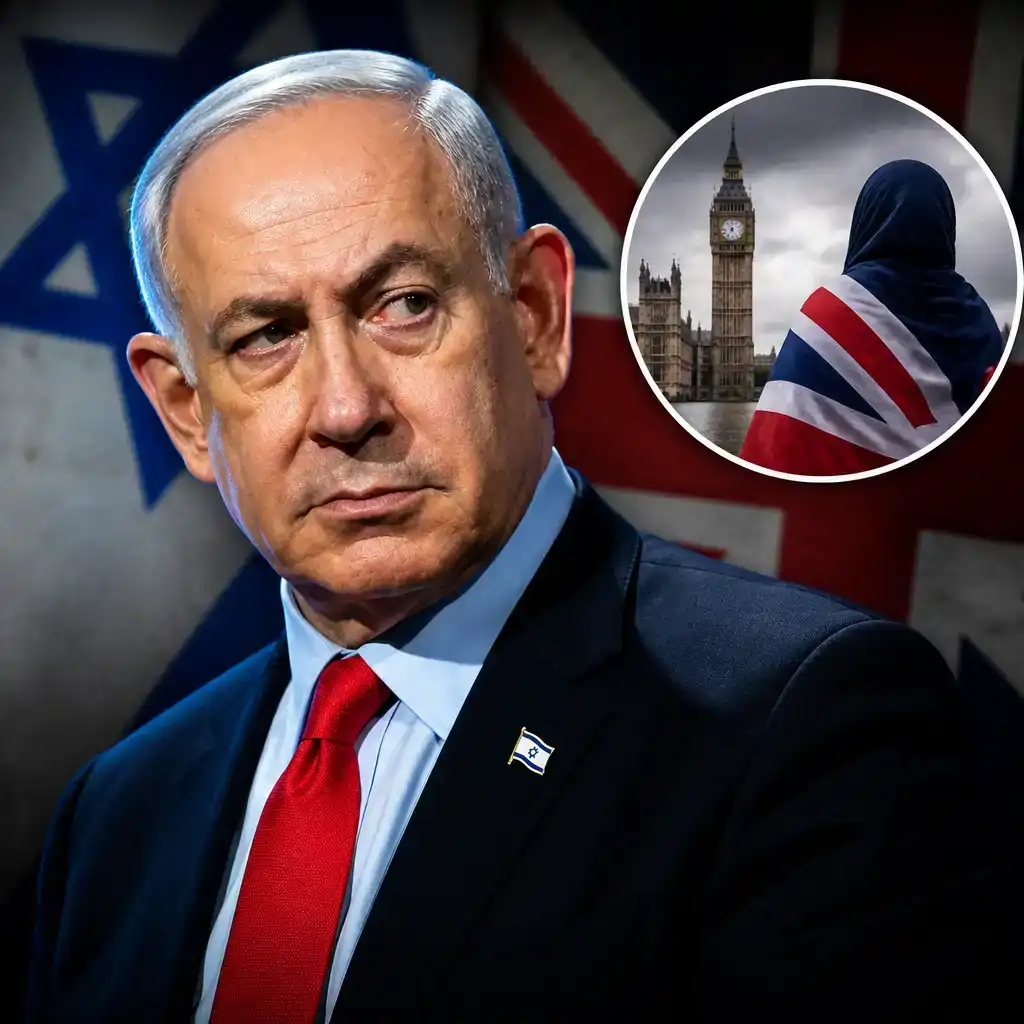
Benjamin Netanyahu has called the United Kingdom the “Islamic Republic of Britain”, attacking British media coverage and borrowing a familiar far-right trope about the country becoming Islamist. The remark adds another diplomatic irritant to a relationship already strained by Gaza, sanctions and arms-export restrictions.
The Israeli prime minister made the comment during an interview aired on Thursday, August 13. Al Jazeera identified the programme as the Melech Blitzer Haim podcast, while The Guardian reported that the interview was produced for Israeli army radio.
Netanyahu praised British writer Randolph Churchill for what he described as positive reporting on Israel during the 1967 Six-Day War. He then contrasted that coverage with the British press today.
“Go find that in Britain today, which you could call the Islamic Republic of Britain,” he said, according to translations published by Israeli media.
What Netanyahu said about Britain and nuclear weapons
Later in the interview, Netanyahu appeared to echo a joke made by United States Vice President JD Vance after Labour won Britain’s general election on July 4, 2024.
Vance had asked which country would become the first “truly Islamist country” to acquire nuclear weapons, before suggesting it might be the United Kingdom. Netanyahu offered his own version: “Someone said the first Islamic republic with nuclear weapons will be the Islamic Republic of Britain.”
“We are making sure there won’t be another one here, in Iran,” he added.
The chronology matters because earlier accounts placed Vance’s comment in 2022. Reuters reported that he made it after Labour’s 2024 election victory.
No named British minister had publicly responded by August 14, although the remarks continued to attract media coverage and online reaction. The absence of an official reply may reflect restraint, scheduling or a judgment that the comment did not require assistance in sounding inflammatory.
British Jewish leaders reject the rhetoric
Rabbi Charley Baginsky and Rabbi Josh Levy, co-leads of the Movement for Progressive Judaism, condemned Netanyahu’s language as hateful and divisive.
“At a time when antisemitism, anti-Muslim hatred and social division are causing real fear across our country, language of this kind is dangerous and irresponsible,” they said.
“Prime Minister Netanyahu does not speak for British Jews. His words do not represent us.”
The demographic evidence also does little to support Netanyahu’s description. According to the Office for National Statistics, 3.9 million Muslims lived in England and Wales at the time of the 2021 census, representing 6.5 percent of residents. By comparison, 46.2 percent identified as Christian and 37.2 percent reported having no religion.
Britain has also recently tightened its response to threats linked to Tehran. In July 2026, the Home Office designated Iran’s Islamic Revolutionary Guard Corps and an alleged proxy organisation under new state-threat powers following attacks on Jewish and Israeli-linked sites. That is an unusual policy choice for a country supposedly turning into Iran, but slogans rarely arrive with statistical appendices.
Why UK-Israel relations have deteriorated
The comments come amid worsening relations between Netanyahu’s government and Britain’s Labour administration. After taking power in 2024, the government led by then-Prime Minister Keir Starmer suspended some arms-export licences and paused free-trade negotiations with Israel.
Britain later joined France in imposing sanctions on far-right Israeli cabinet ministers Itamar Ben-Gvir and Bezalel Smotrich. In 2025, the United Kingdom also joined France, Canada and other allies in recognising a Palestinian state.
Prime Minister Andy Burnham has since apologised for Labour’s initial response to Israel’s military campaign in Gaza, saying the party took too long to demand a ceasefire.
“That is why we need to do more, which includes looking at further sanctions on those involved in the violence in Gaza but also looking at measures to ban trading goods with illegal settlements,” Burnham said. “We’ve got to do more to put pressure on the Israeli government.”
Britain currently advises businesses against trade with Israeli settlements in the occupied Palestinian territories but has not prohibited it, according to the House of Commons Library.
Trade continues despite the diplomatic dispute
Political relations may be souring, but the economic connection remains substantial. UK-Israel trade was worth about £6 billion in 2025. Trade with the occupied Palestinian territories was approximately £38 million over the same period.
Those figures show that sanctions, suspended negotiations and increasingly hostile public statements have not severed the commercial relationship. Britain remains a significant trading partner for Israel even as its government applies more pressure over Gaza, settlements and the conduct of far-right Israeli ministers.
Netanyahu’s latest intervention therefore lands in an awkward space. The alliance is plainly under strain, but Britain continues to trade extensively with Israel and has strengthened measures against Iranian state-linked threats. Calling it an Islamist nuclear power may energise supporters, though it explains rather less about the actual relationship.