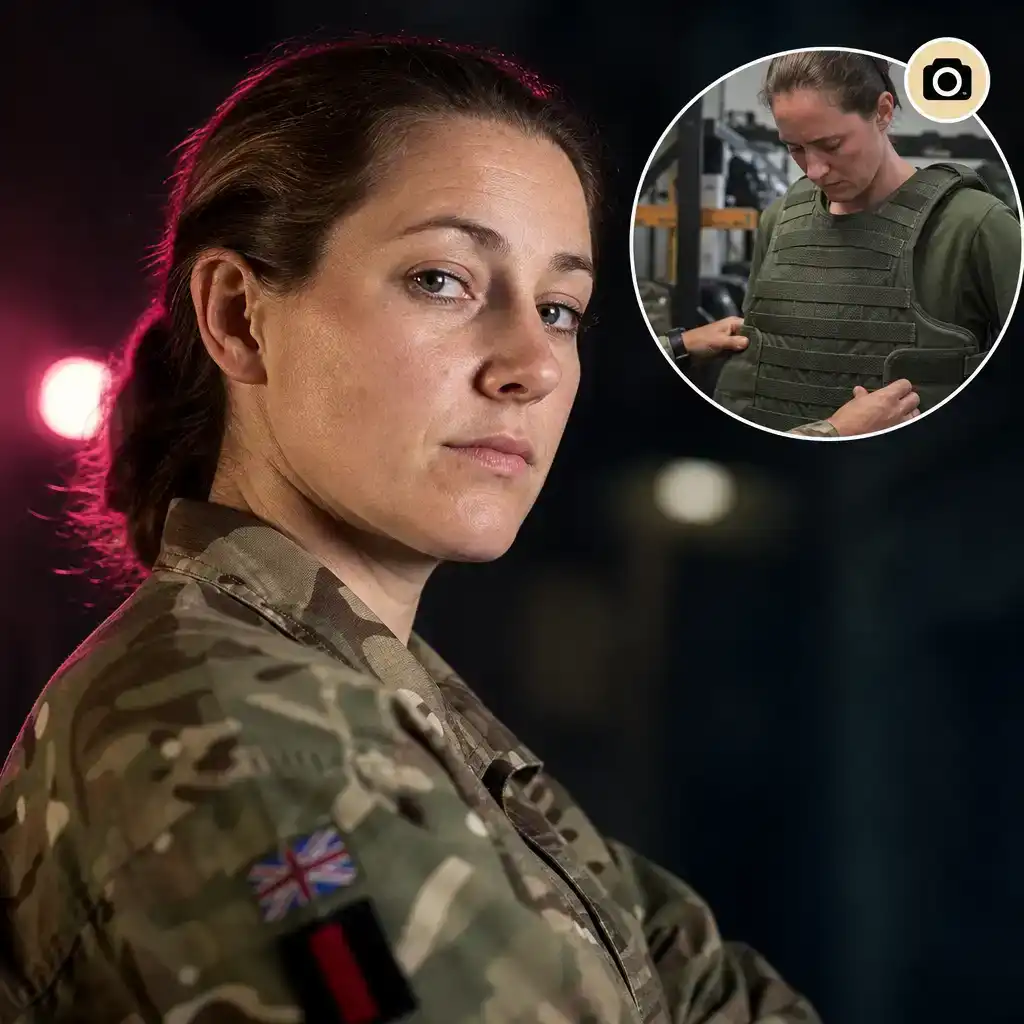
Women in the UK armed forces say military kit for women is still falling short, five years after a landmark report warned that poorly fitting uniform and equipment put female personnel at “greater risk of harm”. The problem is not cosmetic. Body armour, webbing, rucksacks and clothing that do not fit can affect mobility, training, presentation and, in the most serious setting, protection in combat. A uniform looking awkward is one thing. Armour sitting badly is quite another.
The 2021 report led by Dame Sarah Atherton said the Ministry of Defence should urgently provide safer and more appropriate kit for female service personnel by the end of 2022. The MoD says improvements have been made and that all personnel have access to the “best equipment they need to protect themselves in combat”.
But several women have told the BBC that shortages of smaller sizes and body armour designed around male bodies remain a daily issue.
What servicewomen say is still wrong with the kit
Rhian Brown, a 26-year-old veteran from Plymouth, left the Army Reserve in 2024 after seven years as an infantry platoon commander. She said her issued kit never properly did its job.
“I never felt that I was neat, tidy, presentable, or in the uniform that I was meant to be in,” she said.
“I never really felt that it protected me or entirely fulfilled the purpose that it was meant to.”
Brown used the newer Virtus Scalable Tactical Vest in training and on deployments. The system was introduced after the Atherton report and was adapted for female troops in 2022. It includes adjustable straps and smaller flat plates, and the MoD said it improved “fit, comfort and mobility while maintaining consistent ballistic protection standards”.
Brown said it was better than previous versions, describing it as “tight and secure” and smarter in appearance. Then came the important qualifier.
“But, ultimately, it still wasn’t designed to fit me,” she said.
“Women are not flat, we have breasts and curves. The plates are flat, it doesn’t fit, it is not flexible, fit isn’t about vanity, it’s about safety.”
Why body armour fit matters beyond appearance
Body armour is not meant to be flattering. That is not the complaint. The issue is whether it sits securely, allows movement and protects the body it is supposed to cover.
Brown said that on one occasion, the person issuing body armour told her: “You’re probably a small... but we don’t have any smalls so here, take this medium.”
That sort of workaround may sound familiar in any understocked workplace. In a military setting, it carries more weight. If a vest is too large, too loose or shaped incorrectly, it can restrict movement, shift under load or leave gaps in coverage. It can also make training harder for women and smaller recruits, who may already be working with equipment scaled around a default male frame.
Other servicewomen who spoke anonymously described similar problems. One called her body armour “definitely not female and definitely not good”. Another said there was “none or barely any” female-specific kit available to her and that the armour did not account for “busty women”.
The recurring theme is not that every item is unusable. It is that availability and design remain inconsistent enough for women to be competing for the kit that does fit. Not exactly the ideal logistics model.
UK-funded curved armour is going to Ukraine first
The issue has drawn sharper attention because the MoD has paid for 2,000 sets of new curved body armour plates for women in the Ukrainian armed forces.
The UK government said it spent £4.5bn on military support for Ukraine last year. The contract for the curved plates was with NP Aerospace, a Coventry-based company. It is understood the order was made to meet a specific operational need and sits outside the UK’s wider equipment programmes, which have their own testing and approval processes.
Seren White, who worked on the design of the curved armour, said the plates had “been tested with the highest level of rigor”.
For industry certification, she said, the plates needed to be tested 36 times. The new curved plates have been shot almost 300 times. Engineers said testing also challenged assumptions, including the idea that bullets could ricochet off the curve of a ballistic plate.
Erin Grieve, also from NP Aerospace, said the design addressed a basic reality that has apparently required some formal restating.
“Women today are wearing flat plates that have been designed for male torsos,” she said.
“We are trying to address that women are not small men, they’re shaped differently.”
Grieve said the company’s own research found curved plates gave women better protection compared with flat plates. At present, however, that equipment is not available to UK servicewomen.
Inspectors say the problem is not limited to armour
The concerns go beyond ballistic plates. Ofsted, which inspects MoD training establishments as well as schools, said in October 2025 that for the “fourth consecutive year” women and smaller recruits were being issued ill-fitting kit and clothing.
Its report said this put them at a disadvantage because they often did not appear as well turned out as their peers, or because ill-fitting equipment such as webbing or rucksacks stopped them from taking part fully in training.
The inspectorate added that “ill-fitting kit poses a very serious risk” in combat situations.
That finding matters because it places the issue in the routine training pipeline, not just in isolated operational anecdotes. If recruits are beginning their careers with equipment that limits participation, the effect is not only physical. It also sends a fairly direct message about who the system was built around.
Dr Mary Keeling, from the Centre for Evidence for the Armed Forces, said she understood that the rollout and availability of new female kit and equipment had been “inconsistent” since the Atherton report.
She said there had been “good steps in the right direction”, but progress had been slow.
Recruitment targets make the delay harder to defend
The timing is awkward for the MoD because the armed forces have an ambition for women to make up 30% of personnel by 2030.
Keeling said improving access to appropriate kit would likely help recruitment challenges “if women feel welcome by making sure that appropriate kit and equipment are available”.
RAF veteran Stacey Denyer, who left the service in 2023, was among the servicewomen who joined a ministerial roundtable after the Atherton Inquiry to discuss how its recommendations should be put into practice.
She said some progress was visible late in her career, particularly with women’s fitting boots.
“In the latter part of my career, they started doing women’s fitting boots. It was amazing,” she said.
But Denyer, from Taunton in Somerset, said the issue needed to move faster.
“We’re not whinging for the sake of whinging, we’re making noise because it is a massive safety issue.”
She added: “It absolutely needs to happen quickly and there is an aspiration for the armed forces to be 30% female by 2030.
“And, if they want to attract women, they need to start looking after them properly, and that starts with kit.”
What the MoD says happens next
Fred Thomas, the MP for Plymouth Moor View and a former Royal Marine officer, said getting body armour that properly fits women should be “an absolute priority” for the MoD, particularly during a period of heightened global instability.
Thomas was part of a Defence Select Committee hearing in April that reviewed the Atherton report almost five years after its publication. He said he was aware progress on improved kit had been slow, although he added that the services were “doing their best”.
Still, he said it was “unacceptable for some people to be better protected than others”.
The MoD said new ballistic plates are due to be delivered in 2028 and will “be available in multiple sizes offering a better fit for all service personnel”. The BBC understands those plates will be flat, not curved.
The department added: “We are also developing the next generation of body armour through our Complex Geometry Body Armour Programme, which will enable the procurement of curved body armour plates.”
Those curved plates could begin to be delivered from 2029.
That leaves a clear gap between recognition and delivery. Women have been told the issue is understood, that the technology exists, and that better equipment is coming. For those wearing the current kit now, the calendar is doing rather a lot of the heavy lifting.