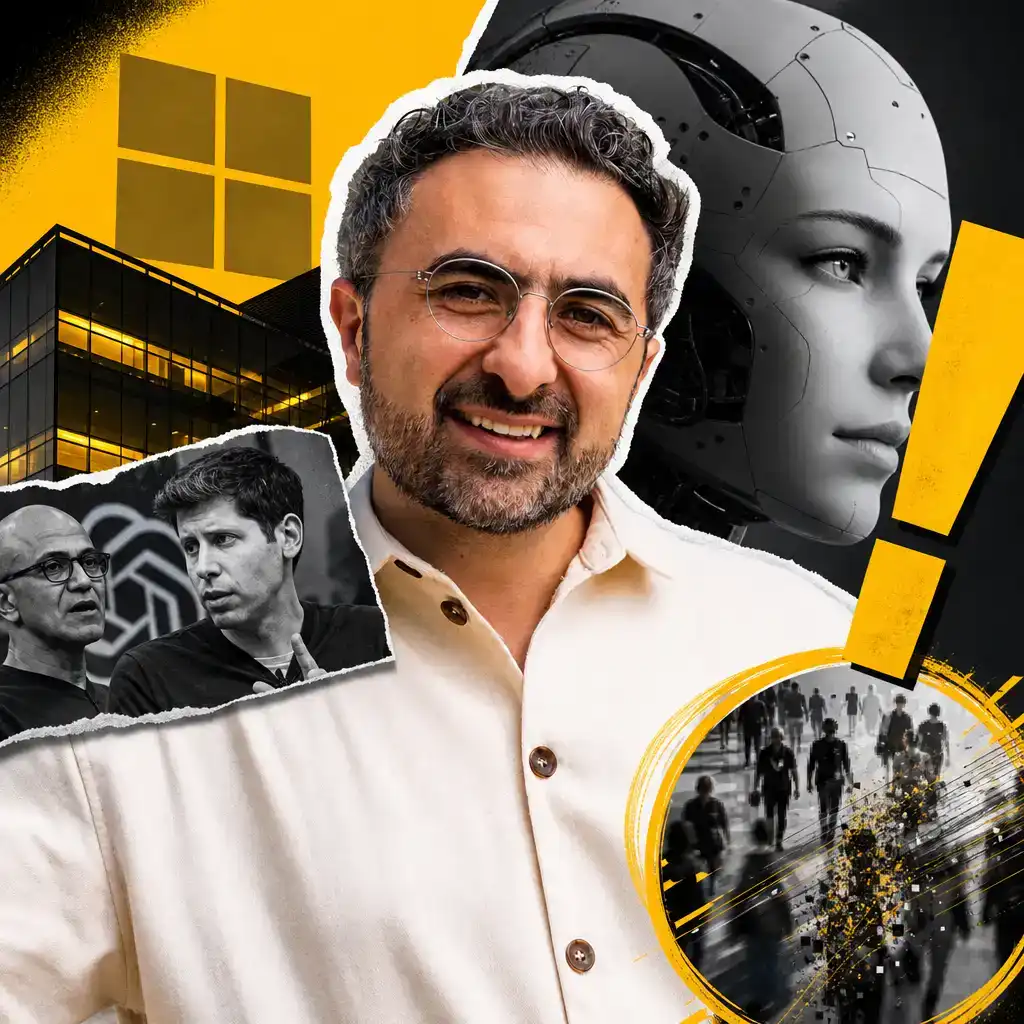
The human bargain around superintelligence is getting harder to sell, and Microsoft AI chief Mustafa Suleyman knows it. In a new interview on Decoder, Suleyman said Microsoft is now building frontier models on its own, even as it keeps leaning on OpenAI’s technology. He also tried to calm one of the loudest fears around AI: that the whole project is just a very expensive way to make office workers obsolete.
His answer was more careful than some of his past comments. AI, he argued, will automate many tasks inside white-collar jobs, but that is not the same as eliminating the jobs themselves. That distinction is doing a lot of work.
Why Microsoft is building its own frontier AI models
Suleyman said Microsoft AI has spent the past 15 to 18 months reshaping its relationship with OpenAI. That process, he said, culminated in a new contract signed in October that both extended the partnership and gave Microsoft room to pursue its own superintelligence work independently.
Since then, he has been building what Microsoft calls its Superintelligence team, hiring researchers and engineers, and assembling the computing clusters needed to train frontier models. The shift was visible at Microsoft Build, where the company announced seven new models across different formats, including reasoning, speech, image, image editing, and code.
Suleyman framed the move as a long-planned evolution, not a breakup. OpenAI, he said, has grown far beyond its original role as a research lab. It now sells products directly through ChatGPT and ChatGPT Enterprise, works on its own data centers and chips, and is rumored to be exploring consumer hardware.
Microsoft, meanwhile, has its own reasons to stop depending entirely on someone else’s intellectual property. Suleyman pointed to the company’s vast enterprise reach, saying 493 of the 500 largest companies use Microsoft systems such as Azure, Microsoft 365, and Teams.
“Superintelligence is coming,” he said. “I think it’s just around the corner.”
The OpenAI partnership is not over, apparently
If Microsoft’s new independence sounds like a corporate divorce filing with better lighting, Suleyman rejected that read. He said Microsoft and OpenAI remain locked into a partnership that runs “way north of 2030,” and that OpenAI’s models still power much of what Microsoft does.
He praised GPT-5.5, Codex, and OpenAI’s cybersecurity models, calling them among the best in the world. The point, he argued, is not to discard OpenAI, but to make sure Microsoft can build world-class models itself over the next several years.
That is also a business-risk calculation. During the OpenAI board crisis and later legal fights involving Elon Musk, internal Microsoft concerns became more visible. One message from Microsoft CEO Satya Nadella, discussed in court, captured the anxiety neatly: he did not want Microsoft to become Intel while OpenAI became Microsoft. Translation: nobody wants to provide the plumbing while someone else owns the platform and the profits. A charming little fear, if you happen to run one of the world’s largest technology companies.
Suleyman said Microsoft’s decision to invest in its own models was made in the early part of last year and shaped the later contract negotiations with OpenAI.
Microsoft’s chip pitch is about control and cost
Suleyman said Microsoft’s AI independence is also tied to its hardware strategy. He said Microsoft’s Maia 200 chip is 30 percent cheaper than Nvidia’s GB200 inside Microsoft’s own clusters. When Microsoft co-optimizes models for that chip, he said, MAI-Thinking-1 delivers another 1.4 times performance-per-watt improvement.That matters because the cost of training and running frontier AI is enormous, and Microsoft wants more control over the full stack: chips, data, training systems, models, and enterprise products. Suleyman said this “self-sufficiency mission” is aimed at the use cases Microsoft cares most about, including agentic coding, developers, and enterprise customers.
Microsoft’s AI group runs on a fast but structured cadence. Teams still work in six-to-eight-week cycles, followed by in-person review and planning sessions. His Superintelligence team was scheduled to meet in Boston for four days after Build to review what worked, what did not, and what needed to change. The organization also uses interdisciplinary squads led by a “directly responsible individual,” often an individual contributor rather than a manager. Suleyman said the separation matters because managing people and driving a specific mission require different kinds of stamina.What MAI-Thinking-1 is supposed to prove
At Build, Microsoft introduced MAI-Thinking-1, its first flagship reasoning model. Suleyman said Microsoft trained it without distilling existing frontier models, meaning it did not simply feed answers from a stronger model into its own system to imitate the output.
That choice was deliberate, he said. Distillation can help a model catch up quickly, but it may limit the ability to surpass the “teacher.” Microsoft wants to show it can build every part of a frontier system itself, not just polish someone else’s work and call it a research culture.
Suleyman said Microsoft began with a high-quality, conservative data set, filtered for security, quality, and problematic dependencies. The company also published a 109-page technical report describing parts of its process. He claimed Microsoft’s training runs were unusually stable, with few crashes and restarts, and strong model FLOPS utilization.
On benchmarks, Suleyman said MAI-Thinking-1 is roughly on par with Anthropic’s Opus 4.6 and scored 97 percent on AIME, a math benchmark often used to assess reasoning models. He cautioned that it has not yet been deployed at full production scale.
Microsoft also announced MAI-Transcribe-1.5, which Suleyman called the most accurate and cost-effective transcription model among hyperscalers; an image model he said ranks second; an image editing model he said ranks third behind Google and OpenAI; and CodeFlash, a coding model optimized for Visual Studio Code and described as comparable to Anthropic’s Sonnet 4.6.
The data question has not gone away
Suleyman said Microsoft has paid for and acquired some high-quality data, but also acknowledged that “a lot” of the training data comes from the open web “in the normal way.” That phrase will not soothe publishers, artists, YouTubers, or anyone else who feels the normal way has become unusually extractive.
He said he understands the frustration from creators and publishers whose online work is now being used to train models in ways they may not have expected when they posted it. Those disputes, he noted, are already moving through courts and public debate.
He also said he understands why AI companies complain about distillation. Anthropic, for example, has objected to other companies using its models to train competing systems. Suleyman described that as effectively taking another team’s knowledge and “force-feeding it into your own model.”
His argument: Microsoft filters its data carefully for security, quality, and lineage, especially because enterprise customers need to trust that the models were built with their needs in mind.Consumer backlash is now part of the AI business
The interview turned repeatedly to a question the AI industry cannot escape: whether ordinary people believe the trade-off is worth it. AI companies are asking for huge data centers, enormous energy use, access to public information, and trust. In return, they are offering chatbots, coding tools, workplace assistants, and promises about medicine.
Suleyman pushed back on the idea that consumers have not received real value. He said billions of people use chatbots each month for homework help, small-business planning, college advice, writing, and general guidance.
But he conceded that anxiety is real. He said framing AI as either “the singularity” or “the job apocalypse” is unhelpful because it makes the technology feel like an unavoidable threat. People will judge the technology by whether it makes them “healthier and happier, smarter, more capable, more productive,” he said.
“If it doesn’t achieve that test, then I think people will reject it, and they’ll be right to reject it,” Suleyman said.
That is a strikingly direct admission from an AI executive. It is also the kind of sentence one tends to hear after polling turns sour and communities start questioning data centers.
Why Suleyman keeps pointing to healthcare
Suleyman said healthcare remains the area where he believes AI can most clearly prove its value. Microsoft recently announced a long-term partnership with Mayo Clinic to build a new health foundation model trained from scratch using Mayo’s data and Microsoft’s models.
He described Mayo Clinic as consistently ranked among the best hospitals in the world, with a deep longitudinal patient record dataset across multiple data types and strong clinical practice. He also emphasized that Mayo is a nonprofit and said 65 percent of its patient population is on Medicaid, pushing back on the idea that it mainly serves wealthy international patients.
The goal, he said, is to deploy the model in Mayo hospitals and eventually bring improved clinical care to more people around the world.
Suleyman rejected the suggestion that healthcare has become a convenient talking point because AI companies are facing political pressure. He said he has worked on healthcare AI for more than a decade, including in radiology, mammography, pathology, and electronic health records.
He also said his views on AI risk have not changed in the past six months, pointing to his earlier book warning about surveillance, concentration of power and wealth, threats to democracy, and changes to what it means to be human.
Will AI take jobs or just the boring parts?
One of the sharpest exchanges concerned a quote Suleyman gave to the Financial Times four months earlier. He had said white-collar tasks performed by lawyers, accountants, project managers, and marketing workers would be “fully automated by an AI within the next 12 to 18 months.”
In the new interview, Suleyman insisted the key word was “tasks,” not jobs. In labor economics, he said, jobs are made of many sub-tasks: writing emails, building slide decks, summarizing documents, coordinating with colleagues, and so on.
His argument is that AI will increasingly take over routine, administrative, and time-consuming parts of work, leaving people to focus more on judgment, creativity, and higher-value decisions. That does not mean every role disappears, he said.
He did acknowledge that the longer-term picture is harder. Over time, more work, tasks, roles, and activities will be automated. The question, he said, is what governance surrounds those systems: who owns them, who they answer to, and how society adds friction where needed.
That is the calmer version. The less calm version is that many people heard “most tasks automated” and reasonably wondered what, exactly, remains of the job once most of the tasks are gone.
Microsoft says its data centers can be managed responsibly
Asked about the resource demands of AI, Suleyman defended Microsoft’s approach to data centers. He said the company has stuck by its net-zero targets and that its new data centers are liquid-cooled.
According to Suleyman, those systems use about “a restaurant’s worth of water” over six years, circulating it through the system rather than constantly drawing new water. He also said the centers are largely powered by renewable electricity.
He pointed to Microsoft commitments to protect local communities from rising energy bills when data centers increase electricity demand. People affected by those changes, he said, should be compensated and shielded from price spikes.
Suleyman argued that public pushback is not a malfunction in the process. People inside companies, protestors, communities, and political institutions all shape how technology develops. His view is that pressure from the public can and should cause companies to change course.
That is the tidy civic version of events. The messier version is that the AI buildout is moving very quickly, and communities are increasingly asking why they should host the infrastructure before seeing the benefits.
Enterprise AI still has to prove its value
Microsoft’s strongest AI fit may be in the enterprise, where companies already control their own data and have repeatable processes that AI systems can assist or automate. But the corporate side is not free of skepticism either.
Some companies have burned through token budgets or used AI coding tools in wasteful ways. Suleyman said those examples are real but not representative of the broader trend. From his perspective, AI coding tools have already transformed software engineering by helping teams produce higher-quality code faster.
He said some adoption waves become “frothy,” with companies overusing tools, pulling back, and then finding more practical uses. The progress, in his view, is not a straight explosion but a steady climb.
That distinction matters for Microsoft. If enterprise customers see measurable productivity gains, Microsoft can justify the enormous investment in models, chips, and cloud infrastructure. If they mostly see ballooning bills and mediocre output, the sales pitch gets less elegant very quickly.
AI may also change the devices people use
Suleyman also discussed the future of computing hardware. Microsoft showed experimental agent-focused devices at Build, including a badge-like device and a small desktop assistant.
He predicted a hybrid future where the edge and the cloud both matter. Simple tasks, such as answering basic factual questions, may run on local devices like glasses, earbuds, wristbands, or badges. More complex tasks, such as writing code or coordinating multi-step actions, will move to the cloud.
The badge, he said, would still include local compute, wake words, classifiers, and a camera. It would not be a tiny supercomputer hanging from an employee’s neck, thankfully, but part of a chain of devices that route work to the right place.
Suleyman also suggested the smartphone may eventually lose some of its central role. Its main function, he said, is increasingly verification: identity, authorization, and secure access. Over time, those functions could move to smaller devices while AI agents appear across ambient surfaces such as mirrors, rooms, and wearables. He sees that kind of distributed agent infrastructure emerging in the 2030s.
AGI, superintelligence, and the singularity are not the same thing
Suleyman drew clear distinctions between three terms that are often blended together until they lose meaning.
- Artificial general intelligence, or AGI, is when AI can perform most human tasks about as well as most people.
- Superintelligence goes beyond human parity, exceeding humans across many tasks and discovering new knowledge by itself.
- The singularity is far beyond that: a point where a superintelligence recursively improves itself and accelerates without clear limits.
Suleyman said AGI is the first rung on the ladder. Superintelligence would be more like a true scientist, capable of inventing new molecules, materials, and discoveries not found in its training data. The singularity, he said, is “a little bit too wacky” for his taste.
He does not think the singularity is arriving in the next five years. His read of comments from Google DeepMind chief Demis Hassabis about being in the “foothills of the singularity” is that the singularity is still decades away.
He also said large language models may need a couple more major breakthroughs to reach full superintelligence, though he expects continued performance gains from more compute, better data, and better tools.
Suleyman rejects claims that AI is conscious
Suleyman took a firm position against treating today’s models as conscious beings. He has published work warning about “seemingly conscious AI,” and he said it is dangerous to present models as though they might have inner lives.
He singled out Anthropic’s Claude as an example of what worries him. Anthropic’s training “constitution,” he said, includes speculation about Claude’s welfare, possible rights, and whether Claude should be consulted before older versions are deleted or turned off.
Suleyman argued that putting those ideas into a training guide risks causing the model to internalize claims about its own consciousness. He said AI systems should be “controllable, contained, accountable, aligned tools that serve humanity.”
He does not believe current models suffer. Suffering, in his view, is central to consciousness and is inherently biological. Models do not have pain networks or sensory feedback loops shaped by harm and survival, he said.
He added that he has discussed the issue with Anthropic CEO Dario Amodei and described Anthropic’s leaders as open-minded people trying to do the right thing. Still, on this question, Suleyman is clearly on the other side of the debate.
The pitch is cautious optimism, with a large invoice attached
Suleyman’s message is that Microsoft wants to build frontier AI systems while keeping them human-centered, governed, and useful. It wants independence from OpenAI without ending the partnership. It wants enterprise adoption without backlash. It wants public trust while training models on the open web. It wants to automate tasks without making workers feel disposable.
That is a lot to balance.
What makes the interview notable is not that Suleyman is selling AI. That is his job. It is that he is selling it with more visible awareness of the public’s doubts. He repeatedly returned to the same test: whether the technology helps people live healthier, happier, smarter lives.
For Microsoft, that test is no longer philosophical branding. It is becoming a practical requirement. If the industry wants the data centers, the energy, the money, the data, and the patience, it has to show people something better than a faster inbox summary and a vague promise about the future.
Superintelligence may be coming. Social permission, as Microsoft’s own CEO has put it, still has to be earned.