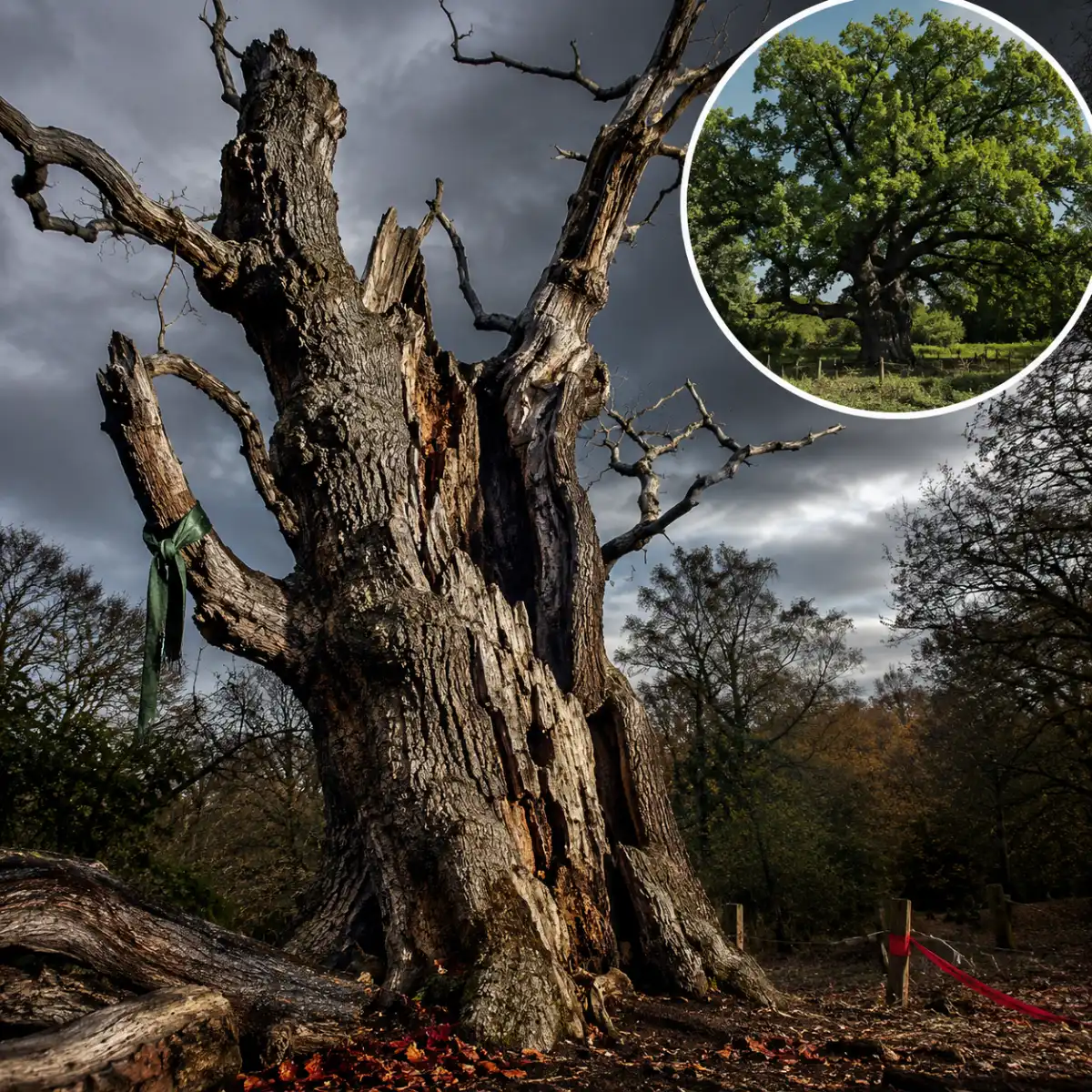
Britain has lost one of its most photographed, fenced-off and politely mythologized natural landmarks. The Major Oak in Sherwood Forest, the vast ancient tree long tied to the legend of Robin Hood, is believed by scientists to have died after its first spring without leaves.
The Royal Society for the Protection of Birds, the conservation charity that manages Sherwood Forest in Nottinghamshire, said the tree had been in visible decline for several years. The oak was estimated to be up to 1,200 years old and was considered one of Britain’s largest oaks.
For centuries, it did what famous trees are expected to do: stand there, look magnificent, collect folklore and survive human attention. That last part appears to have been the difficult bit.
Why experts believe the Major Oak has died
The RSPB said the tree produced no leaves this spring, prompting experts to conclude that it had died. Conservationists had been working for years to protect it, but the charity said its decline had become increasingly clear, with a “noticeable reduction” in both the quality and quantity of its leaves.
Pinning down one exact cause is difficult. The RSPB said the oak’s death was likely the result of several pressures acting together, including years of “well-intentioned structural intervention and huge amounts of human activity” around the tree.
Many of the pressures were worsened by climate change, the charity said, including recent heatwaves and droughts. At the age of roughly a millennium, the tree was already facing the natural stresses that come with extreme old age. Add crowds, compacted soil and hotter summers, and the outcome becomes less mysterious, if no less sad.
Despite the diagnosis, the Major Oak will not be removed. The RSPB said it will remain standing in the forest as a monument for visitors and as a habitat for wildlife.
How a hollow oak became tied to Robin Hood
The Major Oak’s fame rests partly on its size and age, but mostly on the story attached to it. According to legend, Robin Hood used the tree’s hollow trunk as a hideout. The less cinematic explanation is that the hollow was caused by fungi, which is not as good for ballads but much better for biology.
The tree’s shape helped the legend travel. Its long limbs, broad canopy and hollowing trunk made it one of Nottinghamshire’s most recognizable landmarks. Its circumference measured about 11 metres, large enough to make it feel less like a tree and more like local infrastructure.
It was not always known by its current name. The “Major” label took hold after the tree was mentioned in a 1790 book by Major Hayman Rooke, a former British Army soldier who lived in Mansfield Woodhouse, a few miles from Sherwood Forest, after leaving the military.
According to the RSPB, that book helped bring the first waves of tourism to the forest and to what would become a world-famous tree. In other words, the Major Oak was doing destination marketing before anyone had to sit through a branding meeting.
What tourism and conservation did to the tree
The Major Oak attracted millions of visitors over its lifetime. At one time, people even climbed into its hollow trunk. Since the 1970s, a fence has kept visitors at a distance from the tree.
Earlier preservation attempts included supports for some of the oak’s larger branches. Those measures were intended to help the tree survive, but the RSPB said they were likely among the factors that contributed to its eventual decline.
Recent conservation work focused heavily on the soil beneath and around the tree. The RSPB said decades of footfall had compacted the ground, making it harder for rainwater to penetrate and harder for the root system to access the oxygen and nutrients it needed.
Chloe Ryder, RSPB Sherwood Forest estates operations manager, said the cause of death was “complicated,” but agreed tourism had played a role through soil compaction. She said staff had done “everything they can” since the charity took over management of the site.
“It is of such importance to Sherwood Forest,” she said. “We now know that it’s come too late, right at the end stages of its life. But there wasn’t anything more that we could do unless you invent a time machine, really.”
What experts say the Major Oak can teach conservationists
Ed Pyne, senior conservation adviser at the Woodland Trust, described the Major Oak as “one of the country’s most important trees.”
“To see the loss of a tree like this is always incredibly tragic,” he told the BBC. “The Major Oak is perhaps the most famous ancient tree in the UK.”
Pyne said conservationists had learned a great deal from the work carried out around the tree, lessons that could now be applied to ancient trees elsewhere in the country. He added that, without pressures such as climate change and roughly 200 years of tourism compacting the surrounding soil, the oak might have lived for hundreds more years. Trees, he noted, “do not die of old age.”
Simon Parfey, a specialist in soil microbiology testing who had been part of an expert team caring for the tree since 2021, said the soil around the oak was “under far greater stress than anyone had initially realised.”
“While the Major Oak team worked tirelessly to revive the environment around this iconic tree - and saw encouraging signs of life in some areas - the damage, it now seems, was already too deep to fully reverse,” he said.
Parfey said the Major Oak’s legacy now goes beyond folklore. “The Major Oak’s true legacy is no longer just in folklore, but in the future of conservation,” he said.
How climate and extreme weather added pressure
The RSPB had previously pushed back on rumours that the oak would die in the winter of 2024, while acknowledging that the tree was under serious strain.
Over its long life, the Major Oak survived fires, strong winds, snowstorms and the ordinary violence of British weather. More recently, it faced the more extreme conditions linked to climate change.
Reg Harris, director of a tree surveying firm, said he had monitored the tree’s health for the RSPB for the past nine years. He said the latest decline matched a run of very hot, dry summers.
“The most recent decline has corresponded with five very hot and droughty summers, most notably in July 2022 when the UK experienced record temperatures of 40 degrees Celsius,” Harris said.
Still, he cautioned that it was “impossible to pinpoint a single cause” for the decline. That fits the wider assessment from conservation experts: the tree was not felled by one event, but worn down by overlapping pressures that built up over time.
Why the tree will remain standing
Although the Major Oak is believed to be dead, its role in Sherwood Forest is not finished. The RSPB said it will remain standing as a monument for people and wildlife.
As the tree decays over the coming decades, Pyne said it will continue to provide a home for many animals and plants. Ancient trees often become even more valuable to wildlife as they break down, supporting fungi, insects, birds and other species that depend on decaying wood.
Saplings from the Major Oak have also been planted around the world, extending its biological legacy far beyond Nottinghamshire.
Dame Judi Dench, the actor and patron and ambassador for the Woodland Trust, paid tribute to the tree. She said: “The Major Oak has provided inspiration for countless stories, poems, paintings and people for more than 1,000 years - all the while itself teeming with life and providing a home to an enormous range of wildlife.”
She added that she had recently planted an oak sapling from Sherwood Forest in her garden with Woodland Trust chief executive Darren Moorcroft, placing it alongside a cutting from the Sycamore Gap tree.
“I hope everyone who has been inspired by the Major Oak or another ancient tree reaches out to their MP and asks them to improve legal protections for these iconic and vital elements of our national landscape,” Dench said.
The Major Oak’s story now shifts from survival to afterlife: part landmark, part habitat, part warning label for how easily admiration can become pressure when millions of people come to see the same living thing.