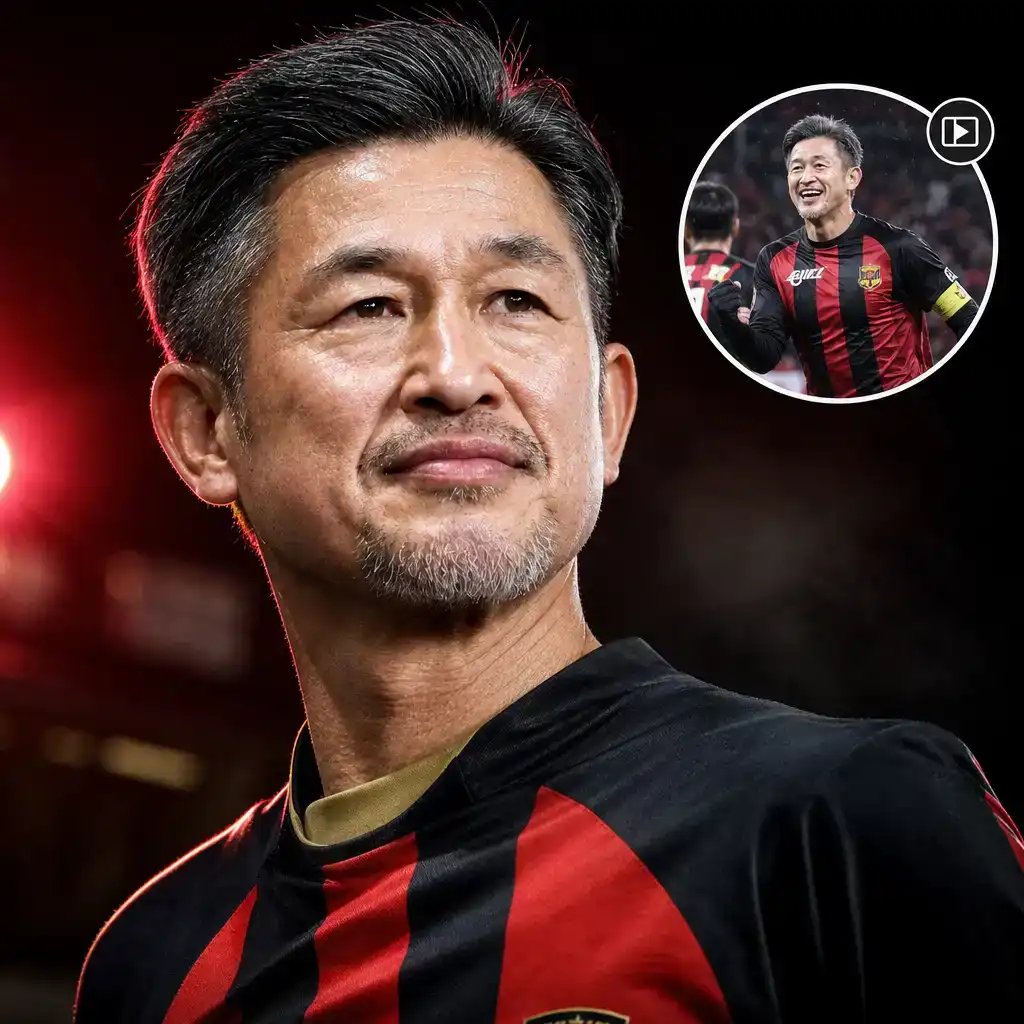
A Kazuyoshi Miura goal ended a 1,351-day competitive scoring drought as Fukushima United beat Iwaki Furukawa 7-0 in a prefectural qualifier for Japan’s Emperor’s Cup. The 59-year-old captain scored from close range in the 52nd minute before leaving the field three minutes later.
The result secured Fukushima’s place in the national tournament, although the match itself was not part of the Emperor’s Cup main competition. The Japan Football Association classifies it as the Fukushima prefectural qualifier, a procedural distinction that matters when assessing both the result and Miura’s latest longevity milestone.
How Miura scored his first goal since 2022
Miura converted with his right foot after work from Takatora Einaga, a teammate 36 years younger than him. Miura credited Einaga for the chance, saying he “created everything,” while noting that his own positioning allowed him to complete the close-range finish.
It was Miura’s first goal in a competitive match since November 12, 2022. Nikkan Sports reported that 1,351 days had passed between the two goals. His appearance also underlined his unusual role within the Fukushima squad: he remains an active player and captain while serving as an experienced figure for teammates born decades after his professional career began.
Fukushima coach Shuhei Terada described the goal as “long-awaited” and praised Miura’s work in training. The veteran forward did not remain on the field for long after scoring, with Terada substituting him in the 55th minute.
What the result means for Fukushima United
The 7-0 victory sent Fukushima United into the first round of the Emperor’s Cup proper. The Japan Football Association has confirmed that the club will host Yamagata representative Oyama Soccer Club on August 19.
This will be Fukushima’s fifth consecutive appearance in the main competition and its 14th overall. The qualification route explains why descriptions of Miura scoring “in the Emperor’s Cup” need a little precision: he scored in the prefectural tournament used to determine Fukushima’s representative, not yet in the national knockout stage.
That does not reduce the practical consequence. Fukushima won its place in the competition, and Miura contributed directly to doing so. It does, however, affect how the goal fits into official records, particularly those that distinguish professional league matches from cup fixtures and regional qualifiers.
Is Miura the world’s oldest professional player?
Miura is frequently described as the world’s oldest professional footballer, but the label is contested because organizations and competitions do not use a single definition of “professional.”
Guinness World Records previously recognized Uruguay’s Robert Carmona as the oldest active professional player. Yahoo Sports reported in 2025 that Carmona, then 63, was playing for fourth-tier side Liffa Club. That makes broad claims about Miura’s global status less straightforward than they may appear.
Guinness separately recognizes Miura as the oldest player to score in a competitive professional league match. He set that record in 2017, when he scored for Yokohama FC in Japan’s J2 League at the age of 50. His latest finish came in a cup qualifier, so it does not replace or extend that specific league record.
The differing categories leave Miura’s achievement intact while making the headline labels less tidy. Football administration has many definitions, and age records are apparently no exception.
A career approaching its fifth decade
Miura began his professional career in Brazil in 1986. Yokohama FC lists him with 89 appearances and 55 goals for Japan, and he remains contracted to the club while playing for Fukushima United on loan through June 30, 2027.
He will turn 60 on February 26, 2027. If he remains active through the end of the loan, his career will have extended across more than 40 years, several countries and multiple generations of teammates.
For now, the verified outcome is narrower but still notable: Miura scored at 59, Fukushima won by seven goals, and the club advanced to the Emperor’s Cup main competition. The larger argument over who qualifies as football’s oldest professional player remains unresolved.