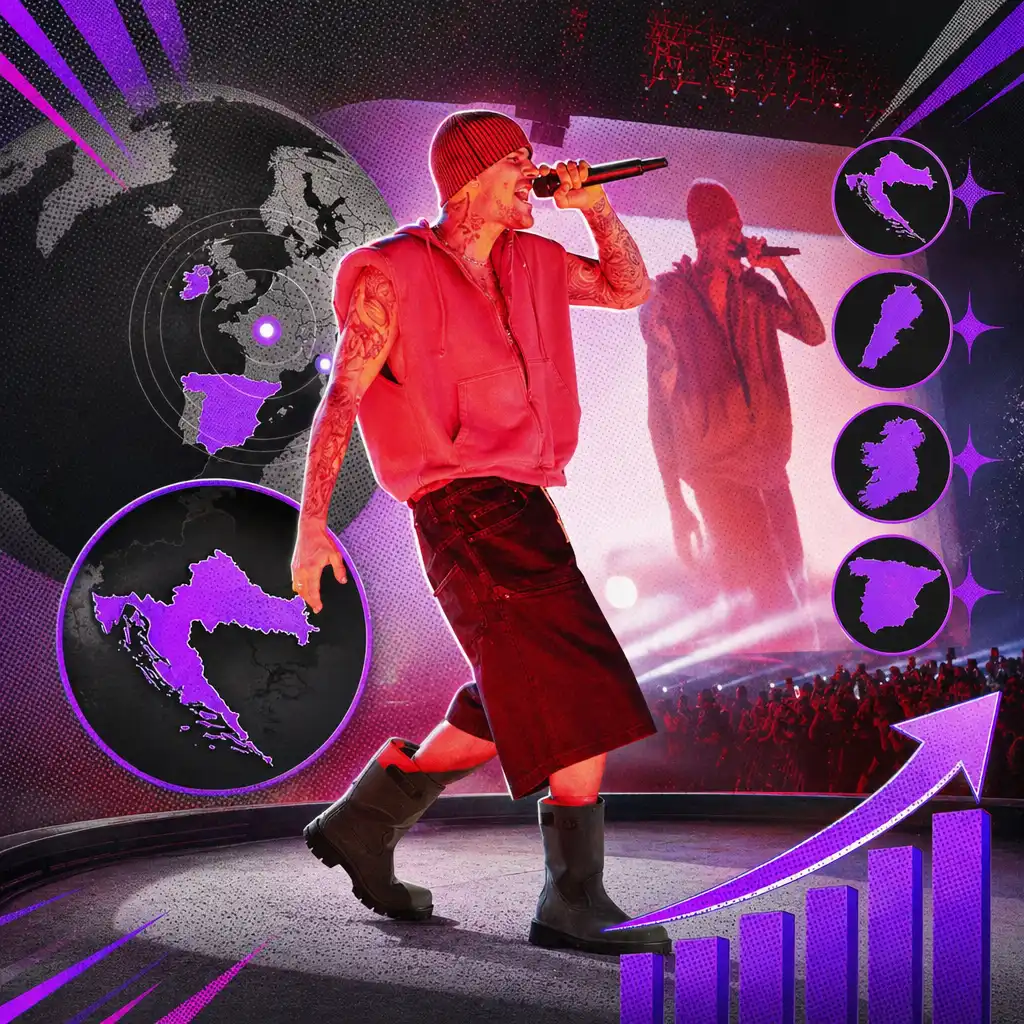
Justin Bieber’s Coachella lift was not just a California story. It was not even mainly a North American one. After his April 11 headlining set, Bieber’s catalog surged around the world, with the sharpest percentage gains landing far from both the festival site and his Canadian home base.
According to Luminate, Bieber’s songs generated 663.9 million official on-demand streams worldwide in the week ending April 16. That is a 171% jump from the previous week, enough to push him across the April 25-dated Billboard charts, including movement on the Billboard 200 and Billboard Hot 100. His April 18 Coachella follow-up set will be reflected on the next chart cycle, dated May 2.
The headline is simple: Coachella still happens in a field, but its real export is now video.
The U.S. Had the Volume, Not the Biggest Spike
The United States remained Bieber’s largest streaming market, as it does for most English-language pop acts. From April 10 to 16, his catalog drew 173.1 million U.S. streams, equal to 26.1% of his worldwide total.
That is a huge domestic number, up 165% week over week after the weekend one Coachella performance. But percentage-wise, the U.S. was not close to the top. Bieber posted gains in all 89 countries tracked by Luminate, and his streams at least doubled in 65 of them.
Ranked by percentage increase, 56 countries beat the U.S. across six continents. That comes with an obvious caveat: Bieber starts from a much larger base in America, so smaller markets can show more dramatic percentage jumps. Still, the spread matters. This was not a local aftershock. It was a global algorithm feeding frenzy, with a proper pop catalog attached.
Croatia Posted the Biggest Gain
The largest jump came in Croatia, where Bieber’s streams climbed 394%, from 95,000 to 469,000. Lebanon, Ireland, and Spain followed, each rising by more than 300%.
At the other end of the table, several African markets showed more modest increases. Cameroon rose 29%, Gabon 28%, and Liberia 17%. Even those smaller gains were still gains, which is the point: no tracked country went backward.
By total volume, the Philippines ranked second behind the U.S. Bieber logged 44.4 million streams there during the tracking week, up from 13.9 million the week before. The Philippines accounted for 6.7% of his global total, up from 5.7%.
Indonesia, Brazil, the United Kingdom, and Mexico followed, each generating between 30 million and 40 million streams.
Per Capita, Iceland Was the Strongest Market
Raw volume favors large countries. Adjust for population, and the map changes.
Iceland was Bieber’s most concentrated streaming market, with 0.87 streams per citizen during the tracking week. Australia, Singapore, Denmark, and Ireland came next, ranging from 0.63 to 0.77 streams per person.
Canada, Bieber’s native country, ranked next at 0.58 streams per person. The U.S. landed ninth at 0.52.
That per-capita ranking is useful because it cuts through the usual market-size distortion. The U.S. can dominate totals while smaller countries reveal where the audience is disproportionately active. In this case, Bieber’s post-Coachella heat was especially dense across parts of Europe, Asia-Pacific, and English-speaking markets, though not only English-speaking ones.
“Beauty and a Beat” Was the Biggest Track
The biggest individual winner was “Beauty and a Beat,” Bieber’s 2012 single featuring Nicki Minaj. The song debuted at No. 4 on the Billboard Global 200 and one position higher on Billboard Global Excl. U.S.
It also appeared on 27 of Billboard’s 48 Hits of the World charts, reaching the top 10 in 13 countries. Its strongest placements included:
- No. 2 on Taiwan Songs
- Top five in Austria
- Top five in Belgium
- Top five in Czech Republic
- Top five in Malaysia
- Top five in Singapore
- Top five in Slovakia
- Top five in Switzerland
In the U.S., “Beauty and a Beat” reached No. 15 on Streaming Songs and No. 26 on the multimetric Hot 100.
The song’s renewed pull is not mysterious. “Beauty and a Beat” is built for fast recognition: bright synths, a clean dance-pop pulse, Bieber’s hook placed upfront, and Minaj arriving as a second ignition point rather than a decorative feature. It is the kind of track that survives short-form video because it does not require much runway. The chorus knows where the camera is.
Dance-Pop Traveled Better Than the R&B Cuts
Bieber placed 16 songs on both of this week’s global charts, and the split in listening geography says plenty about how different parts of his catalog move.
His more R&B-leaning tracks had the highest U.S. share. “Yukon,” released last year, drew 44% of its global streams from the U.S., while 2013’s “Confident,” featuring Chance the Rapper, drew 28%. Both ranked higher on the Billboard Global 200 than on Global Excl. U.S., meaning their American activity carried extra weight.
The more direct pop and dance-influenced tracks traveled more evenly. “Never Say Never,” “Sorry,” and “Beauty and a Beat” drew U.S. shares of 17%, 22%, and 23%, respectively. Collaborations with DJ Snake and The Kid LAROI also showed a broader international distribution.
That tracks with the material. Bieber’s dance-pop and EDM-adjacent records tend to use big melodic shapes, clean drops, and direct rhythmic grids. They do not need much cultural translation. His R&B cuts often lean more on vocal phrasing, groove, and mood, which can still travel, but in this data set they remained more U.S.-weighted.
Coachella’s Livestream Is Now Part of the Chart Machine
The scale of Bieber’s rebound points to Coachella’s expanding digital footprint, especially through its YouTube livestream and official Instagram content.
The festival draws more than 100,000 attendees per day, but Bieber’s set reportedly generated more than 100 million social impressions across the two weekends he performed. That is the more important number for a catalog spike. A crowd can sing along in Indio. A clip can circle the planet before breakfast.
Coachella’s official YouTube clip of “Daisies,” cut into parts, had reached 13 million views by April 21. That was 70% higher than any other video on the festival’s official channel. Sabrina Carpenter’s “Espresso” followed with 7.7 million views.
Then came the fan videos, which spread well beyond official festival channels and the Empire Polo Club grounds. That informal layer matters. It turns a performance into fragments: a vocal line, a transition, a crowd shot, a familiar chorus returning with better lighting than memory usually provides.
The result was a catalog-wide surge that did not behave like a standard U.S. festival bump. Bieber’s home market still delivered the biggest pile of streams, but the bigger acceleration happened elsewhere. For a pop star whose biggest records were always engineered for export, Coachella functioned less like a concert recap and more like a global reminder notice.