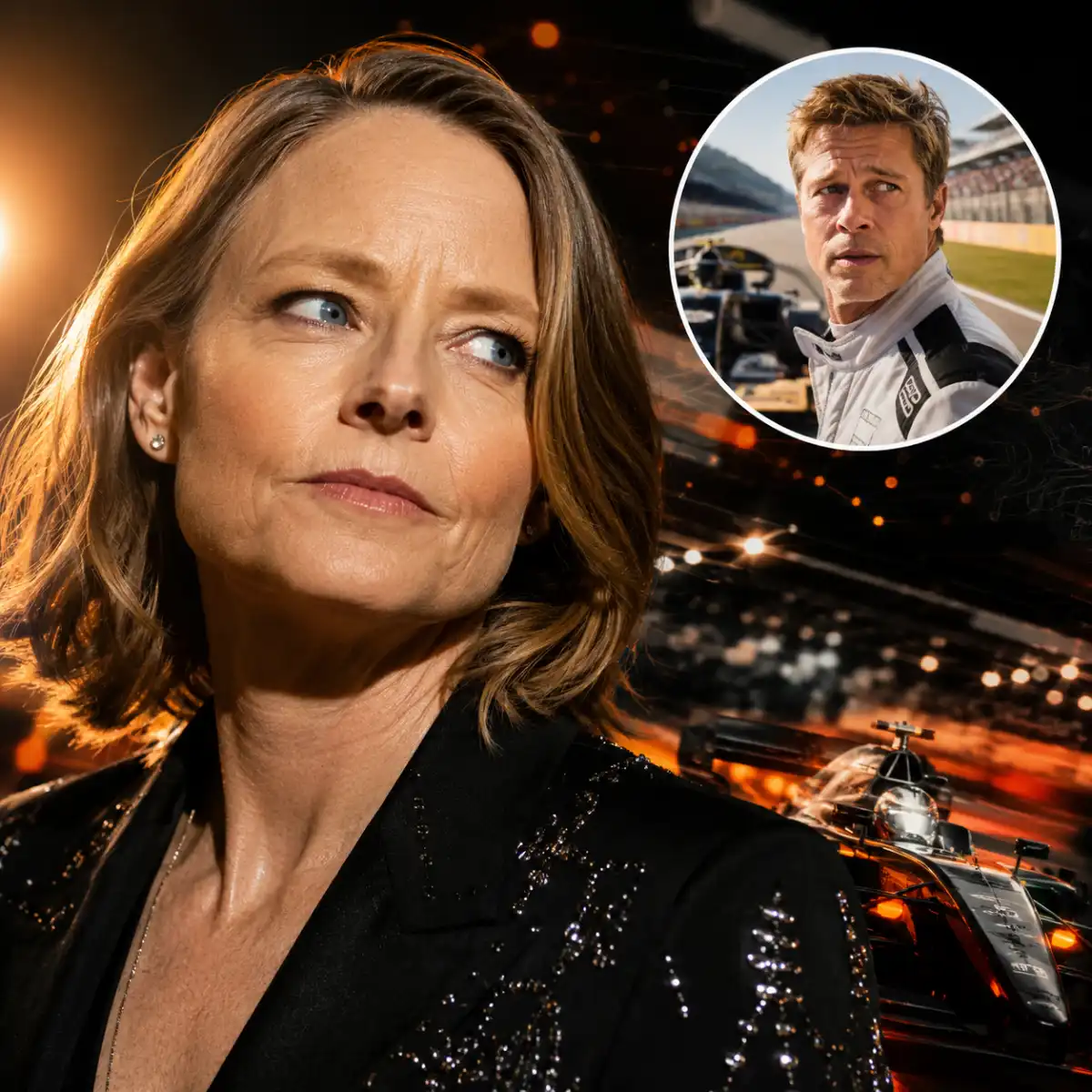
Jodie Foster did not accuse Apple’s F1 of literally being assembled in a server room, but she did use the Brad Pitt racing film to explain why the phrase “F1 made by AI” captures a very real anxiety in Hollywood. Speaking Tuesday at the Aspen Festival of Ideas in Colorado, Foster said the movie felt so structurally polished, and so precisely engineered, that it seemed like a product of machine logic.
The comments came during a conversation titled “Who Owns the Future of Hollywood” with former Sony Pictures Entertainment chief executive Michael Lynton. The broader subject was how artificial intelligence is reshaping film and TV work, now routine in Hollywood and, conveniently, also a steady source of professional dread.
What Jodie Foster said about F1
Foster brought up F1 while discussing how the industry has changed and how technology may be influencing what audiences see on screen.
“I don’t say this disparagingly, how could I? This movie went on to make millions of dollars. But I look at a movie like F1 and I’m like, F1 was made by AI,” she said, laughing. “Wasn’t it?”
She pointed specifically to the film’s clean, almost textbook construction.
“I mean, the structure was exactly the structure that you would learn in school,” Foster said. “The actors say the lines exactly the way it would be written if a computer was writing exactly what would be the right thing for that time. And they were able to dominate the technology to make something big and beautiful and potentially where a lot of the information comes from other places.”
Her point was not that the film lacked craft or audience appeal. In fact, the numbers argue otherwise. F1 has grossed $634 million worldwide and received four Oscar nominations, including best picture. It won for best sound.
Why the AI question matters in Hollywood
The Aspen Festival of Ideas featured several panels about artificial intelligence and its effect on society, and Lynton asked Foster directly what she thought the technology would do to the film business.
“AI is one more giant step forward into changing the industry,” Foster said, after first talking through earlier shifts brought by computer-generated imagery and digital filmmaking.
Lynton then asked the blunt version of the question many creative workers have been asking: “The big question is, is it going to replace actors and writers?”
“We do replace people,” Foster replied.
She used crowd scenes as an example, noting that studios can save money by digitally replicating background performers rather than hiring large groups again and again. That may be efficient for a budget spreadsheet, but it is less charming if your job is being one of those people.
Foster says unions may have to draw the line
Foster said the economic pressure is already clear: “We’re getting rid of a lot of jobs.” Her hope, she added, is that labor protections can help keep compensation attached to repeated digital use.
“Hopefully, things like unions will be able to come in and say, you can use my actor 20 times, but you’re going to pay him 20 times. And I think that’s fair,” Foster said.
That framing gets at Hollywood’s central AI fight. The technology can reduce costs, speed up production and open new visual possibilities. It can also make human labor easier to reuse, remix or quietly avoid paying for, depending on how the rules are written.
For actors, writers and crew members, the issue is not simply whether AI can imitate parts of the creative process. It is who controls that imitation, who benefits from it and whether the original human contribution remains enough that people still get credit — and paid.
Where Foster sees AI as useful
Foster did not reject the technology outright. She said AI can be valuable for “small helpful things,” including previz, the pre-visualization process filmmakers use to plan scenes before production begins.
“What we all would love is that filmmakers would be able to dominate AI, and never lose sight of that,” she said.
She also cited her most recent movie, My Private Life, saying AI had helped create a dream-like sequence she felt worked, even though the images themselves “made no sense.” In that case, Foster suggested, the tool served the filmmaker’s intention rather than replacing it.
“If we are able to dominate AI consistently over time, we will be able to make things that reflect us, and we can make things better,” she said.
That is the hopeful case for AI: AI as a tool under human direction, not a substitute for taste, judgment or lived experience. Foster’s F1 comments landed because they also raised the less comforting possibility, that a movie can be big, successful and technically impressive while still looks like it was assembled from the safest possible parts.