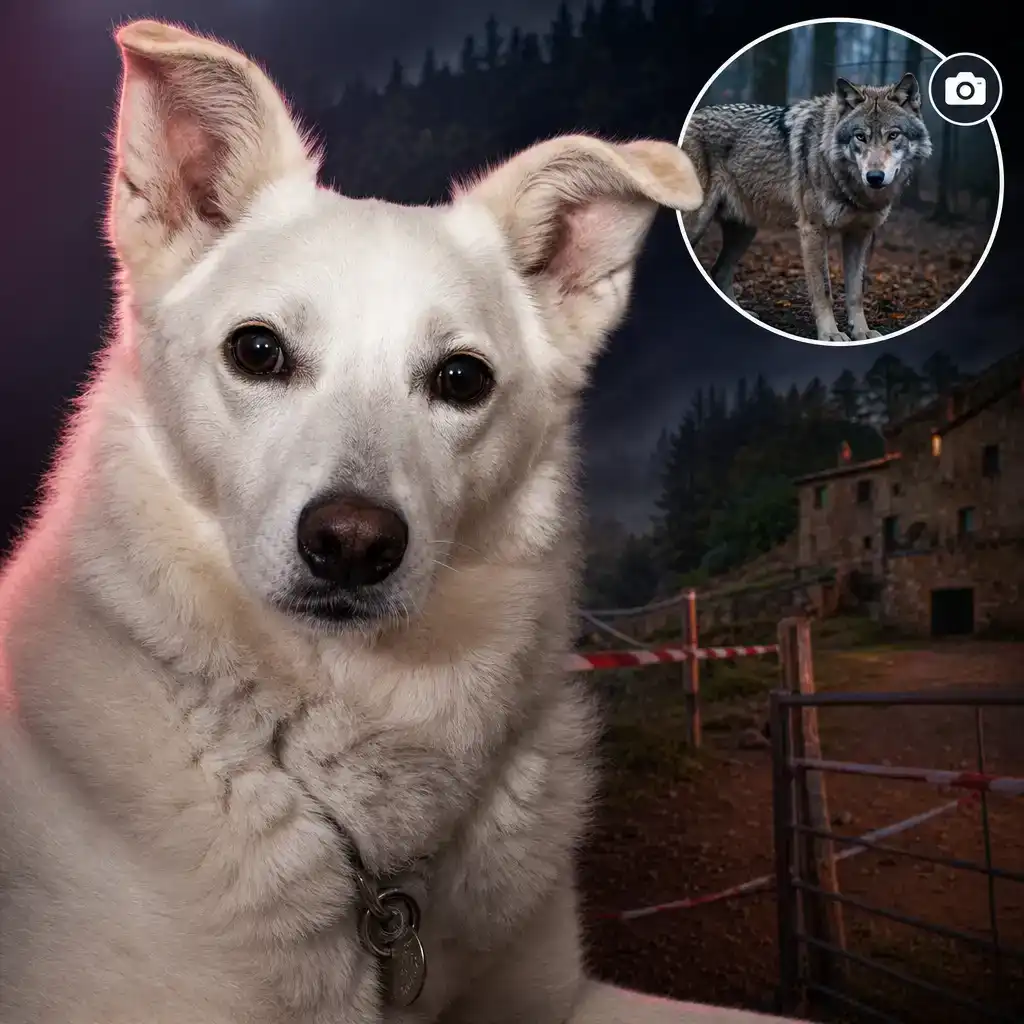
The hero dog wolf attack reported in Tuscany drew international attention for its account of a pet sacrificing herself to save a toddler. But an official investigation later found no evidence that the wolf attacked or attempted to attack any person. Destiny, a seven-year-old mixed-breed dog, was killed. The disputed part is why she encountered the animal and whether a child was ever in danger.
The clarification matters not only to a grieving family. The story quickly entered Italy’s tense debate over wolves, public safety and wildlife management, with Destiny’s death presented as proof that the animal involved posed a threat to humans.
What did Destiny’s family initially report?
The incident happened on July 18 at a rural property in Orbicciano, Tuscany, near woodland. In the first account circulated by several outlets, Destiny was said to have been outdoors with the family’s two-year-old son while his father, Tommaso, prepared a barbecue nearby. His wife, Paula, was reportedly inside the house.
According to that version, a wolf approached the child and Destiny moved between them, barking and confronting the animal. Tommaso said the dog gave him time to take his son to safety.
“She saved me and my son,” he said. “She was always a scaredy-cat who barked at strangers, but in that moment she was fearless.”
Early reports described the wolf as weighing an estimated 60 to 70 kilograms, compared with Destiny’s reported weight of about 20 to 22 kilograms. The animal allegedly bit the dog around the throat and carried her toward the woods.
Paula said she heard Destiny crying out and saw her in the wolf’s jaws. “It carried her off like she was a rabbit,” she said.
Those reports also said the family pursued the wolf, that Paula suffered cuts and bruises requiring hospital checks, and that the toddler was unharmed. Accounts differed over whether the encounter began at about 8:30 p.m., 9 p.m. or 9:30 p.m.
What did investigators find?
On July 23, Tuscany’s specialist wolf task force, the Carabinieri Forestali and local police rejected the central claim that Destiny had protected a child or adult from an attack.
Their reconstruction found that the child and the adults were inside the house when the wolf arrived. Destiny was the only member of the family outdoors. Authorities confirmed that the dog was killed, but said there had been no attack or attempted attack on a person. The carcass was reportedly located the following day.
Camaiore Mayor Marcello Pierucci gave the same conclusion to Italian television channel Canale 5: “There was no direct attack on a human being.”
That finding directly contradicts Tommaso’s statement that Destiny had saved him and his son. It does not diminish the family’s loss, but it changes the public-safety implications considerably. A wolf killing an unattended dog near woodland is serious. A wolf deliberately approaching a toddler is a very different event, and investigators found that the latter did not happen.
Fanpage and its animal-focused publication Kodami had questioned the rescue narrative by July 21, before the official findings were released. Their reporting noted that the property was unfenced and bordered woodland. It also raised the possibility that smells from barbecue meat attracted the wolf, although authorities did not establish that as the definitive cause.
How did the rescue claim spread so widely?
The first version relied heavily on the family’s account and was repeated by Italian and international publications before official checks were complete. Its emotional structure was immediate and powerful: a small dog, a young child and a much larger predator. The more dramatic interpretation required little additional packaging.
Destiny’s history added to the response. She had lived with the family since she was a puppy after reportedly being rescued from a sack in which she had been abandoned. Her violent death was painful regardless of the circumstances, and the family’s grief was real even as investigators disputed their interpretation of the encounter.
The case shows how quickly an unverified account can become settled fact when it contains a clear hero and threat. By the time authorities issued their reconstruction five days after the incident, the “hero dog” framing had already traveled internationally.
Why did the case become part of Italy’s wolf debate?
A rural-environment association that initially promoted the family’s version called the wolf dangerous and urged authorities to remove it, potentially by killing it. The official conclusion that no person was attacked weakened that argument, but the dispute arrived during a broader political fight over how wolves should be managed.
Italy has a substantial wolf population. The first nationwide survey by the Italian Institute for Environmental Protection and Research estimated 3,307 wolves in 2020 and 2021, including roughly 950 in the Alps and nearly 2,400 across the rest of the peninsula.
European Union law changed wolves’ classification from “strictly protected” to “protected” in July 2025. The adjustment gives member states more flexibility in managing populations, while still requiring them to maintain the species at a favorable conservation status.
Tuscany uses a specialist task force for inspections, monitoring and deterrence. The region’s livestock-predation compensation fund for 2026 totals €500,000, reflecting the real economic strain wolf attacks can place on farmers and rural communities.
Destiny’s death belongs within that difficult conversation, but the verified facts matter. Officials found a fatal attack on a dog, not an attempted attack on a toddler. Turning one into the other may produce a more compelling story, but it also distorts the risks people are being asked to judge.