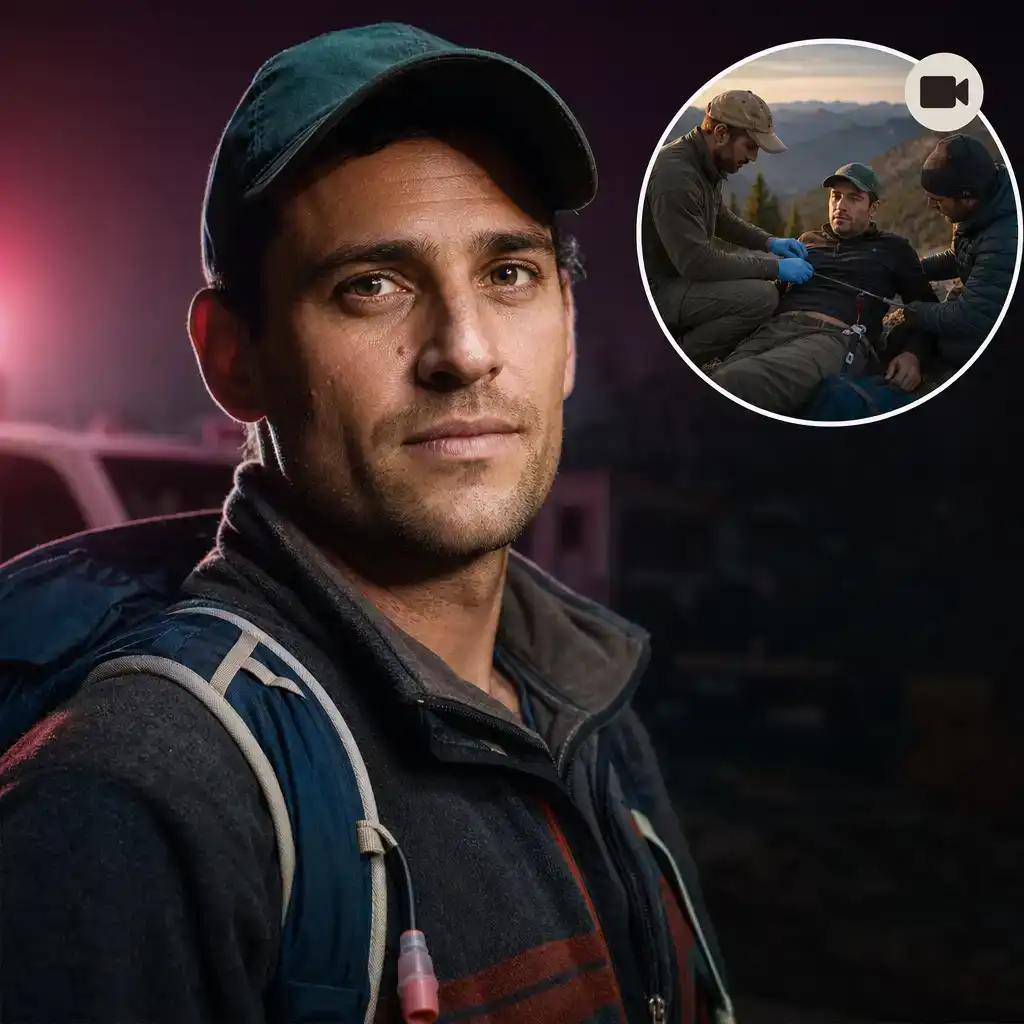
A hiker impaled by a trekking pole on Montana’s highest mountain managed to descend for six and a half hours, covering roughly 10 miles before receiving medical care. David Cifaldi’s escape was not simply an endurance test. It depended on medical judgment, steady friends and the sensible decision not to pull a foreign object out of his body while standing around 12,000 feet above sea level.
Cifaldi, a wound-care nurse, was climbing Granite Peak with Brad Reich and Jesse Ross when he slipped on rocks. After getting back to his feet, he realized one of his poles had pierced his side.
“I just slipped on some rocks,” Cifaldi told KTMF. “It was just kind of a freak thing.”
Why did the group leave the trekking pole in place?
Cifaldi assessed the wound and concluded that the pole appeared to be shallow. According to KTVH, he could breathe deeply and was not experiencing major bleeding or severe pain. Those signs gave him some confidence that the injury was not immediately life-threatening, although there was no harmless version of the situation.
His professional training helped him stay composed.
“I think my nurse brain clicked on,” he said. “As soon as I was able to self-assess and establish that this was not life-threatening right now, I was pretty convinced I was going to get off that mountain under my own power.”
The group left the pole where it was. That aligns with American Red Cross guidance, which warns that removing an embedded object can worsen bleeding. First-aid advice generally calls for applying pressure and dressings around the object, keeping it stable and obtaining medical help.
Reich later described Cifaldi as “very calm and collected.” Ross used a Garmin satellite communicator to contact search-and-rescue personnel, giving the group access to outside assistance even as Cifaldi chose to descend on foot rather than accept a helicopter evacuation.
How did Cifaldi make the long descent?
One friend stayed close behind Cifaldi to monitor his condition while the other moved ahead when necessary. Ross said Cifaldi also asked them to warn families farther down the trail so children would not unexpectedly see the injury. Even while impaled on a mountain, he was apparently still considering everyone else’s afternoon.
Reports differ slightly on the distance. KTMF and CNN described the descent as more than 10 miles, while KTVH put it at nearly 10 miles. All agreed that it took approximately six and a half hours.
The elevation added another layer of difficulty. The Montana State Library lists Granite Peak at 12,799 feet, making it the tallest summit in the state. KTMF placed the accident at roughly 12,000 feet, while a fundraiser for Cifaldi said it happened around 11,800 feet.
Cifaldi said he understood that the outcome could have changed with only a small difference in where the pole entered his body.
“I feel very lucky,” he said. “A couple inches the other way and this would be a different story.”
What happened after the hikers reached safety?
Accounts also vary slightly on Cifaldi’s transport after the group reached the trailhead. KTMF and CNN reported that he was taken to a hospital in Columbus and later transferred to Intermountain Health. KTVH said he was evaluated at a nearby clinic before Reich and Ross drove him to Billings.
At the hospital, a surgeon successfully removed the pole. Cifaldi said the surgeon attached a drain to it so that pulling out the pole simultaneously guided the drain into position. It was a practical solution to a highly impractical injury.
Cifaldi later returned home to recover. A GoFundMe organized by Ross was raising money for medical expenses, lost work and equipment damaged during the incident. No verified further development on his recovery had been reported as of July 27, 2026.
The experience has not ended Cifaldi’s interest in Granite Peak. He said he hoped the full story would eventually conclude with the three friends returning and reaching the summit the following year.
Ross offered one possible adjustment to the plan: “Maybe we go without trekking poles next time.”