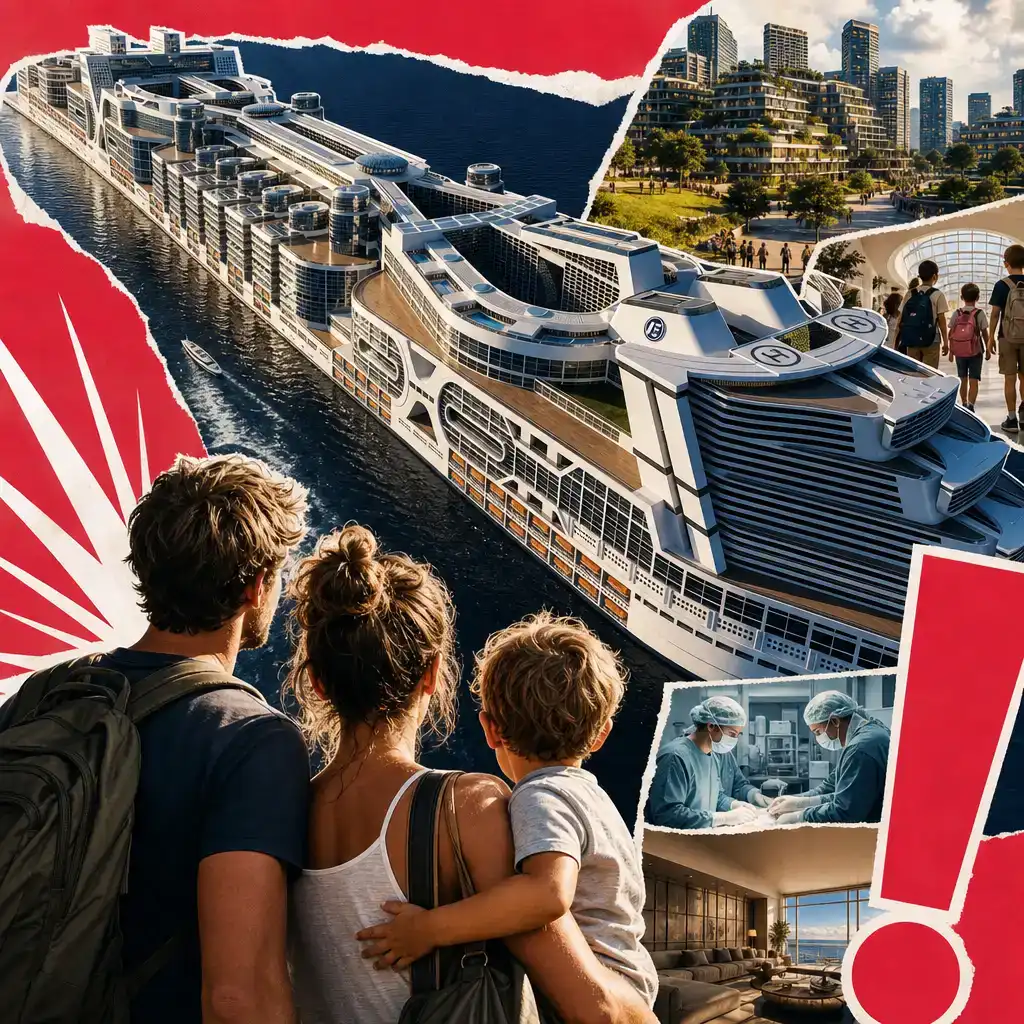
The Freedom Ship is being pitched as less of a cruise and more of a permanent ocean city, which is one way to make moving house sound both futuristic and administratively exhausting.
The proposed vessel would be nearly a mile long and, if built, would be larger than the Empire State Building. Its backers say it could house up to 80,000 people while traveling through international waters, with residents, tourists and crew living aboard for years rather than simply packing for a week at sea.
What is planned for the floating city?
The project is led by Freedom Cruise Line chief executive Roger Gooch, alongside nine other directors. Their idea is not a larger version of a holiday ship, but a self-contained city with the basics people would need to live full time on the water.
Plans for the vessel include entire neighborhoods, communal areas, civic spaces, schools, local services and green spaces. Concept images also show the kind of amenities usually reserved for glossy brochures and very optimistic investors:
- Swimming pools
- A shopping center
- A football, or soccer, pitch
- Tennis courts
- Bars
- A scuba-diving area
- Colleges
- Hospitals
The plan also emphasizes medical care and long-term living infrastructure, not just pools and shopping. That matters because this is not just a pitch for entertaining passengers. It is asking people to imagine raising families, studying, working, getting medical care and growing old on a ship that is effectively its own municipality.
How many people could live on board?
According to the plans, the ship would be able to carry up to 80,000 people in total. That figure breaks down into 50,000 residents, 10,000 tourists and 20,000 crew members.
Because of its enormous size, the vessel would remain in international waters. Reports say it could complete a full trip around the globe every two to three years, turning the usual cruise itinerary into something closer to a slow-moving world tour with property management issues.
Its backers say it would run on nuclear fuel, alongside systems meant to make it more self-sufficient. Those proposed features include rainwater collection, solar panels, aeroponics, wind turbines and a bio harvest reactor.
For now, the self-sufficiency claim is carrying a lot of weight. A floating city would need more than restaurants and deck chairs. It would need reliable power, water, food production, waste handling and healthcare, all while operating far from the usual support systems on land.
The project still needs a very large cheque
Gooch told The Telegraph he is “very confident” his team can turn the plan into reality. The main obstacle is not confidence, apparently. It is money.
The project is seeking $16.16 billion in funding. That is the estimated price of taking the Freedom Ship from an ambitious concept to an actual vessel large enough to dwarf even major military aircraft carriers.
Sridev Mookerjia, project manager at the Singapore-based Blossom Group, also told The Telegraph she believes in Gooch’s vision.
“I believe that with Roger’s efforts, patience and desire to make this a success, the sky’s the limit,” she said. “It’s a fantastic concept, and I will put all my efforts into making it happen.”
The proposal has drawn fresh attention online as large transportation concepts continue to circulate widely on social media. It follows renewed interest in Klein Vision’s AirCar, which secured funding in 2025 and is expected to launch sometime in 2026.
For now, the Freedom Ship remains a plan with a very large price tag and an even larger promise: a life at sea that is not a break from normal life, but a replacement for it.