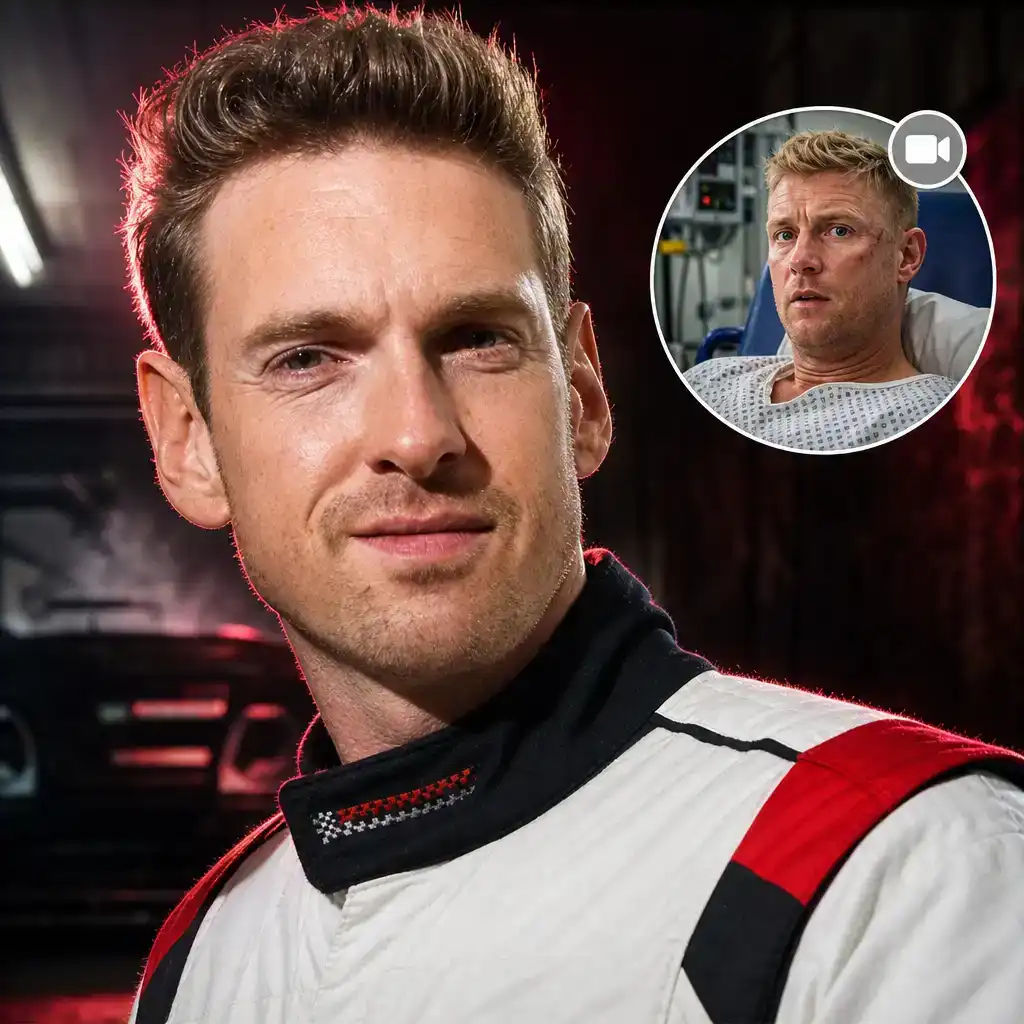
Paul Rees, the professional driver who says he played The Stig from 2019 to 2022, has sued BBC Studios over the Top Gear crash that seriously injured Andrew “Freddie” Flintoff. Rees says he warned the production about safety concerns, suffered a broken back and post-traumatic stress disorder, then felt blamed for an accident he feared neither man would survive.
The December 13, 2022 crash at Dunsfold Aerodrome happened while Flintoff was driving an open-topped Morgan Super 3 during filming for series 34. Rees was in the passenger seat when the three-wheeled car overturned and slid roughly 50 metres with both men upside down.
BBC Studios disputes his claim, denies negligence and argues that instructions Rees gave immediately before the manoeuvre contributed to the crash. The court action turns on what was said inside the car, what risks were understood and whether the production had adequate safety measures in place.
What Paul Rees says happened inside the Morgan
Rees told The Sun that the crash appeared to unfold in slow motion. He initially thought the red he could see was part of the vehicle before realizing it was Flintoff’s blood.
“I genuinely felt like we were going to potentially die, because we had no protection,” he said. “I was acutely aware the only thing holding my head off the tarmac was Fred’s head. I still have no idea how I walked away.”
According to Rees, he had told Flintoff that a helmet was needed. Flintoff allegedly replied that the planned costume required a racing cap and comedy glasses, which crew members then confirmed.
Rees also says he told Flintoff that he had never driven a three-wheeler and was outside his “comfort zone.” He claims a Morgan mechanic advised that the vehicle could not roll unless it was steered while reversing, and that he passed this information to Flintoff.
After several attempts at the corner, the car overturned. Rees described Flintoff’s condition as resembling “a war injury” and said everyone immediately focused on saving him.
Why BBC Studios says Rees bears responsibility
BBC Studios presents a sharply different account in its defence filings. According to court documents reviewed by The Independent, the company argues that the manoeuvre was not inherently unsafe and that Rees did not express reluctance before it began.
The company says recordings from in-car microphones captured Rees telling Flintoff, “Now turn right… now full power, full power,” as they approached the corner. It also contends that Rees did not make his lack of experience with that specific vehicle sufficiently clear.
Rees acknowledges encouraging Flintoff to apply power but rejects the suggestion that his instructions caused the accident. He argues that responsibility for managing the filming environment and its risks rested with the production.
BBC Studios said it disputes the claim and is defending it. In its legal response, it denied being negligent “as alleged or at all.” The company has also said it believes Rees received comprehensive medical and welfare support after the accident.
Rees is seeking more than £100,000 in damages, with some reporting placing the claim at up to £150,000. The amount covers alleged personal injury following the crash, including a spinal fracture he says was not diagnosed until 2023 and PTSD.
Rees questions the emergency response and aftercare
Rees claims the on-site medic immediately told him he was not equipped to deal with an injury of Flintoff’s severity. He also says the nearest ambulance was around two hours away.
According to his account, a full-sized ambulance had previously been stationed on set but had been replaced by a trained medic using a small hatchback. Because Flintoff’s injuries were so serious, Rees says his own condition was not assessed until much later.
He was eventually taken to hospital on a spinal board and initially cleared. Rees says he learned the following year that he had broken his back.
The emotional damage, he argues, was compounded by what happened afterward. Rees says an executive asked him to soften his comments and that he received little contact before being offered a group therapy session with other staff.
At a later meeting in London, Rees says a BBC representative suggested that, as the professional driver beside Flintoff, he needed legal advice. He recalled asking, “How are you pinning this on me?”
“It felt like the accident just happened over again, like I was being thrown under the bus,” he said.
The public record contains important contradictions
Several central details have been reported differently since the crash. A 2023 report in The Guardian said Flintoff and his passenger had been wearing helmets. Rees and Flintoff have since both said they were not wearing them.
There has also been confusion over Flintoff’s compensation. Some reports placed his settlement with the BBC at £12 million, but BBC Sport and The Independent reported a figure of £9 million. Flintoff later described suffering anxiety, nightmares and flashbacks following the accident.
The Health and Safety Executive reportedly found no evidence of serious failings. BBC Studios’ broader health and safety review, which was separate from the accident investigation, concluded that required policies and established industry practices had been followed. It nevertheless identified “important learnings.”
BBC Studios halted production after the crash, apologized to Flintoff and later rested Top Gear indefinitely. Those decisions showed the scale of the consequences even as the parties continued to disagree over precisely how the crash occurred and who was responsible.
Chris Harris says the danger was flagged earlier
The dispute also raises a wider question about production pressure. Former Top Gear co-host Chris Harris has said he warned the BBC three months before the crash that the programme’s approach risked a serious or fatal accident.
“If we carry on, at the very least, we’re gonna have a serious injury and at the very worst, we’re gonna have fatality,” Harris said he told the broadcaster.
Harris also claimed the shoot involving the Morgan was rushed, preventing him from properly advising Flintoff about the vehicle. BBC Studios declined to respond directly to those allegations.
The programme had already experienced major accidents. Flintoff crashed at 125mph during filming in 2019, while Richard Hammond survived a 288mph crash in 2006.
That history does not decide Rees’s case, which will depend on evidence about this specific incident. But it gives added weight to his claim that concerns extended beyond one instruction shouted in the final seconds before the Morgan overturned.
Rees says he loved Top Gear and remains fond of its crew. His case is not framed as a rejection of the programme, but as an argument that the people taking its risks deserved stronger protection and better support afterward. For viewers, that distinction matters: television can make danger look effortless, while the people inside the car live with what happens when it is not.