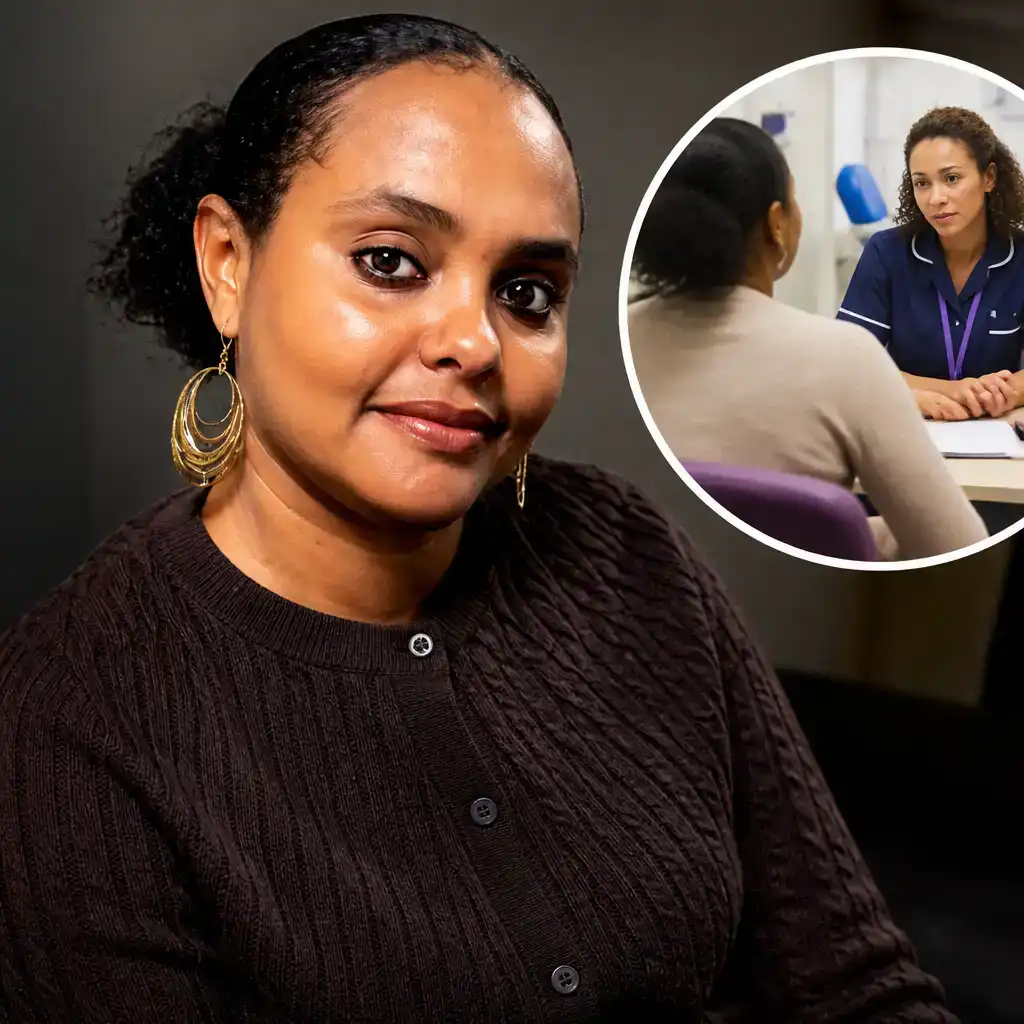
Sara Kahsai grew up in Sudan and moved to Birmingham in 2022 after marrying a bus driver from the city. As she adjusted to her new home and married life, she made a devastating discovery: she was a survivor of female genital mutilation, carried out when she was a young child.
“The shock was massive,” she said.
The realisation helped explain years of severe pain, including difficulties in her physical relationship with her husband. She said he responded with kindness and patience as she began to understand what had happened to her body.
Warning: This article contains descriptions of female genital mutilation and its effects.
Why did Sara’s mother allow FGM?
Kahsai turned to the person she believed must have arranged the procedure: her mother, who still lives in Africa.
“I was a baby. It was the culture to do it for everybody,” Kahsai recalled her mother telling her.
“When I spoke to my mum she was really upset and she apologised to me.”
Female genital mutilation, commonly known as FGM, involves partially or completely removing the external female genitalia for non-medical reasons. It is practised in parts of Africa, the Middle East and Asia, as well as within some migrant communities elsewhere.
The reasons given for the practice vary. They include pressure to gain social acceptance, religious claims, false ideas about hygiene and attempts to preserve a girl’s virginity. None provides a medical benefit.
In the United Kingdom, FGM is illegal and treated as child abuse. Taking a girl abroad to undergo the procedure is also against the law.
The Home Office cites World Health Organization estimates suggesting that three million girls undergo some form of FGM each year in Africa alone. It is a very large figure for a practice that often remains hidden behind family and community silence.
How can FGM affect pregnancy and childbirth?
Kahsai did not tell health professionals what had happened until she became pregnant. She was then referred immediately to the specialist FGM Clinic at Birmingham Women’s Hospital, where midwives support patients and assess risks to unborn children.
Midwife Renata Hanif handles about 200 cases a year. She said some forms of FGM can make vaginal delivery more difficult or dangerous.
The clinic offers deinfibulation, a procedure that separates tissue fused by FGM. It can be performed during pregnancy to help make childbirth safer.
The damage can extend far beyond labour. Survivors may experience:
- Difficulty urinating or menstruating
- Repeated infections and an increased risk of sepsis
- Severe or persistent pain
- Anxiety, depression and psychological trauma
- Problems with intimacy and sexual health
Hanif said many patients struggle to speak about the procedure, particularly when it happened in early childhood and was never explained to them.
“It is very difficult, very emotional,” she said. “It’s very difficult for the woman to actually come forward and to come to the clinic, attend the clinic, and have a conversation with me as well.”
She reassures patients that the clinic exists to help, then carefully explains what was done to them and how it may continue to affect their health.
What support does the Birmingham clinic provide?
Appointments include detailed explanations of female anatomy, which tissue has been removed and which symptoms may need treatment. Hanif said most patients leave with a clearer understanding of their bodies and a stronger sense of control.
“We talk about every part, what that part is there for and what’s been removed and what cause for concern and what effect this will have for the rest of her life,” she said.
The clinic also offers counselling and advice for partners and husbands. That support matters because the consequences are not limited to a medical record. They can shape relationships, pregnancy, mental health and everyday activities for decades.
For Kahsai, specialist care provided answers she had not known were available. It also showed how easily survivors can remain outside the health system until pregnancy or another medical event forces the issue.
Can education help prevent FGM?
Children’s charity Barnardo’s established the National FGM Centre in 2015 to improve protection for women and girls. The centre works to prevent the practice, increase public awareness and support people affected by it.
Schools are legally required to teach pupils about FGM and the law surrounding it as part of relationships and sex education, according to the centre. However, the content and quality of those lessons can differ significantly between schools.
Teaching about FGM is not mandatory in primary schools. The National FGM Centre wants that to change, arguing that children need suitable information before they reach an age when they may be at risk.
“For us, a huge part of tackling FGM is prevention,” said Rohma Ullah of the centre.
“Yes, a conviction, a prosecution, can provide justice, accountability and send strong messages into communities, but by then the harm has already happened.”
The government held its first dedicated FGM Summit in a decade in April, bringing together people working to improve protection for women and girls. Planned measures include new guidance to help professionals identify children who may be at risk of being taken abroad for the procedure.
What does Sara want other survivors to know?
Kahsai is urging women who have undergone FGM to seek medical support as soon as they can, rather than waiting until pregnancy.
“I have a message to all ladies who’ve had FGM,” she said. “When they come to the UK it is different. There’s help here. Go to their GP, seek help, ask for help.”
She added: “If I knew I could seek help I would not have waited until I was expecting, because I did suffer a lot before.”
Support for anyone affected by FGM is available through general practitioners, specialist National Health Service clinics and the BBC Action Line.