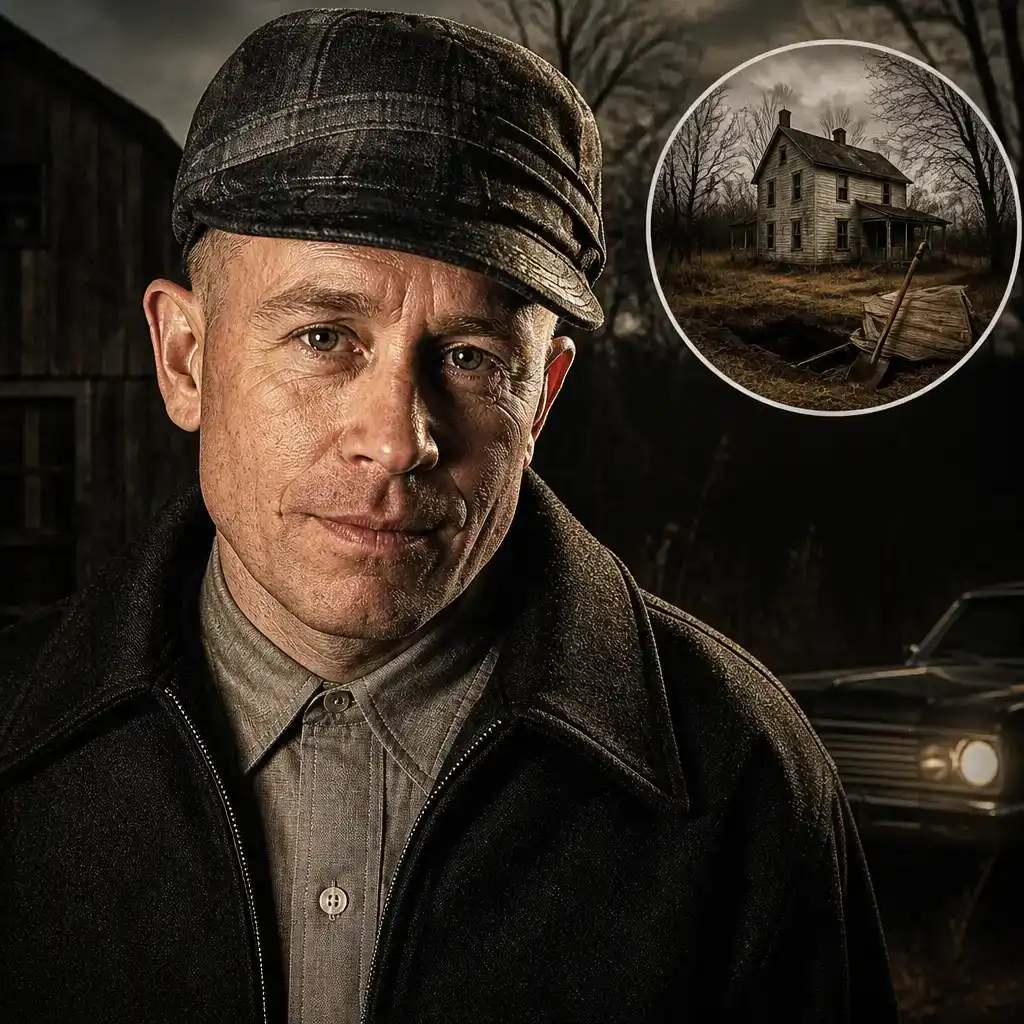
The Ed Gein true story contains the sort of details horror films usually invent after deciding reality is not unpleasant enough. The Wisconsin farmer admitted killing two women, exhuming corpses and keeping objects made from human skin and bone inside his isolated home.
His crimes helped inspire Psycho, The Texas Chain Saw Massacre and The Silence of the Lambs. Decades later, Ryan Murphy and Ian Brennan brought his life to Netflix in Monster: The Ed Gein Story, the third season of their crime anthology after installments about Jeffrey Dahmer and the Menendez brothers.
The series premiered in October 2025 with Charlie Hunnam playing Gein and Laurie Metcalf portraying his controlling mother, Augusta Gein. It later received seven nominations for the 2026 Emmy Awards, including acting recognition for both stars. The debate over whether Monster offers serious examination or polished exploitation continued as scheduled.
Murphy said he considered Hunnam after seeing a paparazzi photograph in which the Sons of Anarchy actor looked “haunted.” There was, Murphy thought, “something very Ed about him.”
“I must have been having a bad day,” Hunnam replied.
How did Ed Gein’s childhood shape his life?
Edward Theodore Gein was born on Aug. 27, 1906, in La Crosse, Wisconsin. He was the second son of George Gein and Augusta Gein, who had reportedly hoped for a daughter, according to Harold Schechter’s 1989 book Deviant.
In 1914, the family moved to a remote 195-acre farm near Plainfield, then a village of roughly 700 people. George was an abusive alcoholic. Augusta held extreme religious views and demanded that Ed and his older brother, Henry Gein, remain “uncontaminated by women.” It was not an ideal foundation for healthy adult relationships.
Both sons stayed on the farm and remained unmarried. George died in 1940. Henry died in 1944 at age 42, officially from an apparent heart attack after a fire on the property.
Ed then lived alone with Augusta. She suffered a major stroke shortly afterward and died in 1945, leaving him devastated.
Forensic psychiatrist Dr. N.G. Berrill described Gein’s attachment to his mother in the 2023 documentary series Psycho: The Lost Tapes of Ed Gein as a case in which an adult man remained psychologically fused with a parent. Schechter said Gein treated Augusta as a saint and cried whenever he discussed her after his arrest.
That relationship helped shape Norman Bates and his fixation on “Mother” in Robert Bloch’s 1959 novel Psycho. Alfred Hitchcock adapted the book into the 1960 film that made showers considerably less relaxing.
What happened to Bernice Worden?
On Nov. 16, 1957, Frank Worden returned from deer hunting to his family’s hardware store in Plainfield. His mother, 58-year-old Bernice Worden, was missing. A trail of blood ran from the sales counter toward the rear exit, and investigators found .22-caliber shell casings inside.
A receipt near the register recorded the sale of antifreeze. Frank remembered that Gein had visited the previous day and asked about buying it. He contacted the sheriff, and deputies headed to Gein’s farmhouse.
Inside a woodshed, officers found Bernice’s decapitated body hanging upside down from roof beams. Her heart was later discovered in a plastic bag.
Police located Gein that night at a neighbor’s home and arrested him. The search of his property then revealed that Bernice was far from the only person whose remains had ended up there.
Investigators found the severed head of Mary Hogan, a 54-year-old tavern manager who had disappeared in 1954, inside a paper bag. Blood, spent cartridges and evidence of a struggle had been discovered at Hogan’s tavern after she vanished.
Gein had previously joked to local residents that Hogan was “down at his place.” Nobody interpreted this as a confession, largely because most people do not expect casual conversation to require a homicide investigation.
What did investigators find at Gein’s farmhouse?
During questioning, Gein confessed to killing Bernice Worden and Mary Hogan. He also admitted visiting cemeteries, opening recently filled graves and removing bodies or body parts.
Gein said he identified fresh burial sites by reading newspaper death notices. He denied exhuming his mother.
At the farmhouse, investigators documented human remains transformed into masks, containers, furniture coverings and other household objects. The collection included bones, skulls and preserved organs. Some remains belonged to the two murdered women, while others came from bodies stolen from cemeteries.
His statements to authorities were often indirect. Gein claimed not to remember many details and said he “must have used a knife” to dismember Bernice. Asked about female genitalia stored in the house, he replied, “I wouldn’t enjoy it or anything.” This did not clarify matters as much as he may have intended.
Although Gein became widely known as a serial killer, authorities proved only two murders. Investigators examined possible links to other disappearances, but no additional killing was conclusively attributed to him.
His combination of murder, grave robbery and attempts to construct a female body suit later influenced several fictional characters. Norman Bates borrowed elements of his maternal obsession. Leatherface in The Texas Chain Saw Massacre and Buffalo Bill in The Silence of the Lambs reflected aspects of his use of human skin. None was a literal screen biography.
Did Ed Gein kill Evelyn Hartley?
Netflix’s Monster depicts Gein as responsible for the disappearance of Evelyn Hartley, played by Addison Rae. Historical evidence does not establish that connection.
Evelyn, 14, disappeared in October 1953 while babysitting. After she failed to call her parents at the arranged time, her father went to the house. He found an open basement window and the child she had been watching asleep inside. Evelyn was gone. Blood appeared near the window and outside on the lawn.
Gein denied involvement. According to Schechter, he also passed two lie detector tests concerning the case. Evelyn’s disappearance remains unsolved.
The series therefore turns a long-standing theory into a dramatic storyline rather than presenting a proven crime. True-crime television has rarely been known to reject additional menace when it becomes available.
Was Adeline Watkins really his girlfriend?
After Gein’s arrest, 50-year-old Adeline Watkins publicly described herself as his former girlfriend. Suzanna Son plays her in Monster.
“I loved him and I still do,” Watkins reportedly told the Minneapolis Tribune. She called him “good and kind and sweet” and claimed that she rejected his marriage proposal during their final date on Feb. 6, 1955.
Watkins said the refusal reflected her own doubts rather than concerns about him. She also described their shared interest in books and said they discussed murders they had read about. According to Watkins, Gein would analyze what each killer had done wrong and which mistakes had led to capture.
Early reports suggested that the relationship lasted 20 years. Within weeks, however, Watkins told the Stevens Point Journal that they had dated only “intermittently” for roughly seven months. She also emphasized that she had never entered his house, which proved to be an exceptionally fortunate boundary.
Why did Ed Gein avoid a conventional prison sentence?
Authorities charged Gein with Bernice Worden’s murder in November 1957. He pleaded not guilty by reason of insanity and was declared mentally unfit to stand trial. The state committed him to a psychiatric hospital.
In 1968, doctors determined that he could understand the proceedings and assist his lawyers. He received a bench trial before Judge Robert H. Gollmar.
The defense argued that Gein had not intended to kill Bernice. According to that account, he was examining a firearm for sale at Worden Hardware when it discharged accidentally. Gollmar rejected the argument and found him guilty of murder.
A second proceeding considered whether Gein had been legally sane at the time of the killing. The court found him not guilty by reason of insanity, and he returned to state psychiatric custody rather than prison.
Gein remained institutionalized for the rest of his life. He died from cancer-related respiratory failure at the Mendota Mental Health Institute on July 26, 1984. He was 77.
What happened to Ed Gein’s grave?
Gein was buried beside his parents and brother at Plainfield Cemetery. His grave no longer has a public marker.
Visitors repeatedly chipped pieces from the original headstone until someone stole it entirely in 2000. Authorities eventually recovered the stone and placed it in storage to discourage the cemetery from becoming a destination for souvenir hunters.
That did not end the vandalism. Visitors instead began breaking fragments from Augusta Gein’s marker, apparently concluding that damaging a different grave was an acceptable compromise.
Gein’s physical legacy is therefore mostly kept out of sight. His cultural influence has been harder to contain, resurfacing through horror films, documentaries and television dramas nearly seven decades after police entered the farmhouse.
Monster: The Ed Gein Story brought that history back into the awards conversation with seven Emmy nominations. The 2026 Emmy Awards air Sept. 14 on NBC and stream on Peacock.