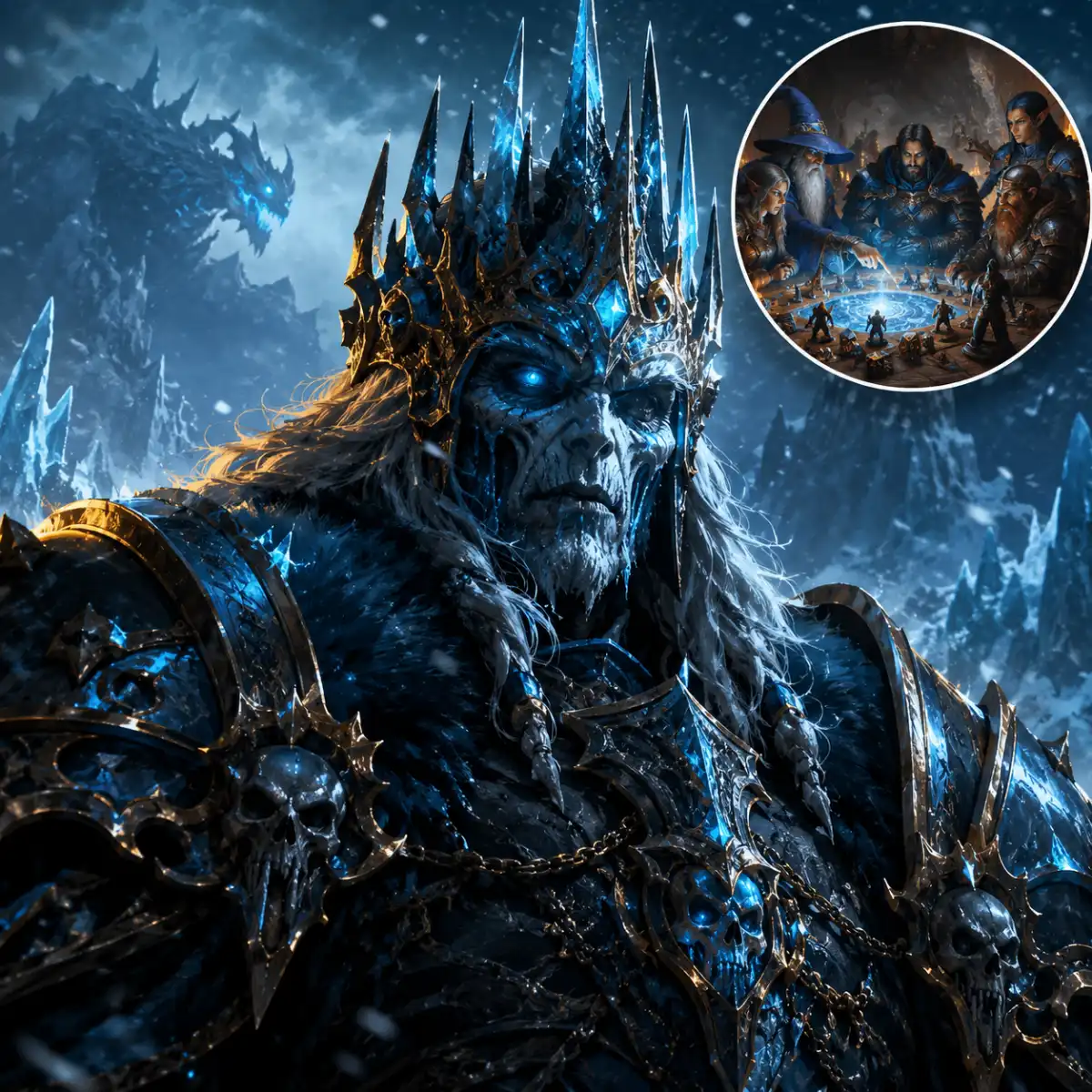
For players who have spent years translating favorite characters into homebrew rules, the new Dungeons & Dragons crossovers remove some of that unpaid design work. Wizards of the Coast has announced official collaborations with World of Warcraft and Star Wars, giving two enormous fan communities a formal route into the revised fifth-edition game.
The projects arrive as D&D continues building on renewed mainstream attention from Stranger Things and Baldur’s Gate 3. They also follow the 2024 rules revision, commonly called 5.5e, which updated the game without entirely replacing fifth edition. At Gen Con, Wizards presented the collaborations under the Universes Beyond banner, extending a licensing strategy already familiar to Magic: The Gathering players.
What is included in the World of Warcraft book?
Dungeons & Dragons x World of Warcraft: The Season of Champions is scheduled for November 17, 2026. D&D Beyond Master Tier subscribers will receive early access on November 3, while Roll20 has opened preorders for its digital edition ahead of the same general launch date.
The book brings Azeroth into D&D with rules intended to represent all 13 Warcraft classes. That does not mean 13 completely new D&D classes, however. According to the circulated product description, those options are delivered through nine new or revised subclasses and more than 40 specializations.
The package reportedly includes:
- 16 playable species, including Dracthyr, Draenei, Earthen, Forsaken and Haranir
- More than 60 spells
- 25 magic items
- 50 monsters
- 30 dungeon-boss stat blocks
- Seven recognizable Warcraft dungeons
- 23 factions
PC Gamer and Windows Central reported details of the project before its Gen Con reveal after a Roll20 listing appeared prematurely. PC Gamer described it as a full setting book rather than a limited starter product. Wizards had previously identified The Season of Champions only as an unnamed winter 2026 release.
Has Warcraft appeared in a tabletop RPG before?
This is not Azeroth’s first encounter with tabletop roleplaying rules. White Wolf previously published a licensed World of Warcraft RPG based on the third-edition D&D system through the Open Gaming License.
The new release is different because it comes directly through the current D&D product line and uses the revised fifth-edition framework. For players, that means the Warcraft material should sit more naturally beside existing character options, monsters and campaigns, rather than functioning as a separate game with a familiar rules ancestor.
That compatibility is likely a large part of the appeal. Warcraft already has decades of class identities, factions, locations and dungeon encounters that map neatly onto a party-based fantasy game. The emotional draw is just as obvious: players who know Azeroth through a screen can now revisit it around a table, preferably without waiting for the rest of the group to finish downloading an update.
What do we know about the Star Wars release?
The second collaboration, The Season of Rebellion, will bring Star Wars into official D&D rules in 2027. Wizards has not yet disclosed a precise release date, product format or detailed list of playable options.
Its title places the project during the rebellion against the Galactic Empire, but further story details remain under wraps. The basic promise is significant because Star Wars already has an established tabletop history, including multiple d20 roleplaying editions previously published by Wizards of the Coast. Those releases included 2007’s Star Wars Roleplaying Game Saga Edition.
Edge Studio also continues to sell its own licensed Star Wars roleplaying line. That creates an unusual overlap: the 2027 D&D book will need to appeal to players who want familiar fifth-edition mechanics without simply duplicating a dedicated Star Wars game that is already available.
It also raises a mechanical question. D&D is built around fantasy classes, spellcasting and steadily escalating heroic power. Star Wars has the Force, blasters and starfighters, which are not exactly minor substitutions. Wizards has yet to explain how extensively the rules will be adapted.
Why is D&D adopting the Universes Beyond model?
Universes Beyond has already become a major licensing vehicle for Magic: The Gathering, connecting the card game with outside properties and attracting buyers who may not otherwise enter a hobby shop. Hasbro Chief Executive Officer Chris Cocks previously called the program “fantastic” for bringing new people and “different collector” energy into Magic.
Applying that model to D&D gives Wizards access to established audiences while offering those fans a recognizable entry point into tabletop roleplaying. The multiverse is also a business plan now.
Community reaction has been divided. As GamesRadar reported, some Reddit commenters welcomed crossover settings that remain separate from D&D’s traditional worlds. Others questioned whether the system is well suited to Star Wars and whether licensed properties could take space away from original or returning campaign settings.
Wizards appears aware of that balance. Its Gen Con announcements paired the major licensed worlds with new material for Dark Sun, Greyhawk, Dragonlance and established characters such as Drizzt Do’Urden.
What else did D&D announce at Gen Con?
The crossover books were part of a much larger schedule extending into 2027. Wizards outlined new adventures, returning settings, digital tools and casting news.
The announced tabletop projects include:
- Dark Sun: Blood and Power, a gameplay expansion planned for 2027
- Dark Sun: Edge of Oblivion, an adventure expansion planned for 2027
- Greyhawk: Crown of the Witch Queen, an adventure book planned for 2027
- A Dragonlance return involving co-creator Tracy Hickman
- A Greyhawk return involving Luke Gygax
- A new Drizzt Do’Urden story from R.A. Salvatore
D&D Beyond is also getting a Looking for Group feature and a new mobile app with additional tools. For the Warlock cast, Wizards announced Maggie Robertson as Tasha and Tricia Helfer as Kaatri.
The breadth of the schedule suggests Wizards is not replacing its established worlds with licensed ones, at least not yet. Instead, it is trying to serve longtime players and newcomers at the same time. Whether those groups happily share the same table will depend on execution, especially when lightsabers enter a rules system designed around swords and spells.