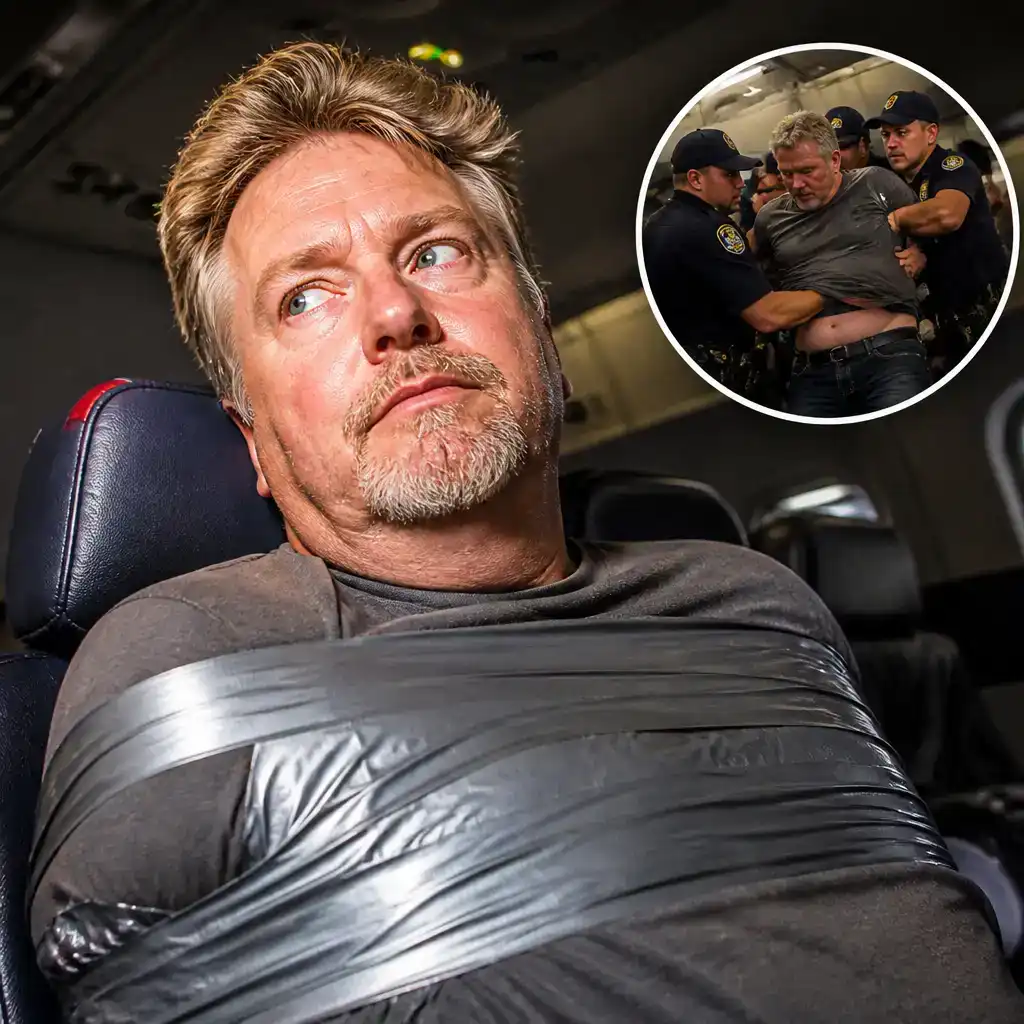
As the disturbance escalated, several passengers and crew members restrained him with duct tape and zip ties supplied by flight attendants. Footage showed his body secured to the seat and his head taped against the headrest while he continued shouting. Witnesses described passengers as alarmed by both the outburst and the improvised restraint operation unfolding in first class.
The crew diverted the aircraft to Baltimore/Washington International Thurgood Marshall Airport rather than continuing to Newark.
How did police remove Arthur Lundeen?
Video obtained after the incident shows several Maryland Transportation Authority Police officers standing over Lundeen after the plane landed. He remained seated and restrained while officers spoke with him.
An eyewitness said police removed the duct tape, brought Lundeen to his feet and escorted him from the aircraft. The process reportedly took about 20 minutes. Paramedics examined an open wound on his arm and cleared him before authorities completed the arrest.
Reports have identified him as Arthur Lundeen, Layne Arthur Lundeen and Arthur Layne Lundeen. Court reporting has generally used Lundeen while noting the fuller variations in official and media accounts.
Prosecutors charged him in Maryland state court with:
- Second-degree assault
- Disorderly conduct
Lundeen was released on his own recognizance after a bail review on September 4. He is scheduled to appear in Glen Burnie District Court on October 19.
American Airlines said it does not tolerate violence and thanked its employees for handling the incident professionally. The carrier’s statement did not address the mechanics of taping a passenger to a seat, presumably because the available video had already covered that department.
Could federal charges still follow?
The current case involves state misdemeanour charges, not federal aviation offences. The FBI told CBS Texas that agents were interviewing witnesses and would consult federal prosecutors in Maryland about whether additional charges were appropriate.
As of September 10, no federal charge against Lundeen had been announced. That distinction matters because interfering with a flight crew can carry a federal prison sentence of up to 20 years. The Federal Aviation Administration can also impose civil penalties of as much as $43,658 per violation and refer serious incidents for prosecution.
Those possible penalties are general enforcement tools, not punishments already imposed in this case. For now, Lundeen faces the Maryland assault and disorderly conduct counts while federal authorities review what happened aboard the aircraft.
The diversion also sits within a broader aviation problem involving disruptive passengers. Airlines and regulators have repeatedly warned that abusive or violent conduct can lead to arrest, large fines and federal prosecution. Apparently, the routine request to remain seated still requires legal reinforcement for a small but determined section of the travelling public.
Why are witnesses describing the motive differently?
The central facts reported by witnesses are broadly consistent: a religious conversation preceded a sudden escalation, Lundeen allegedly became abusive and violent, and passengers helped restrain him until the plane landed.
Cahn has offered a more spiritual interpretation. He described the episode as “demonic” and connected it to their discussion about religion and his book. That is Cahn’s personal account, not a conclusion announced by police, prosecutors or the FBI.
Investigators have not publicly identified a motive beyond the conduct described by passengers and crew. Nor have authorities said that the religious discussion itself caused the disturbance. The criminal case concerns the alleged assault and disorderly behaviour, rather than competing theological explanations for why they occurred.
The consequences have already extended beyond court. Long Realty, where Lundeen had been affiliated, said it immediately ended its relationship with him because the reported behaviour violated the company’s standards.
Lundeen’s next scheduled court appearance will determine the immediate direction of the state case. The FBI review could still produce a separate federal decision, but until prosecutors announce one, the more serious aviation penalties remain possible rather than pending.