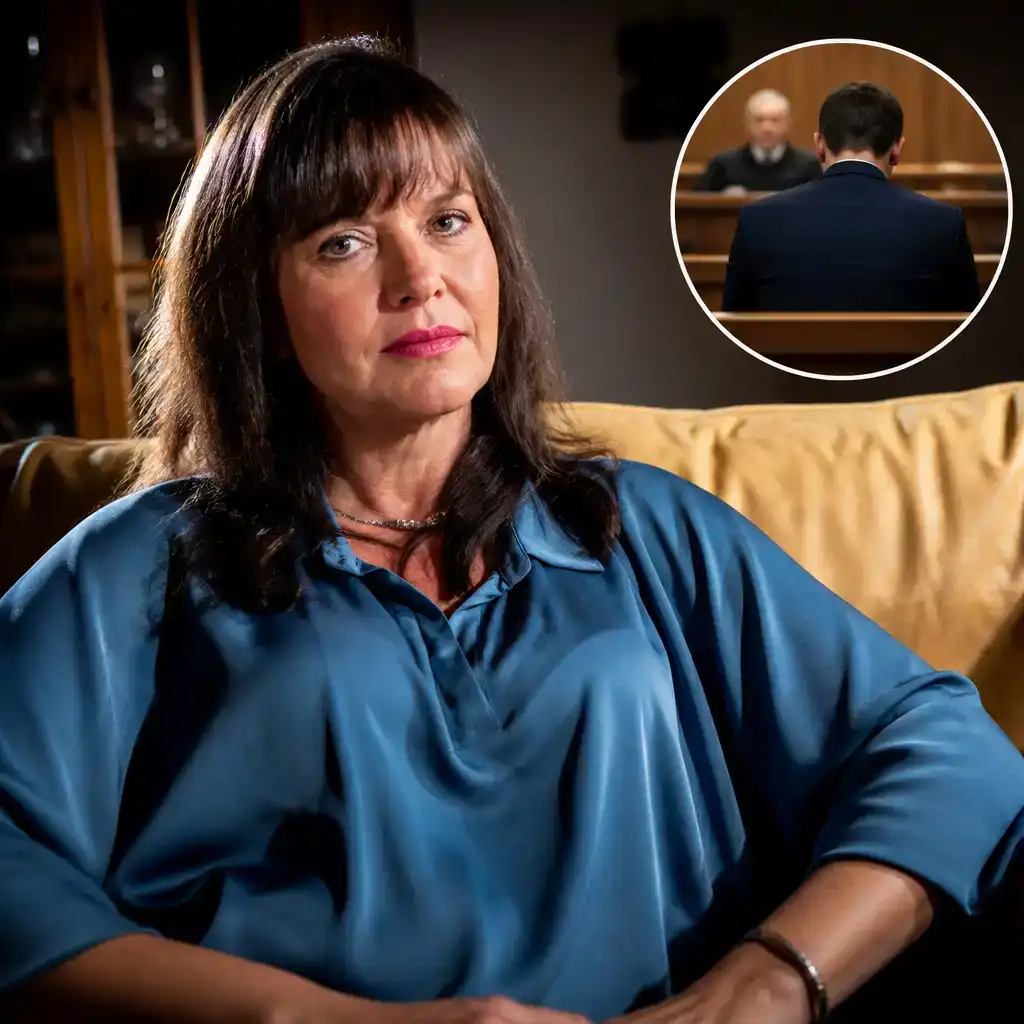
Police arrested Rogers on 24 February 2024 after the abuse was reported. Boucher’s divorce was finalised in September 2025, while the criminal proceedings remained unresolved.
ITV News West Country reported that the criminal case also involved assault, that ten witnesses had been expected and that repeated cancellations left Boucher waiting more than two years. She described that period as being in “no man’s land”, unable to move forward.
There is a discrepancy in reports about the final criminal timetable. ITV placed Rogers’s sentencing in July 2026, after a guilty plea, while another account reported that the plea and sentence occurred in April. Both report the same outcome: a guilty plea to coercive and controlling behaviour and a 20-month suspended sentence.
The important sequence is clear. When the divorce concluded, there was no criminal conviction for the family court to consider.
Why did Boucher have to pay £75,000?
Boucher knew the divorce would require some financial division, but said she and Rogers had largely maintained separate arrangements. She kept her family home, he kept his, and they paid their bills separately.
Even so, she was ordered to make a £75,000 lump-sum payment. Her own legal expenses added more than £30,000, taking the total cost beyond £105,000.
“I thought being stuck in this relationship I couldn’t get out of would be highlighted within the divorce procedure,” she said. “But the divorce law doesn’t take into account the fact that he was a criminal.”
She financed the bill through personal loans and described the cost as “crippling”. Although the marriage has legally ended, the debt has extended its financial consequences for years.
“I’m not going to be free of this situation for several years,” she said.
Boucher argued that requiring a victim to pay an abusive former partner can feel like further punishment, particularly when the criminal process moves too slowly to establish the abuse before financial proceedings finish.
Why does abuse often carry little financial weight?
Financial settlements in England and Wales are governed principally by the Matrimonial Causes Act 1973. The legislation is more than 50 years old, which does not automatically make it defective, but neither does it make it especially well designed for modern recognition of coercive control and economic abuse.
Olive Craig, senior legal officer at women’s rights charity Rights of Women, said family courts generally consider domestic abuse only when it crosses a very high threshold.
Physical violence is more likely to influence a judge, she said, while coercive control can be subtle, manipulative and difficult to fit within the existing framework. Judges are often effectively directed to treat it as irrelevant to the financial decision.
The Law Commission reached a broader criticism in December 2024. It found that financial-remedy law lacked a cohesive and sufficiently predictable framework. The commission specifically identified the treatment of serious misconduct, including domestic abuse, as an area requiring reform.
Law Commissioner Professor Nick Hopkins said the legislation does not give separating couples enough certainty about the outcome. Around 50,000 financial-remedy applications were made in 2025, so this uncertainty is not confined to an obscure legal corner.
How could divorce law change?
The Ministry of Justice opened its A Fairer End to Relationships consultation to examine reform of financial settlements and stronger protections for people leaving relationships. That consultation has now closed, and responses are expected to inform possible legislation.
Officials considered several approaches to abuse and asset division:
- Keeping abuse relevant only in exceptional cases
- Considering it when there is a clear financial effect
- Allowing established abuse to influence settlements more generally
Each option carries complications. A broader rule could recognise coercive control more fairly, but it might also require extra fact-finding hearings. Those hearings could lengthen cases, increase legal bills and reduce the assets left to divide.
They could also create another forum in which an abusive former partner prolongs contact or litigation after separation. Reform therefore has to recognise abuse without constructing a new, expensive process that gives perpetrators more opportunities to continue it through the courts. Apparently even fixing an obvious problem requires ensuring the repair does not become a second problem.
Family law specialist Kit O’Brien said recognition of domestic violence and its effects has changed substantially, though reform would not mean every example of poor behaviour altered a settlement. Instead, courts could approach serious abuse in a way that better reflects current social and legal understanding.
Economic abuse extends beyond one divorce
Boucher’s case sits within a much larger financial problem. Research cited by the Ministry of Justice estimates that 4.1 million women in the United Kingdom, roughly one in seven, experienced economic abuse by a current or former partner during a single year.
Women’s Aid estimates that leaving an abusive relationship and rebuilding a life can cost almost £50,000. Family court fees may be the largest expense, particularly when cases become prolonged or require repeated hearings.
Those costs matter because economic abuse often involves control over money, housing, employment or debt. A legal process that creates another large financial burden can preserve some of that control long after the relationship itself has ended.
Boucher said the law needed to “catch up with the times”, especially for victims whose experiences never meet the courts’ demanding threshold.
“I just think it’s very sad that people that have been through far worse than this are still told that that has no relevance to the divorce proceedings they’re going through,” she said.
The Ministry of Justice has said reform should ensure family courts meet the needs of domestic abuse victims. Any legislation, however, will arrive only “when parliamentary time allows”. That is not a timetable, and for people already waiting through criminal and family proceedings, it offers limited comfort.