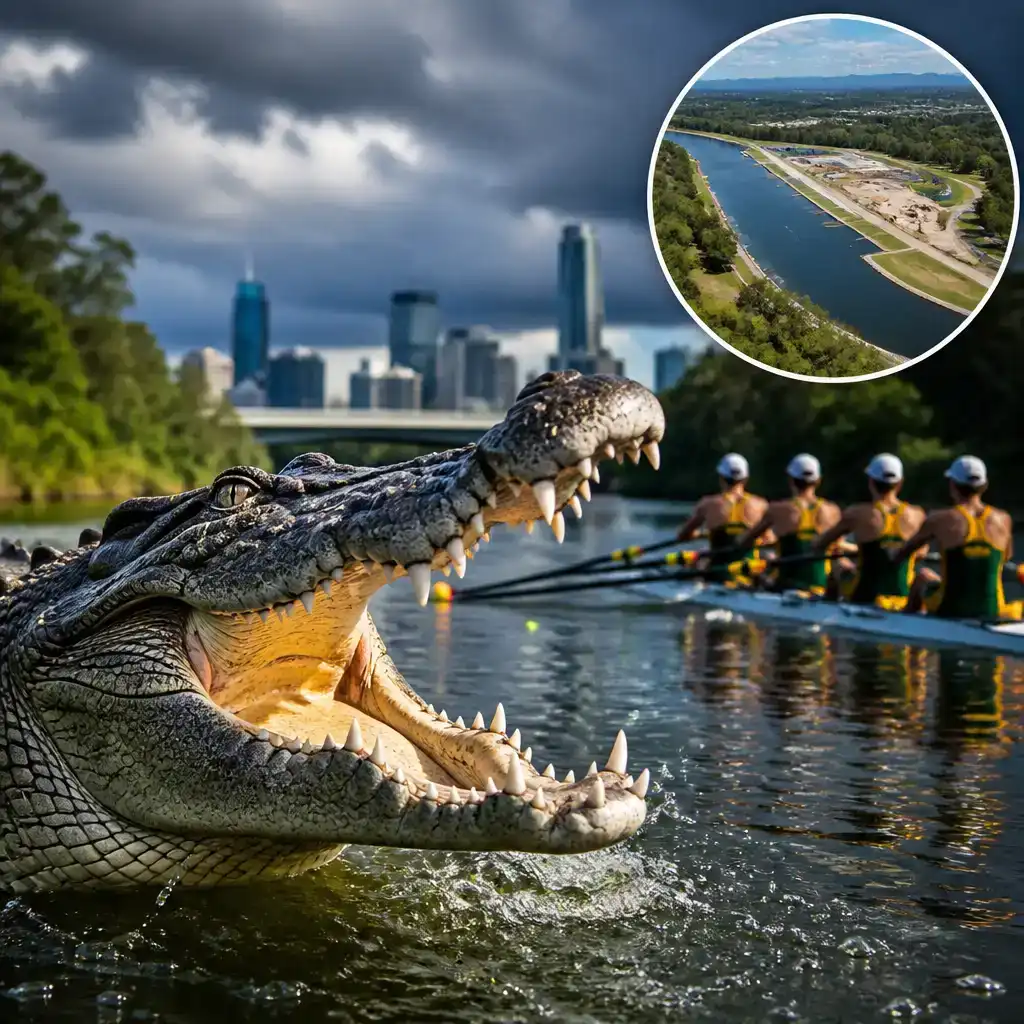
A Queensland river inhabited by about 500 saltwater crocodiles has been approved as an Olympic rowing venue for the Brisbane 2032 Games. The Fitzroy River course in Rockhampton will host Olympic and Paralympic rowing and canoe sprint events, following an independent technical assessment of its suitability.
The review found the river capable of staging fair competition under expected conditions. It examined weather patterns, water levels, flood risk and how the course could perform both during the Games and throughout the years of preparation.
It did not assess the crocodiles. Evidently, even a technical review must draw the line somewhere.
Why was the Fitzroy River approved?
The Games Independent Infrastructure and Coordination Authority commissioned the assessment as part of planning for Brisbane 2032.
The authority said the Fitzroy River Flatwater Facility already operates as a training and competition site. It hosts school state championships, local regattas and national team training camps, so organised racing on the river is not a new experiment.
Because the Fitzroy is already recognised as a rowing facility, event organisers have contingency plans for crocodile sightings. Olympic officials have also previously received assurances that competitors can be kept safe.
World Rowing and Paddle Worldwide, formerly known as the International Canoe Federation, both endorsed the proposed course after reviewing the technical findings.
World Rowing President Jean-Christophe Rolland said the analysis showed the river could provide fair racing during the Games and meet the requirements for Olympic and Paralympic rowing.
“Based on the extensive analysis undertaken, we now know that the Fitzroy River is capable of providing fair competition conditions during the period of the Games,” Rolland said.
What do canoeing officials say about the course?
Paddle Worldwide President Thomas Konietzko said the technical work had given the governing body and its athletes greater confidence in the venue.
“The quality and depth of the technical work undertaken has significantly improved our understanding of the field of play and provides confidence to us and our athletes that the course can deliver fair competition for Canoe Sprint athletes,” he said.
Brisbane 2032 President Andrew Liveris welcomed the endorsement, saying it provided more certainty as organisers entered the next stage of venue planning and delivery.
He said future design and operational work could now focus solely on Rockhampton.
Liveris had already played down concerns about crocodiles in 2025, comparing the issue with surfing in waters where sharks may be present.
“There are sharks in the ocean and we’re still surfing,” he said at the time, calling for a “can do, not a can’t do” approach. The comparison was direct, if not especially comforting to anyone expected to sit in a narrow racing shell.
How serious is the crocodile risk?
Saltwater crocodiles, commonly called “salties” in Australia, live in both fresh and salt water. Adults can grow beyond six metres in length, which makes them difficult to dismiss as a minor feature of the local ecosystem.
Officials have not detailed what crocodile management measures will operate during the Games. Existing rowing events use contingency procedures when one is spotted, while possible relocation has previously been discussed.
Former Australian rower Drew Ginn, who won three Olympic gold medals, said crocodiles were among his concerns, although not necessarily the most important one.
“Personally, I’m not fearful of the Australian animals but I’ve never had a crocodile near me,” Ginn told BBC Radio.
“I’m sure I’d row faster, I’m sure all the athletes would row faster. That’s on the list of concerns, I don’t think it’s the highest priority in concerns but it was certainly cited very early on.”
He also questioned whether international rowing should accept any possibility that athletes could be placed at risk, particularly if organisers need to remove crocodiles from the river.
Why do some rowers still oppose Rockhampton?
Ginn’s wider objections involve flooding, competitive fairness and the experience offered to athletes and spectators. Rockhampton is roughly six or seven hours from Brisbane, creating a significant geographical split between the rowing events and the main host city.
He remains unconvinced that every lane would offer equal conditions, despite the endorsements from World Rowing and Paddle Worldwide. In elite racing, where half a second can decide a medal, even small variations can matter.
“Even just the idea of being at a venue where you could have your race decided by half a second and it could show it’s different in lanes by two or three seconds,” Ginn said.
He also argued that distributing venues so far from Brisbane could weaken the Olympic experience.
“While I’m thinking Rockhampton is a great town, I just don’t think it’s right for the Olympic Games to spread the venues out in such a way that jeopardises the experience for the athletes and spectators,” he said.
For now, the governing bodies are satisfied that the Fitzroy can deliver fair racing. Questions about distance, flooding and the river’s large resident reptiles will move into the operational planning stage, where they may prove harder to exclude from the paperwork.