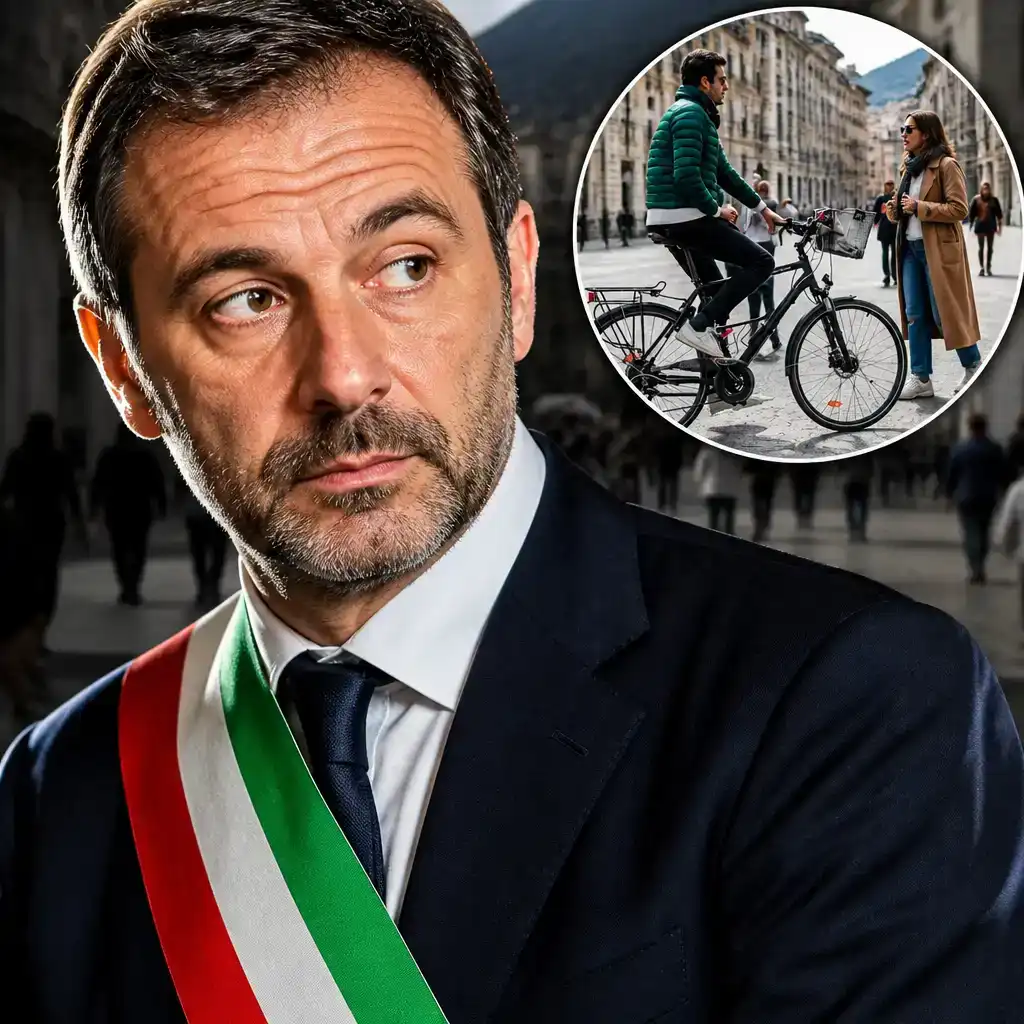
The Como bike ban is not, despite some excitable descriptions, a complete prohibition across the Italian city. The proposed restrictions cover roughly 30 streets in Como’s walled historic centre, where people could still bring bicycles but would have to get off and walk them.
Mayor Alessandro Rapinese linked the measure to pedestrian safety after a cyclist struck him as he left a meeting about traffic restrictions in June. The rider has not been identified. Rai described the mayor as injured, although Rapinese said he did not need hospital treatment.
“People act based on their own experiences, and I know what it’s like to be hit by one of these beasts,” Rapinese told Italian media, referring to e-bikes. “I was hit by a bike. I gathered information, and that’s where the measure came from.”
A personal collision followed by municipal regulation is certainly an efficient policy timetable. Critics are less convinced that it is a sound one.
Where would cycling actually be restricted?
The rules apply to conventional bicycles and e-bikes in parts of the limited-traffic zone, rather than throughout Como. Cyclists could enter the affected streets, but only while pushing their bikes.
According to The Guardian, about 30 streets in the historic centre are covered. Rapinese told La Provincia that riding would remain permitted across 80% of the limited-traffic zone. He also said many restrictions were already in place and that only Via Muralto, Piazza San Fedele and Via Balestra had newly become exclusively pedestrian areas.
The proposal forms part of a broader traffic package contained in city executive resolution No. 178, adopted on August 5. Other changes include:
- Restricting freight deliveries to between 6 a.m. and 11 a.m.
- Tightening vehicle access for accommodation businesses
- Expanding areas where bicycles must be walked rather than ridden
Como had already prohibited rental e-scooters from the city centre in 2022, so the local government’s suspicion of small electric vehicles did not begin with the mayor’s encounter.
Has the restriction taken effect?
Reports initially said the rules would begin in September, with riders facing warnings and possible fines. That timetable is less certain than the early headlines suggested.
Il Giorno reported that Como’s council still needs to approve the new regulation and that no confirmed start date has been set. As of August 21, 2026, no later report had established that the restrictions were in force.
That distinction matters. Resolution No. 178 sets out the city executive’s plan, but the regulation required to enforce it still faces another political step. For now, claims that Como has already imposed a total bicycle ban get both the scope and the legal status wrong.
Road-users association ACUS has also raised concerns about whether broad restrictions would be lawful without first assessing alternatives. It argued that stronger checks and targeted penalties could address dangerous riding without treating every cyclist as the same problem.
The city has not publicly settled how enforcement would work in practice, including whether police would begin with warnings or move directly to fines once the rules receive approval.
Why are cyclists and businesses objecting?
Opponents say the plan responds to reckless behaviour by some riders with a general restriction affecting residents, delivery workers and merchants. Tourists taking a slow ride through the centre may attract attention, but businesses relying on cycle deliveries would have to manage the consequences every day.
Nova Como president Vincenzo Falanga accused the administration of “turning individual problems into collective ones.” The group scheduled protests for September 1 and September 12, including a demonstration in which participants planned to walk their bicycles through the affected area to show how impractical the rules could become.
Paolo Emilio Russo, a member of parliament for Forza Italia, called the proposal “crazy.” Environmental organisation Legambiente Como accepted that some delivery riders travel at dangerous speeds, but described a general prohibition as environmentally “absurd.”
Rapinese maintains that pedestrian safety is the point, not punishment following his own collision. Critics counter that speed enforcement, penalties for dangerous riding and clearer separation between pedestrians and bicycles would be more proportionate.
For the moment, Como has a disputed proposal covering a limited section of its centre, not a citywide disappearance of bicycles. Cyclists may eventually have to walk through certain streets. The policy itself still has a few procedural steps to cover first.