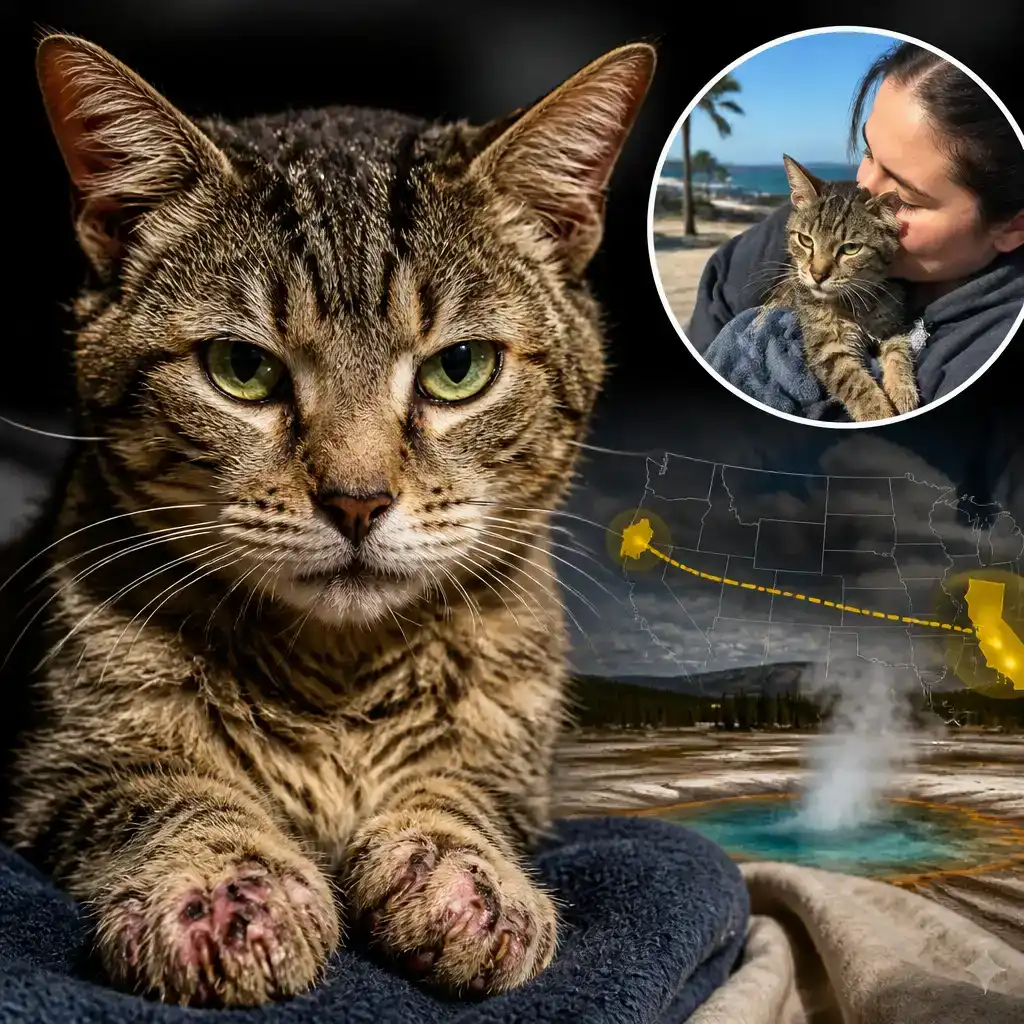
A lost cat’s 900-mile journey home to California ended with a microchip scan, badly damaged paws and one rather large unanswered question: how did Rayne Beau travel from Yellowstone National Park to a city hundreds of miles away in just two months?
The gray cat disappeared shortly after arriving at Yellowstone’s Fishing Bridge RV Park with owners Benny and Susanne Anguiano on June 4, 2024. By August, he had somehow reached Roseville, California — nearly 900 miles from the park and roughly 200 miles from his home in Salinas.
Rayne Beau, whose name is pronounced “rainbow,” could not explain his route. The condition in which he was found, however, convinced the Anguianos that much of the journey had been made without human help.
Rayne Beau vanished minutes into his Yellowstone adventure
The Anguianos had taken Rayne Beau and their other cat to Yellowstone for the animals’ first trip into the forest. Their cats were already accustomed to a comparatively adventurous life, including visits to the beach, journeys to the lake and camper trips spent watching deer and squirrels through large windows.
Yellowstone proved less relaxing. Soon after the family arrived, something startled Rayne Beau and he bolted into the trees surrounding the RV park.
The couple searched for four days, leaving out his favourite toys and treats in the hope that a familiar smell might draw him back. Nothing worked.
On June 8, they finally began the long drive home without him.
Susanne Anguiano said she was devastated but continued to believe the cat would survive. While the couple were crossing the Nevada desert, she spotted what she interpreted as a hopeful sign.
“We were entering the Nevada desert and all of a sudden I see a double rainbow. And I took a picture of it and I thought, that’s a sign. That’s a sign for our rainbow that he’s going to be okay,” she said.
A microchip ended the two-month search
The first concrete news arrived in August, when a microchip company contacted the Anguianos to say Rayne Beau had been taken to the Society for the Prevention of Cruelty to Animals in Roseville.
A woman had noticed the cat wandering through the northern California city and began leaving him food and water. On August 3, she managed to trap him and brought him to the local SPCA, where staff identified his owners through his microchip.
The Anguianos drove to Roseville the following day and brought him home.
The reunion was joyful, but Rayne Beau’s condition suggested that his travels had been punishing. He had lost six pounds — about 40% of his body weight — and had low protein levels and severely worn paws.
“I believe truly that he made that trek mostly on his own,” Susanne Anguiano said. “His paws were really beat up. Lost 40% of his body weight, had really low protein levels because of inadequate nutrition. So he was not cared for.”
His route from Wyoming to California remains unknown
The Anguianos believe Rayne Beau was trying to return to Salinas, although there is no evidence establishing precisely how he reached Roseville or whether anyone transported him for part of the journey.
A direct explanation may be difficult to recover. Between Yellowstone and Roseville lie several states, long stretches of rugged terrain and many opportunities for an exhausted cat to have accepted an unrecorded lift.
The family contacted the media in the hope that someone who encountered Rayne Beau during those missing weeks might recognise him and help reconstruct his route.
Until then, his damaged paws support the possibility of extensive travel on foot, but they cannot turn a remarkable reunion into a complete itinerary.
The family is taking no chances on the next trip
The experience has changed how the Anguianos keep track of their pets. Benny Anguiano said that, in addition to microchips, two of the cats now wear AirTags, while Rayne Beau has been fitted with a GPS tracker.
The family’s enthusiasm for camper trips has taken a hit. Although the cats enjoy travelling and watching wildlife through the windows, Benny said another long journey is not being planned soon.
“It was a very ugly feeling after we lost him,” he said. “We’ll have to practice camping at home and camp in the driveway to get him used to it.”
For now, the driveway is likely to provide enough adventure. Rayne Beau has already completed the sort of road trip most cats would sensibly decline — and returned with no obligation to reveal how he managed it.