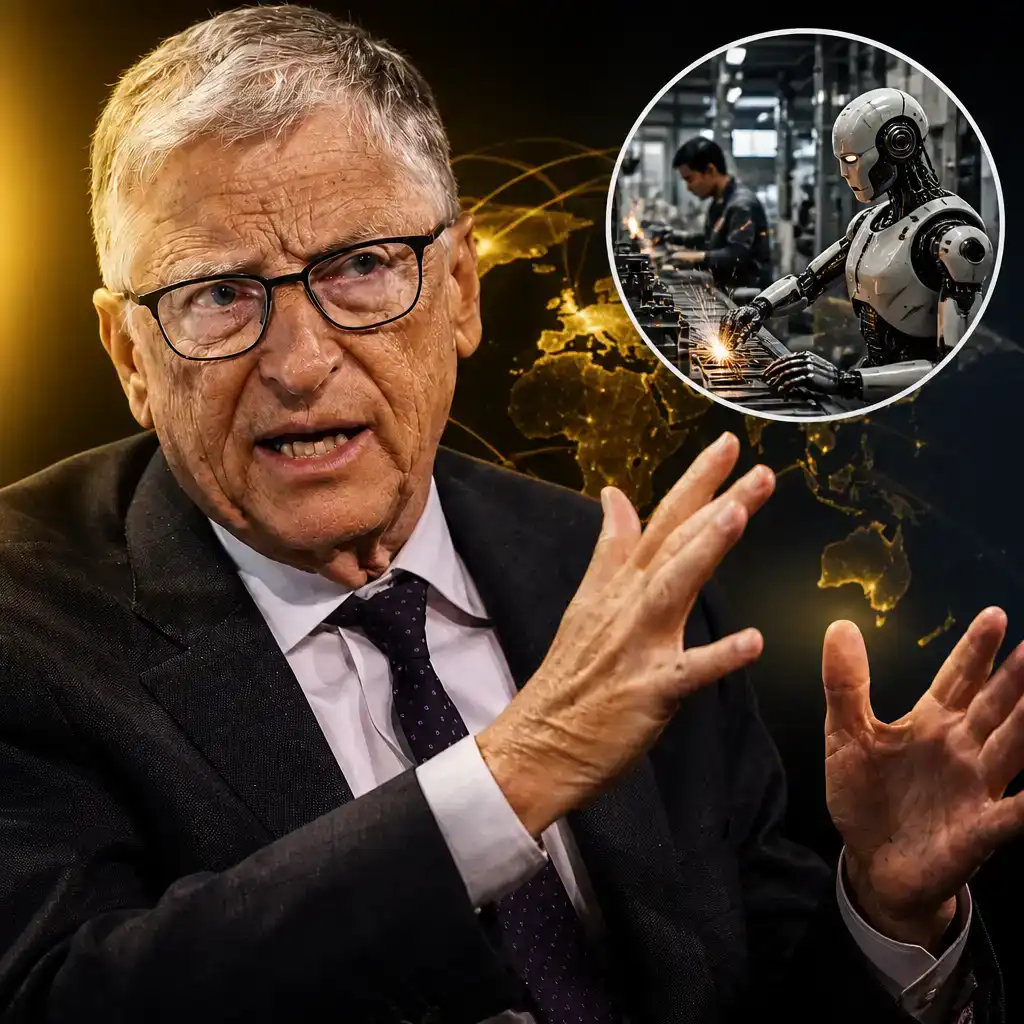
A sweeping new intervention from Bill Gates on AI has turned the Microsoft cofounder from enthusiastic booster into a very wealthy man sounding the alarm. In an essay published on August 26, 2026, Gates argues that governments are badly unprepared for a technological shift that could permanently remove jobs, deepen inequality and create risks that national regulators cannot contain.
The nearly 6,000-word essay, titled The turbulent AI era is here. The choices we make now are critical, is markedly darker than Gates’s optimistic 2023 assessment. Still, he rejects the suggestion that he has become wholly pessimistic. He told The Washington Post that AI’s benefits remain substantial and said the goal should be to secure “a small amount of the bad with the large amounts of the good.”
That is optimism, technically. It just arrives with robot taxes, protected occupations and a request for the United States and China to cooperate before events become less cooperative on their own.
Why does Gates think this technological shift is different?
Gates predicts that the move into an AI-driven economy will rank among “the most turbulent times in human history.” Comparisons with personal computers and earlier innovations are misleading, he argues, because artificial intelligence can improve rapidly and spread across industries at unusual speed.
Current models still make obvious mistakes, but Gates cautions against treating those weaknesses as permanent. Performance problems that appear reassuring today may be “fixed quickly,” leaving governments to regulate systems after companies and workers have already reorganized around them.
“This time really is different,” he wrote. Gates added that if anyone produced a credible international plan to slow development, he would probably support it. The important word is international. A pause by one country would do little if its rivals continued building more capable systems.
His concern also reflects an awkward imbalance in timing. “The good stuff is moving a bit slowly” while much of the harm is “imminent,” Gates told Axios. Medical, educational and productivity gains may take years to reach people broadly. Fraud, disruption and poorly managed automation require rather less patience.
Will AI eliminate jobs or mainly change them?
Gates expects both white-collar and blue-collar workers to face replacement, with many positions disappearing permanently. That is a stronger forecast than the available labor research supports.
The International Labour Organization estimated in 2025 that one-quarter of workers worldwide had some exposure to generative AI. Its conclusion was not that a quarter of humanity should clear its desks. Most affected occupations were more likely to be transformed than eliminated.
The International Monetary Fund estimated in 2026 that about 40% of jobs globally could be affected. Again, exposure includes changed responsibilities, productivity gains and partial automation, not just redundancy.
Research summarized by the Massachusetts Institute of Technology offers a more concrete warning from industrial automation. Each additional robot per 1,000 workers reduced the employment-to-population ratio by roughly 0.2 percentage points and displaced about 3.3 manufacturing workers. That is real damage for the people and communities involved, though it falls short of proving permanent mass unemployment across the economy.
Gates nevertheless wants politicians to act before job losses surge, communities suffer and public trust deteriorates. Waiting for perfect evidence would provide intellectual comfort, but possibly after the payroll has vanished.
How would robot taxes and protected human work operate?
Gates proposes taxing AI tokens and robots to make replacing employees less financially attractive and to raise money for social programs. The token proposal would effectively place a cost on AI usage, while a robot tax would target physical automation.
He also wants governments to establish a category called “Human Reserved,” covering work that should remain the responsibility of people even when machines can technically perform it. Examples reported by The Guardian include:
- Childcare
- Jury service
- Delivering grave medical diagnoses
- Other roles in which human judgment, accountability or empathy matters
The idea recognizes that efficiency is not the only public value. Few patients are likely to welcome life-changing medical news from software simply because it completed the task 14 seconds faster.
Economists have challenged technology-specific taxes before. Dean Baker described Gates’s earlier robot-tax proposal as a “Luddite solution,” while former Treasury secretary Larry Summers called it “misguided.” Critics argue that penalizing particular technologies could reduce investment, productivity and economic growth while encouraging companies to disguise automation in accounting categories regulators have not yet named.
Gates has not resolved those design problems. He acknowledged to The Washington Post that his proposals remain too undeveloped to win endorsements from AI executives. The essay therefore supplies a direction rather than legislation ready for a vote.
What kind of global AI authority does Gates want?
National governments, Gates argues, need dedicated institutions capable of coordinating policy across labor, taxation, education, health and national security. Existing agencies usually focus on one field, while AI has shown the administrative discourtesy of affecting all of them at once.
He also wants countries to create a new international organization for risks that cross borders. Gates offers no detailed structure, enforcement system or membership rules, but points to cooperation on nuclear safety, aviation and protection of the ozone layer as possible models.
“It will be unlike any other institution we have ever created,” he wrote. That may be true, although the absence of a blueprint makes comparison difficult.
Any credible system would require cooperation between the United States and China, the two powers most capable of shaping advanced AI development. Reuters later reported that Gates’s staff were seeking a November meeting with Chinese President Xi Jinping to discuss international controls on AI risks.
That would position Gates as an unofficial technology diplomat at a time when formal relations between Washington and Beijing remain central to any global agreement. He did not explain how either government might be persuaded to accept limits that could constrain its strategic advantage. He did insist that work on the institution should begin now because “we do not have the luxury of moving slowly.”
Why is Gates returning to the AI debate now?
Despite his status in the technology industry, Gates has recently maintained a lower profile in public arguments about artificial intelligence. His association with Jeffrey Epstein may have contributed to that absence. Gates has called those dealings a “huge mistake” and said he hopes they do not overshadow his work on global health and AI.
The new essay marks a deliberate return. Gates said he plans to use his time and influence to put AI and inequality higher on the political agenda, including during visits to Washington, DC, and meetings with world leaders.
The Washington Post reported that he expects to spend most of his time addressing problems created by AI, potentially reducing his focus on the Gates Foundation. He also promised further proposals on limiting harm and more detail about how the foundation is using the technology.
His intervention does not yet amount to a workable global settlement. The taxes lack detailed rules, the protected-job category raises difficult boundary questions, and the international body remains largely conceptual. Yet the shift matters because Gates is no longer treating AI’s benefits as sufficient reason to let deployment race ahead of policy.
“AI will either be the greatest equalizer ever invented, or the worst source of injustice,” he wrote. Governments now have several Gates-approved ideas to consider and, inconveniently, no guarantee that any of them will be ready before the technology is.