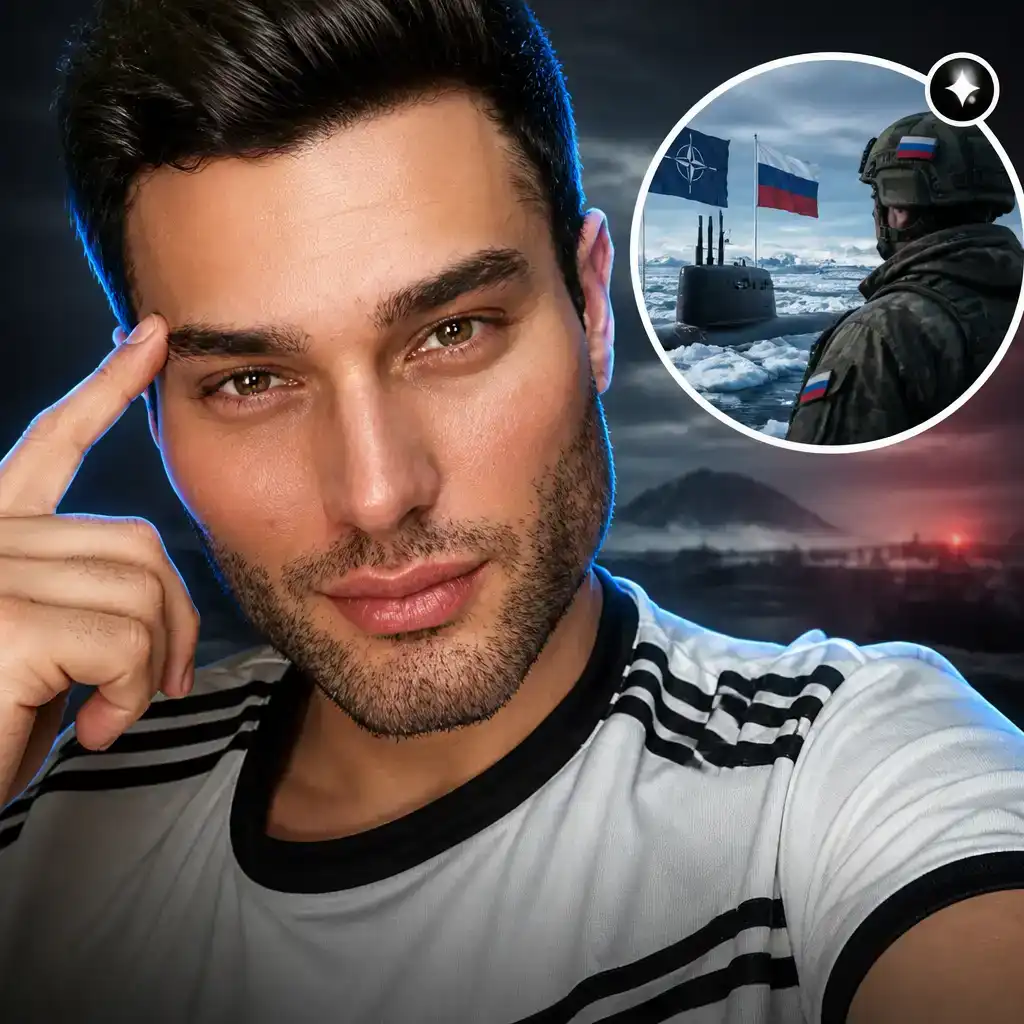
Athos Salomé’s 2026 predictions are back in the spotlight after the Brazilian parapsychologist claimed that two of his 10 forecasts for the year have already been fulfilled. With five months remaining, he is now drawing attention to a darker possibility: a confrontation between NATO and Russia in the Arctic.
The 39-year-old, sometimes described as a “living Nostradamus,” published his predictions shortly before 2026 began. He says his forecasts about worsening conflict in the Middle East and the colors worn by the FIFA World Cup winner have since proved accurate.
Why Salomé believes two forecasts came true
Salomé predicted that tensions in the Middle East would reach a “critical threshold,” with disputes over Iran’s uranium enrichment potentially causing a deeper period of regional instability during the second quarter of 2026.
He now points to President Donald Trump’s war in Iran as evidence that the forecast was correct. The prediction identified a real and longstanding source of international tension, although forecasting trouble in the Middle East was not exactly a high-risk leap.
His second claimed success concerned the 2026 World Cup. Salomé told the Express that the winning nation would be represented by colors associated with fire, which he interpreted as red. Spain subsequently defeated Argentina in the final, leaving him “satisfied” that the result matched his prediction.
The wording allowed for a fairly broad field. Spain, France, Portugal, the Netherlands, Morocco and England’s away kit all featured red, among many other national teams. Still, Spain lifted the trophy, so Salomé is counting it.
Could the Arctic become a NATO-Russia flashpoint?
The forecast now causing Salomé the most concern involves the Arctic Circle. In December, he predicted that NATO and Russia could enter into conflict in the region.
Since then, NATO has launched its Arctic Sentry operation and deployed thousands of soldiers, while Russia has reportedly expanded its military presence in the far north. Salomé believes those developments make a confrontation more plausible.
“The most recent interceptions indicate that Russia is moving missile systems to strategic areas in the Arctic,” he told Tyla.
“This increases the likelihood of direct confrontations with NATO during the ice melt in 2026, a time when new shipping routes and energy reserves could play a crucial role.”
The concern reflects the Arctic’s growing strategic importance. Melting ice can open shipping routes and improve access to energy reserves, giving governments more reasons to compete over territory, security and resources. That does not mean a military clash is inevitable, but it does explain why increased activity in the region is being watched closely.
What else did Salomé predict for 2026?
Salomé also warned that the Sahel region of Africa could face increasingly violent conflict, particularly as extremist organizations strengthen their presence in northern Niger.
“With the rise of extremist groups in northern regions of Niger, I believe that the area could become a scene of indirect confrontation between nations seeking to preserve their influence after the departure of Western troops,” he said.
His remaining forecasts for 2026 include:
- Russia and Ukraine remaining in a military stalemate
- China-Taiwan tensions increasing without leading to an invasion
- More cyberattacks against critical infrastructure and major global events
- Further outbreaks of deadly diseases
- Growing dangers connected to artificial intelligence
- More heatwaves, floods, droughts and water shortages
These predictions cover several risks already monitored by governments and international organizations. Their breadth also makes judging success complicated, particularly when the language describes general trends rather than specific events, dates or locations.
How does Athos Salomé make his predictions?
Salomé says he combines analysis of long-term patterns with his study of Kabbalah. He has previously claimed to have anticipated the Covid-19 pandemic and the death of Queen Elizabeth II.
Those claims have helped build his public profile, but they remain his interpretations of earlier statements. As with his 2026 forecasts, whether a prediction counts as accurate often depends on how narrowly its original wording is read after events unfold.
Salomé himself acknowledges that limitation. He describes his forecasts as “interpretations, not certainties.” That distinction matters, especially when the subject is a possible armed confrontation between nuclear powers rather than a football kit color.