Aaliyah’s legacy remains unusually vivid 25 years after her death, partly because her work still sounds modern and partly because her career ended while it was expanding in nearly every direction. Months before the fatal crash on August 25, 2001, she told E! News that she sometimes reminded her mother, “I’m 22, and I’ve accomplished so much.” Then she added the part that now lands differently: “I just know I have to appreciate every moment.”
The crash froze Aaliyah Dana Haughton at 22, but it did not create her importance. She had already reshaped contemporary R&B, earned major film roles and developed a controlled public image that revealed only what she wanted revealed. Privacy was still possible in pop music then, an almost historical concept.
How did Aaliyah become famous so quickly?
Born in Brooklyn and raised in Detroit, Aaliyah started performing well before adolescence. She sang at weddings at 8, appeared on Star Search at 10 and performed in Las Vegas at 11 alongside Gladys Knight. Knight had briefly been married to Aaliyah’s uncle, record producer Barry Hankerson, during the 1970s.
Her debut album, Age Ain’t Nothing but a Number, arrived in 1994. It eventually sold more than 6 million copies worldwide and received double-platinum certification in the United States. “Back & Forth” and her Isley Brothers cover “At Your Best (You Are Love)” both reached the top 10.
Aaliyah was still attending high school while promoting the record. During a New York television interview tied to her first Apollo Theater performance, she proudly discussed her straight-A report card. She wanted to study music history in college and minor in engineering, though she also intended to remain in entertainment “as long as possible.”
Her brother and frequent creative partner, Rashad Haughton, was central to that life. She called him her best friend. Decades later, he told Vanity Fair that he still treasured the “positive energy” she carried everywhere.
What happened between Aaliyah and R. Kelly?
The success of Aaliyah’s debut cannot be separated from R. Kelly, who wrote and produced much of the album. Nor can that professional relationship be separated from what happened while she was a minor.
Kelly was 27 when he married 15-year-old Aaliyah at a hotel in Rosemont, Illinois, on August 31, 1994. A fraudulent identification card listed her as 18. Her parents had the marriage annulled in February 1995.
In 2019, federal prosecutors charged Kelly with bribing a government employee to obtain the false ID. His former tour manager later testified that Kelly paid a Chicago-area welfare office employee $500 to secure it. Prosecutors argued that Kelly wanted the marriage so Aaliyah could not testify against him in connection with allegations involving sex with minors. Kelly’s attorney said in 2019 that the singer had claimed not to know her real age.
Kelly is now serving federal prison sentences totaling 31 years following convictions involving racketeering, sexual exploitation, child pornography and related crimes.
Aaliyah rarely addressed the marriage publicly. When questioned during her early career, she said she ignored the reports because she could not control what people said. Vibe published the marriage certificate in 1995. Professionally, she moved on, leaving Jive Records for Atlantic Records and ending her work with Kelly.
Why did One in a Million change R&B?
For her second album, Aaliyah teamed with producers Timbaland and Missy Elliott. The result, 1996’s One in a Million, replaced the sound of her debut with sparse percussion, unusual rhythms and relaxed vocals that treated empty space as part of the song rather than a technical problem requiring immediate repair.
The album sold 8 million copies worldwide. Rolling Stone later included it among the essential recordings of the 1990s. Its influence travelled well beyond that decade, particularly through the production style Timbaland developed around Aaliyah’s understated delivery.
Her image was just as deliberate. She often wore sunglasses, loose clothing and minimal styling, presenting herself as calm and self-contained rather than aggressively available for public inspection. “Be yourself,” she told MTV News in 1994. “That’s the best way to go, really.”
She also refused to rush a third album simply because the industry would have preferred one immediately. Instead, she graduated from high school in 1997 with a 4.0 grade-point average, appeared in the Fox drama New York Undercover and became a Tommy Hilfiger model.
At the 1998 Academy Awards, she performed “Journey to the Past” from Anastasia. A year later, “Are You That Somebody?” from the Dr. Dolittle soundtrack earned her first Grammy nomination.
How was Aaliyah building a film career?
Aaliyah made her film debut opposite Jet Li in the 2000 action thriller Romeo Must Die. The film became a sleeper success, earning $91 million worldwide, and The New York Times called her “a natural.”
Its soundtrack produced “Try Again,” her first No. 1 single and the song most closely associated with her career. It brought another Grammy nomination and won two MTV Video Music Awards, for Best Female Video and Best Video from a Film.
Aaliyah then travelled to Australia to film Queen of the Damned, an adaptation of Anne Rice’s novel starring Stuart Townsend as the vampire Lestat. She played Queen Akasha while also recording much of her self-titled third album.
Released on July 7, 2001, Aaliyah introduced a more mature mix of R&B, electronic production and neo-soul. It sold 187,000 copies in its first week, the strongest opening of her career, and debuted at No. 2 on the Billboard 200.
The album had barely begun its commercial run when Aaliyah went to the Bahamas to film the video for “Rock the Boat.” Less than two months after the record’s release, the planned next phase of her career disappeared with her.
What is known about Aaliyah’s final flight?
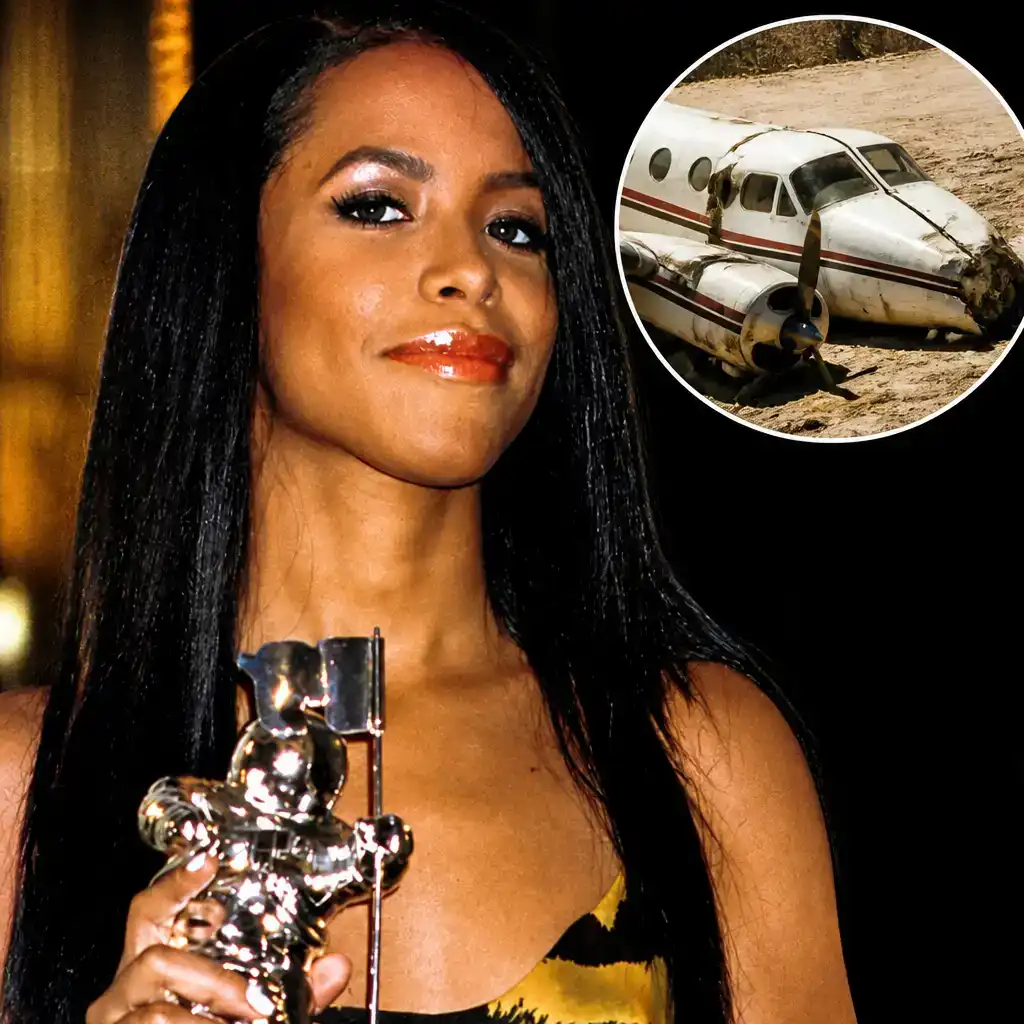
On August 25, 2001, Aaliyah and members of her team boarded a twin-engine Cessna 402B at Marsh Harbour Airport in the Abaco Islands. They were returning to Florida after completing the “Rock the Boat” shoot.
The aircraft crashed and burned a few hundred feet beyond the runway, less than a minute after takeoff. Aaliyah, seven colleagues and pilot Luis Morales III were killed. The other victims were makeup artist Eric Forman, hairstylist Anthony Dodd, security guard Scott Gallin, stylist Christopher Maldonado, Virgin Records video executive Douglas Kratz, and Blackground Records executives Keith Wallace and Gina Smith.
Later reporting cited investigators who found that the aircraft was more than 900 pounds overweight, improperly balanced and carrying one passenger beyond its certification. Morales was not authorized to fly the plane, had falsified records about his experience and tested positive for cocaine and alcohol. Investigators also believed both engines were operating, focusing attention on weight, balance and pilot qualifications rather than mechanical failure.
Aaliyah’s parents later reached an undisclosed settlement in a wrongful death lawsuit against companies involved in operating the aircraft.
Why are accounts of the boarding still disputed?
What happened before takeoff remains less settled than the physical cause of the crash. Damon Dash, Aaliyah’s boyfriend at the time, has said she messaged him, “I don’t like the plane.” He recalled telling her not to board, but said she felt she had to complete the trip connected to the video.
Biographer Kathy Iandoli later repeated a claim from former airport worker Kingsley Russell that Aaliyah resisted boarding, was given an unidentified pill and was carried onto the aircraft while asleep. That account remains unverified.
It also conflicts with early reports suggesting members of the travelling party pushed for departure despite concerns about the aircraft’s weight. The Washington Post cited a Bahamian pilot who alleged that the group argued for takeoff without having the cargo weighed.
Those versions cannot all be treated as established fact. The passage of time has produced more testimony, but not necessarily more certainty, a familiar problem when recollections become part of a public tragedy. What the investigation did establish was already damning enough: the plane was severely overloaded, badly balanced and flown by a pilot who should not have been at the controls.
Dancer Carmit Bachar, who worked on “Rock the Boat,” told Us Weekly that the crash turned the shoot from “the highest of highs” into sudden devastation. Dash has continued to describe Aaliyah as his soulmate.
How did her death change the album’s fate?
News of the crash spread through the music industry within hours. Singer Monica, who had known Aaliyah since 1996, described her as “an easy person to like” and said the loss was bigger than music. Ludacris learned what had happened while onstage and told the audience. Ja Rule said he received the news before performing and initially refused to believe it.
Sales of Aaliyah, which had slipped after its No. 2 debut, rose by 595 percent. The album climbed to No. 1 on the Billboard 200.
Director Hype Williams remembered her as generous and graceful. “She had nothing but love to give to others,” he told MTV News after the crash.
Queen of the Damned reached cinemas in February 2002 and drew harsh reviews. Critics generally agreed that Aaliyah’s largely non-speaking role gave her little material to work with, particularly after the promise she had shown in Romeo Must Die. It was only her second film, though it became her last.
On the first anniversary of the crash, Jay-Z stopped a concert at Detroit’s DTE Energy Music Theater as “Try Again” played. Standing with Dash, he told the crowd, “We love you. We miss y’all.”
Who controls Aaliyah’s music now?
Aaliyah’s recordings did not move smoothly into the streaming era. Most of her catalog remained unavailable on major services for years because of disputes involving its control and release. A wider rollout finally began in 2021, despite opposition from her estate.
The delay kept some of her most important work away from younger listeners during the period when streaming became the music industry’s default archive. Once released, however, the audience was clearly still there. Forbes reported in July 2026 that the self-titled album had passed 497 million streams on Spotify alone.
A promised posthumous album titled Unstoppable remains unreleased. The continuing disagreement over how to distribute and monetize her work has become another part of her story, one Aaliyah herself has no ability to direct.
Her influence is easier to hear than to quantify. The restrained vocals, futuristic production and carefully guarded image that distinguished her in the 1990s became standard reference points for later R&B and pop performers. At 22, she had already made three major albums, scored a No. 1 single and established herself on screen. The tragedy is not that she died before showing promise. It is that she had already delivered on so much of it, with far more plainly underway.