Taylor Swift is putting legal guardrails around the parts of her public identity that AI can now imitate with alarming ease: her voice, her face, and even a very specific Eras Tour pose.
According to online records from the U.S. Patent and Trademark Office, Swift’s company TAS Rights Management filed three trademark applications on April 24. Two of the filings cover sound marks, meaning short audio identifiers tied to a brand or public figure. The third covers a visual image of Swift performing during the Eras Tour.
What Swift’s team filed
The two sound trademark applications are for short spoken phrases closely associated with Swift’s public-facing persona:
- “Hey, it’s Taylor Swift”
- “Hey, it’s Taylor”
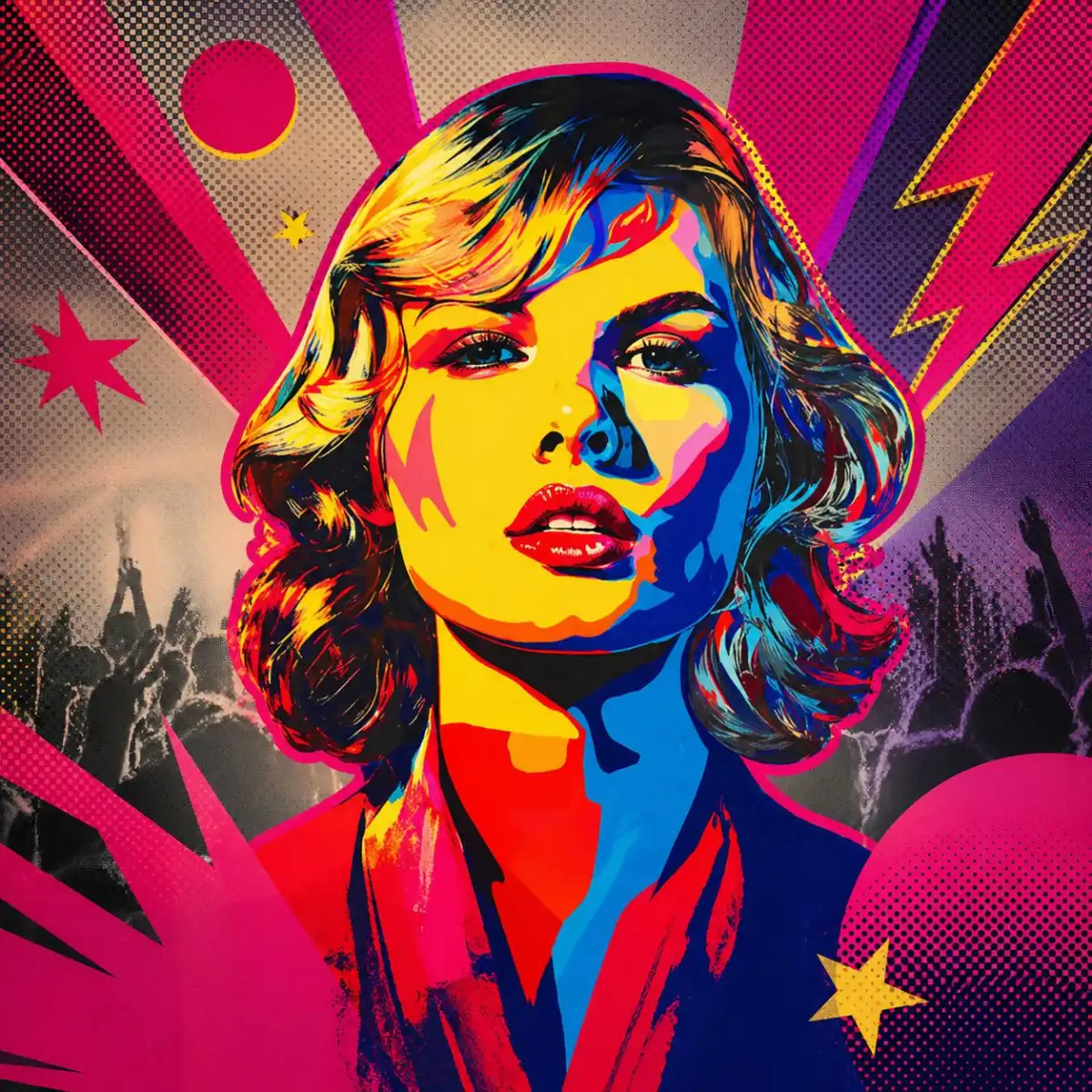
The visual filing centers on a photograph used to promote Taylor Swift: The Eras Tour on Disney+. The application describes Swift on stage “holding a pink guitar, with a black strap” while wearing “a multi-colored iridescent bodysuit with silver boots.”
The description continues: “She is standing on a pink stage in front of a multi-colored microphone,” with “purple lights in the background.”
That level of detail is not decorative. In trademark terms, specificity helps define exactly what is being claimed. In pop terms, it is the legal version of saying: yes, that look.
Why AI is the obvious backdrop
The filings arrive after Swift’s likeness has repeatedly been used in AI-generated material without permission. Those incidents have included AI chatbot depictions, pornographic deepfake images, and fake political content.
In 2024, Donald Trump shared AI-generated images that falsely suggested Swift endorsed his presidential campaign. Swift later addressed the incident in an Instagram post ahead of the U.S. presidential election, explaining why she wanted to be direct with voters.
“Recently I was made aware that AI of ‘me’ falsely endorsing Donald Trump’s presidential run was posted to his site,” she wrote. “It really conjured up my fears around AI, and the dangers of spreading misinformation. It brought me to the conclusion that I need to be very transparent about my actual plans for this election as a voter. The simplest way to combat misinformation is with the truth.”
Swift’s applications do not erase the larger AI problem. They do signal a more aggressive effort to protect the commercial and reputational value of a celebrity identity, especially when synthetic audio and images can be produced and distributed at scale.
Matthew McConaughey made a similar move
Swift is not alone in testing trademark law as a defense against AI misuse.
Earlier this year, Matthew McConaughey filed eight trademark applications with the U.S. Patent and Trademark Office to protect elements of his likeness. Those filings included depictions of the actor smiling and talking while saying “Alright, Alright, Alright,” the line made famous by his character in 1993’s Dazed and Confused.
The applications also included audio of McConaughey saying, “Just keep livin’, right? I mean, what are we gonna do?”
McConaughey explained the thinking in January, telling The Wall Street Journal: “My team and I want to know that when my voice or likeness is ever used, it’s because I approved and signed off on it. We want to create a clear perimeter around ownership with consent and attribution the norm in an AI world.”
The legal idea behind the strategy
Josh Gerben, an intellectual-property attorney at Gerben IP, wrote in an April 27 blog post that Swift’s filings point to a broader change in how public figures may use trademark law.
Gerben, who is not affiliated with Swift, wrote: “Swift’s trademark filings suggest a broader shift in how celebrities are applying trademark law to fight back against AI.”
He noted that artists have traditionally relied on copyright to protect songs, while a person’s image or likeness has generally been covered by right of publicity laws. AI, he argued, has complicated that old structure.
“Now, anyone can spin up a version of an artist’s voice, have it say anything, attach it to anything, and distribute it at scale,” Gerben wrote. “And the scary part? It doesn’t have to be an exact copy to cause damage.”
That is where trademark law may become useful. As Gerben put it: “Trademark law doesn’t just stop identical uses (like copyright law): it stops anything that is confusingly similar to the registered trademark. That’s a much broader right and more powerful tool in an AI world.”
For Swift, the move fits a long-running pattern of tight control over her work, image, and business rights. This time, though, the issue is not a master recording or a concert film rollout. It is whether a global star can keep synthetic versions of herself from speaking, posing, or endorsing things she never approved.