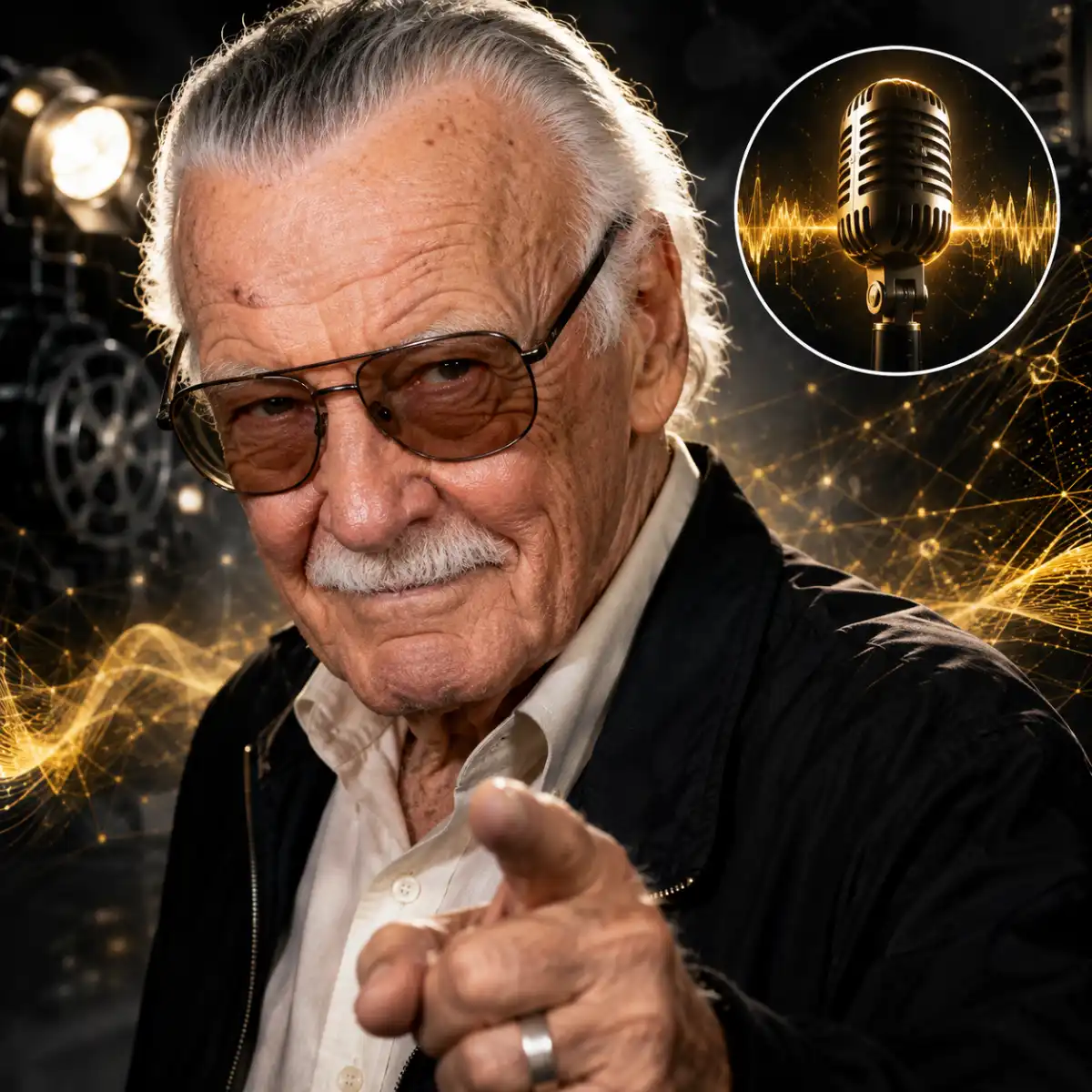
Stan Lee could once again sound — and potentially look — like Stan Lee long after his death, thanks to an artificial intelligence licensing deal that immediately raises an obvious question for Marvel fans: are the cameos coming back?
The late Marvel figurehead’s voice and likeness have been recreated through a partnership between AI company ElevenLabs and Stan Lee Universe, the rights-holding venture that manages his name, image and other intellectual property. His synthetic voice is now available through ElevenLabs’ Iconic Marketplace, where approved commercial projects can seek to license it.
That does not mean Marvel Studios has announced a digitally resurrected Lee wandering through its next superhero film. It does, however, make that prospect rather less theoretical than it was before.
Stan Lee’s voice is now available for commercial licensing
ElevenLabs announced the partnership with Stan Lee Universe on May 27, saying Lee’s recreated voice had been built using professional recordings intended to preserve his distinctive delivery. It is available through both the company’s Iconic Marketplace and its Eleven Reader app.
The Marketplace is the more consequential part of the arrangement. It allows companies to request licences for recognisable voices, with commercial projects subject to approval from the relevant rights holder rather than simply giving anyone unrestricted access to a celebrity impersonation.
Lee’s likeness is also being incorporated into ElevenLabs’ Creative Templates. Ordinary users are limited to personal, non-commercial uses under approved safety guidelines, while commercial use of his likeness can be licensed through the Stan Lee Universe team.
Chaz Rainey, a lawyer and board member for Stan Lee Universe, framed the technology as an extension of Lee’s unusually close relationship with his audience.
“Stan always believed in meeting his fans where they were,” Rainey said, adding that fans had long described hearing Lee’s voice in their heads while reading his comics.
There is already a practical example. ElevenLabs has launched a Stan Lee Book of the Month Club, beginning with Robert Louis Stevenson’s Treasure Island, while users of Eleven Reader can hear other material narrated using the recreated voice.
Does this mean Stan Lee can appear in Marvel movies again?
Technically, the route for that possibility existed before the ElevenLabs announcement.
In 2022, Stan Lee Universe signed a 20-year licensing agreement with Marvel Studios covering Lee’s name, voice, likeness and signature for future film and television productions. The agreement also covered the use of existing footage and audio, along with broader rights for Disney theme parks, resorts and other experiences.
In other words, Marvel already obtained permission to use Lee in future screen projects. ElevenLabs now provides another technological mechanism capable of recreating aspects of his performance.
Those two facts together make an AI-assisted cameo possible in a way that is difficult to ignore. They do not, however, amount to confirmation that Marvel intends to make one.
Neither the ElevenLabs announcement nor the earlier Marvel agreement identified a particular movie, Disney+ series or other production in which a recreated Lee would appear. The new partnership is therefore better understood as expanding what rights holders can do, rather than announcing what Marvel will do.
The distinction may disappoint anyone already picturing an AI Stan Lee complaining about interdimensional parking in the next Avengers film, but it is a fairly important one.
Why the cameo question matters so much
Lee died in November 2018 at the age of 95, after decades as one of the most recognisable figures associated with Marvel. Beyond his work helping create or develop characters including Spider-Man, the X-Men, Iron Man, Thor and the Hulk, his brief screen appearances eventually became a ritual of their own.
By the height of the Marvel Cinematic Universe, viewers were actively waiting for the moment Lee would turn up: as a bus driver, security guard, bewildered bystander or some other character who generally seemed blissfully unaware that superheroes were busy destroying the scenery around him.
That tradition gave Lee a peculiar place in Marvel films. His cameos were not usually relevant to the plot, but removing them after his death was immediately noticeable because audiences had been trained to look for him.
Artificial intelligence now creates the possibility of continuing that tradition without relying exclusively on archived footage. It also creates a more uncomfortable question: when does preserving somebody’s public persona become creating new performances on their behalf?
Stan Lee Universe has presented the ElevenLabs partnership as an attempt to protect and extend Lee’s legacy rather than simply imitate him. Rainey said the technology offered a way to keep Lee’s “voice, his image, his love of storytelling” available to fans while remaining faithful to who he was.
The technology is ready before Marvel has made the decision
Lee is hardly the only famous figure whose identity is being brought into commercial AI systems. ElevenLabs’ marketplace includes voices connected to living and deceased celebrities and historical figures, illustrating a rapidly developing business in which estates and rights holders can authorise synthetic performances rather than leaving AI replicas entirely to unofficial creators.
For Marvel, however, Lee presents an unusually sensitive case. His cameos worked because audiences knew there was a real person behind them — a man visibly enjoying the strange second career that came with watching characters he helped popularise become Hollywood’s dominant superheroes.
An AI version could reproduce the voice, glasses and timing. Whether audiences would regard that as another affectionate cameo or something fundamentally different is a question technology cannot settle.
For now, Marvel has the licensing rights, Stan Lee Universe has embraced AI recreation, and ElevenLabs has built the tools. A new MCU cameo has not been announced.
But for the first time since Lee’s final filmed appearances, the question is no longer whether Marvel could bring him back. It is whether it decides that it should.