The Scottish FA has withdrawn support for Gianni Infantino, saying it has lost confidence in the FIFA president and will not back his bid for another term in 2027.
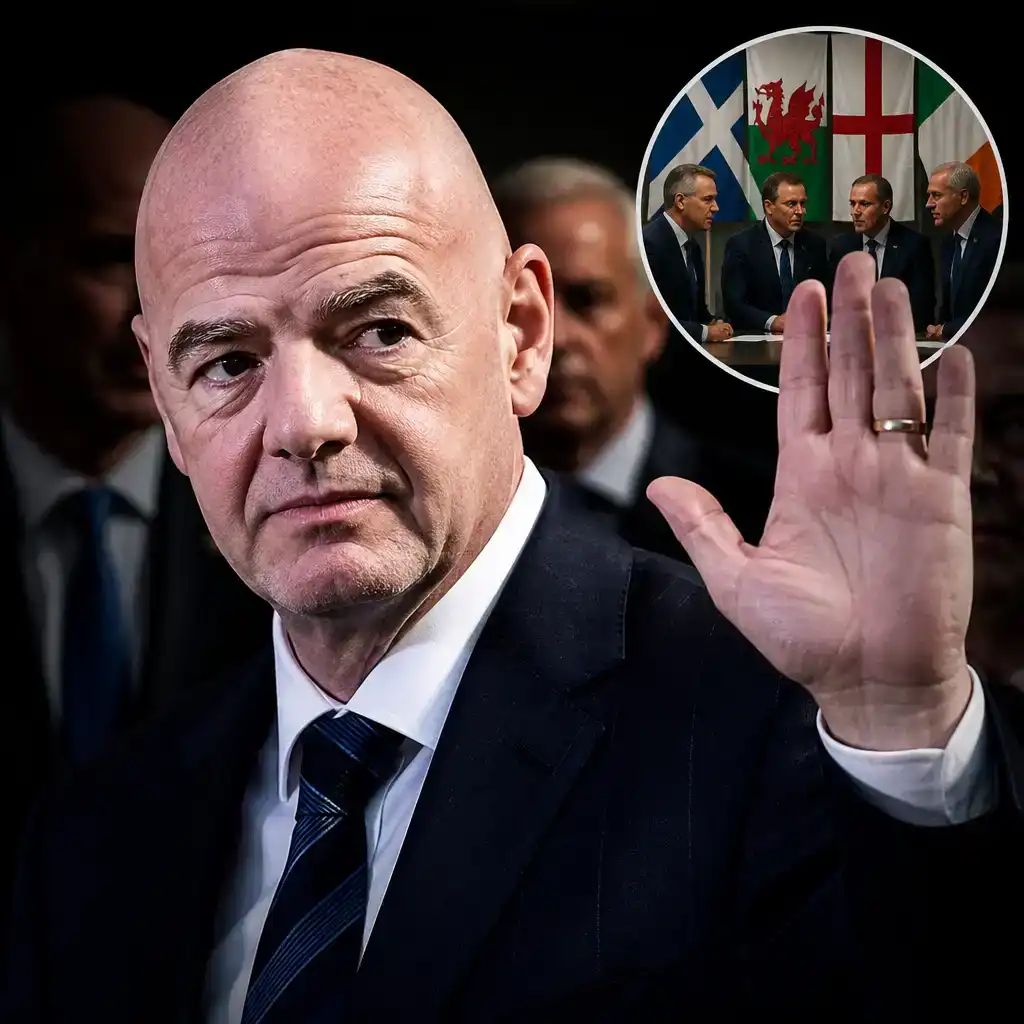
Ian Maxwell, chief executive of the Scottish Football Association, confirmed the decision while announcing Belgian coach Sebastian Pocognoli as Scotland’s new head coach. Scotland now joins England, Wales and the Republic of Ireland in publicly opposing Infantino’s re-election.
“The position of the SFA has been clear since the 55 UEFA associations met,” Maxwell said. “We have aligned ourselves with the UEFA position and 55 nations are stronger than one voice.”
He added that UEFA’s subsequent statement expressed a lack of confidence in FIFA’s leadership, a conclusion the Scottish FA “agree completely with”.
“The SFA will not be voting for Gianni Infantino come the re-election in early 2027,” Maxwell said.
Why has the Scottish FA turned against Infantino?
The dispute centres on Infantino’s abandoned attempt to create FIFA Forward Enterprise, known as FFE. The proposed company would have controlled commercial and ticketing rights across FIFA competitions, including the World Cups, with a 21% stake sold to a private investment company.
The plan attracted extensive criticism from several regional confederations, led by the Union of European Football Associations. UEFA has threatened to boycott FIFA competitions if the governance crisis remains unresolved, which is not the sort of response usually associated with a routine commercial restructuring.
Maxwell rejected the suggestion that Scotland had previously avoided a public break with Infantino because Scottish FA president Mike Mulraney chairs FIFA’s finance committee. He said the association’s position had already been established through its alignment with UEFA’s 55 members.
Infantino is expected to seek a fourth election victory in March 2027. England, Wales and the Republic of Ireland have already said they will not support him.
Can Infantino legally seek another term?
FairSquare, a non-profit organisation campaigning for accountability in sport, has separately asked FIFA’s governance, audit and compliance committee to rule Infantino ineligible.
Its argument is straightforward: FIFA’s statutes allow a president to serve three four-year terms, setting a maximum of 12 years. Infantino took office in 2016 after replacing Sepp Blatter, won election again in 2019 and secured another term in 2023. If he remains president until 2031, he will have held the position for 15 years.
The dispute concerns his first period in office. Infantino completed the remainder of Blatter’s term between 2016 and 2019. In 2022, he successfully argued before FIFA’s governance, audit and compliance committee that this period should not count because it was shorter than four years.
FairSquare says that interpretation defeats the purpose of the term-limit rule. In a letter to the three members of FIFA’s review committee, the organisation said the exemption “clearly violates the letter and purpose of the FIFA statutory provision on presidential term limits”.
It also argued that the decision lacked a clear legal basis, was made without transparency and came with no published reasoning. FairSquare questioned why the FIFA Council granted the exemption rather than the FIFA Congress, and why no written justification has appeared since. FIFA’s governance structure has once again produced a question to which FIFA has not supplied a convenient document.
What have the regional confederations said?
UEFA, the Confederation of North, Central America and Caribbean Association Football, and the Asian Football Confederation escalated the pressure last week in a joint open letter.
Signed by the presidents and general secretaries of all three bodies, it accused FIFA and Infantino of damaging trust “through deception”. The letter did not identify Infantino by name, but said the controversy concerned “the integrity of the game, and the integrity of those elected to lead it”.
Sources said the statement should be understood as an opportunity for Infantino to resign and leave office with dignity.
FIFA has promised to present a report on FFE at the next FIFA Council meeting, expected in October. The three confederations said an internal report was insufficient, arguing that such a “profound lack of judgement” required an investigation by a fully independent third party.
UEFA has also issued a legal warning instructing FIFA not to delete or destroy documents connected to the abandoned proposal.
Preliminary discussions have taken place among the three confederations about possible breakaway competitions if Infantino stays in office. Those conversations have not yet developed into substantive negotiations, according to other sources.
Does Infantino still have enough support?
The opposition is substantial, but FIFA has 211 member associations and the voting picture remains uncertain. No rival candidate has yet declared a campaign ahead of the November 18 deadline.
The African, South American and Oceanian confederations have backed Infantino. Even so, several national associations have rejected their regional position.
- New Zealand will not follow the Oceania Football Confederation’s endorsement.
- Mexico, Grenada, and St Kitts and Nevis have separated from the other 32 Concacaf members by supporting Infantino.
- Eight of the Asian Football Confederation’s 46 members have backed him: the United Arab Emirates, Qatar, Sri Lanka, Lebanon, Kuwait, Mongolia, the Philippines and Bhutan.
The 37-member FIFA Council, consisting of Infantino and 36 confederation or national association leaders, appears similarly divided.
That creates a broader problem beyond the election itself. Infantino could still win a vote among FIFA’s full membership while lacking enough political support to govern effectively. Securing office and exercising authority are related tasks, but apparently FIFA may soon test how separate they can become.
When will UEFA’s boycott threat be tested?
The first practical test is approaching quickly. The FIFA Under-20 Women’s World Cup is due to begin in Poland in just over three weeks, with five other European countries taking part, including England.
Any withdrawal would move the dispute from letters, committee meetings and legal arguments into an actual FIFA tournament. For now, UEFA’s boycott remains a threat rather than a confirmed plan.
Infantino therefore faces pressure on several fronts: national associations withdrawing support, three major confederations questioning FIFA’s leadership, a formal challenge to his eligibility and continuing demands for an independent investigation into FFE.
He also still has influential allies and no declared opponent. The election remains difficult to predict, but Scotland has now made its position unusually clear: whatever happens next, its vote will not go to Infantino.