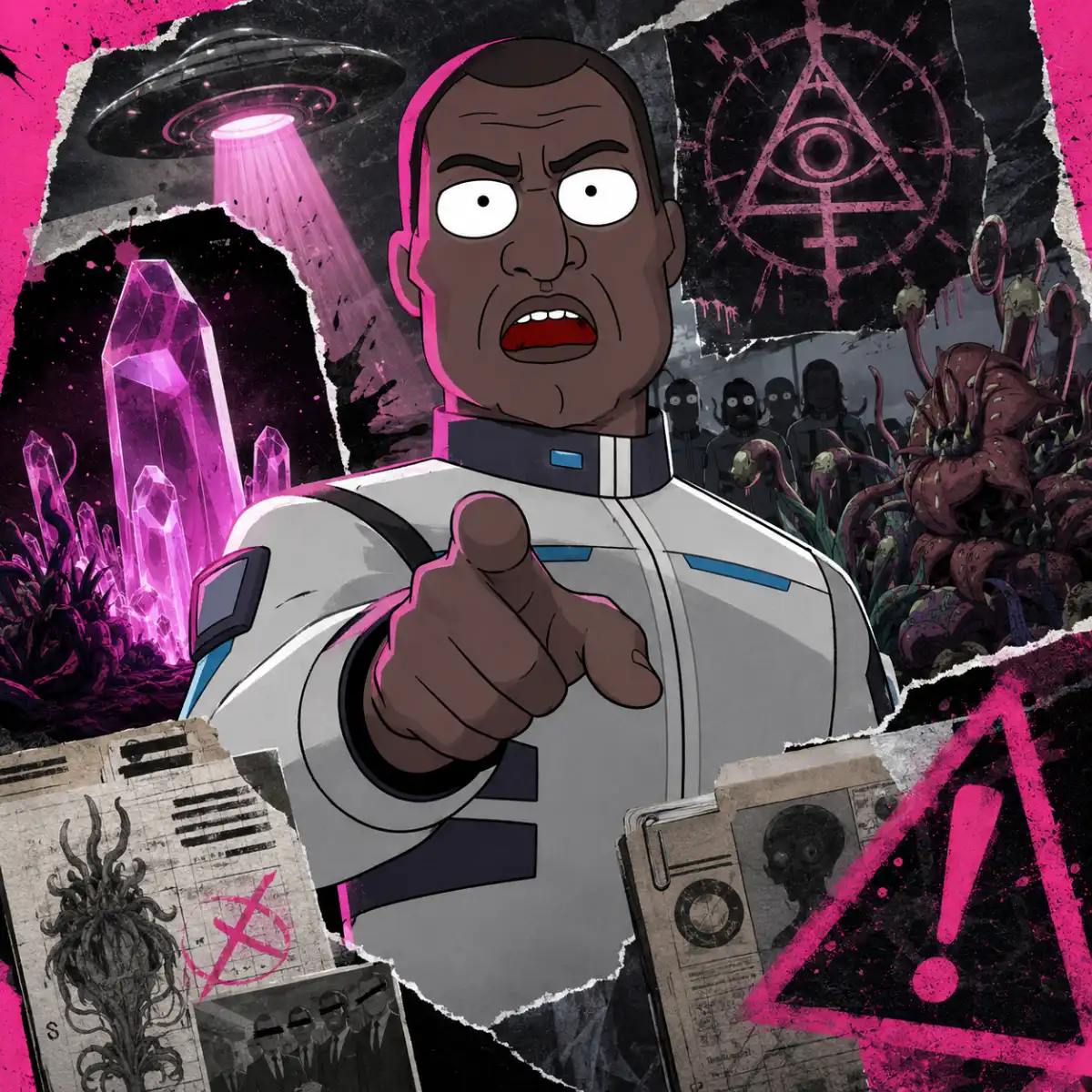
When Rick and Morty season 9 wraps on July 26, Adult Swim is not giving viewers much time to sit quietly with whatever animated damage has just occurred. The same night brings President Curtis, a new spinoff centered on U.S. President Andre Curtis, voiced by Keith David, as he tries to keep the country functioning while occult and alien threats make that job even less reasonable than usual.
The series moves one of Rick and Morty's recurring political foils into the lead role. That shift matters because Curtis has usually been defined by his clashes with Rick Sanchez. Here, he gets a staff, a mission, and, apparently, a slightly better moral compass. A modest promotion, by television standards.
Do viewers need to know Rick and Morty first?
Not really, though longtime viewers will recognize the setup faster. Rick and Morty appear in the premiere, which was shown at Annecy Festival, but their cameo is mostly there to make a self-aware joke about spinoffs and how much fuel remains in their own long-running series.
Beyond that, the new show is built around Curtis and a fresh group of characters with their own stories. The idea is not simply to park Rick and Morty in the background while another character borrows the lighting.
Harmon also said Curtis has been adjusted for the spinoff so audiences can spend more time with him without rooting for immediate constitutional collapse.
“He's a much better person,” Harmon said. “He's less motivated by the numbers than he is in the Rick and Morty universe, where we see him sort of betray himself and others for likes and subscribes.”
That is a meaningful change for a character who has often functioned as a rival, obstacle, or political punchline. The spinoff needs him to be flawed, not hollow.
What is President Curtis actually about?
If Rick and Morty is a family sitcom filtered through Doctor Who, President Curtis is being positioned as a workplace comedy with the paranormal-government energy of The X-Files. Instead of bouncing through infinite universes with Rick's usual disregard for consequences, Curtis and his team are dealing with strange threats on Earth, where the paperwork presumably survives.
Curtis is joined by chief of staff Banks, voiced by Stephanie Beatriz. Banks is a cyborg who can download new skills directly into her brain, which is one way to make onboarding more efficient. The team also includes Special Agent O'Doyle, voiced by Jim Rash, a half-leprechaun bodyguard who can read auras and carries specialized ammunition for monsters.
Harmon said the central trio was designed to balance each other in the spirit of Captain Kirk, Spock, and McCoy from the original Star Trek. But he did not want the characters divided into simple boxes, with one being all logic and another being all emotion.
Banks is the most idealistic about public service. O'Doyle believes strongly in hierarchy and distrusts deception and magic because of his own history with it. Curtis, meanwhile, is a recently divorced former Marine who will do whatever he thinks is necessary to protect the United States and, when required, the world.
How does Curtis differ from Rick Sanchez?
The biggest difference is power. Curtis and his team have access to advanced technology and magical tools, but they are not Rick Sanchez. They cannot wreck a universe and casually decamp to another one when the consequences become inconvenient.
Co-showrunner James Siciliano framed Curtis as someone who rejects political gamesmanship in favor of direct action.
“He's an outside-the-system guy,” Siciliano said. “He doesn't believe in playing 4D chess with this shit. He doesn't believe in playing politics. He's dedicated to the job.”
That difference gives the show a different emotional engine. Rick and Morty often leans into cosmic scale and existential detachment. President Curtis keeps the threats closer to home, which makes the stakes feel less abstract for its lead character. If something goes wrong, Curtis cannot wave it away as one timeline among many.
“It’s still weird sci-fi action, but we’re able to do more terrestrial things,” Siciliano said. “Rick and Morty can be nihilistic and nothing matters because it’s multiversal. This show is more grounded, and because of Curtis’ job, everything matters so much to him.”
For viewers, that could be the real hook: the chaos remains strange, but the consequences are harder to shrug off.
What kinds of stories will the spinoff tell?
The pilot sends Curtis into conflict with the CIA over a cover-up tied to what really happened during the first moon landing. That is very much the show's lane: government institutions, historical weirdness, and supernatural or science-fiction threats colliding in ways that probably do not appear in civics textbooks.
Other planned episodes involve:
- Occult rituals at Camp David
- A secret prison in the Bermuda Triangle
- France trying to renegotiate the Louisiana Purchase
That range gives the series room for monster-of-the-week stories, political satire, and workplace tension. It also lets the show stay on Earth while still indulging in the kind of absurd escalation Rick and Morty audiences expect.
The supporting cast is central to that formula. Banks brings public-service idealism and cybernetic problem-solving. O'Doyle brings loyalty, suspicion, aura-reading, and monster ammunition. Curtis brings force of will, military background, and a tendency to treat impossible crises as part of the job description.
When and where can viewers watch it?
President Curtis premieres at 11:30 p.m. ET on July 26 on Adult Swim, immediately after the Rick and Morty season 9 finale. The episode will be available on HBO Max the next day.
That timing makes the spinoff feel less like a distant promise and more like a handoff. One series closes its season, then another steps forward with Keith David's president facing a very different version of animated catastrophe. Same universe, new office, slightly more government stationery.