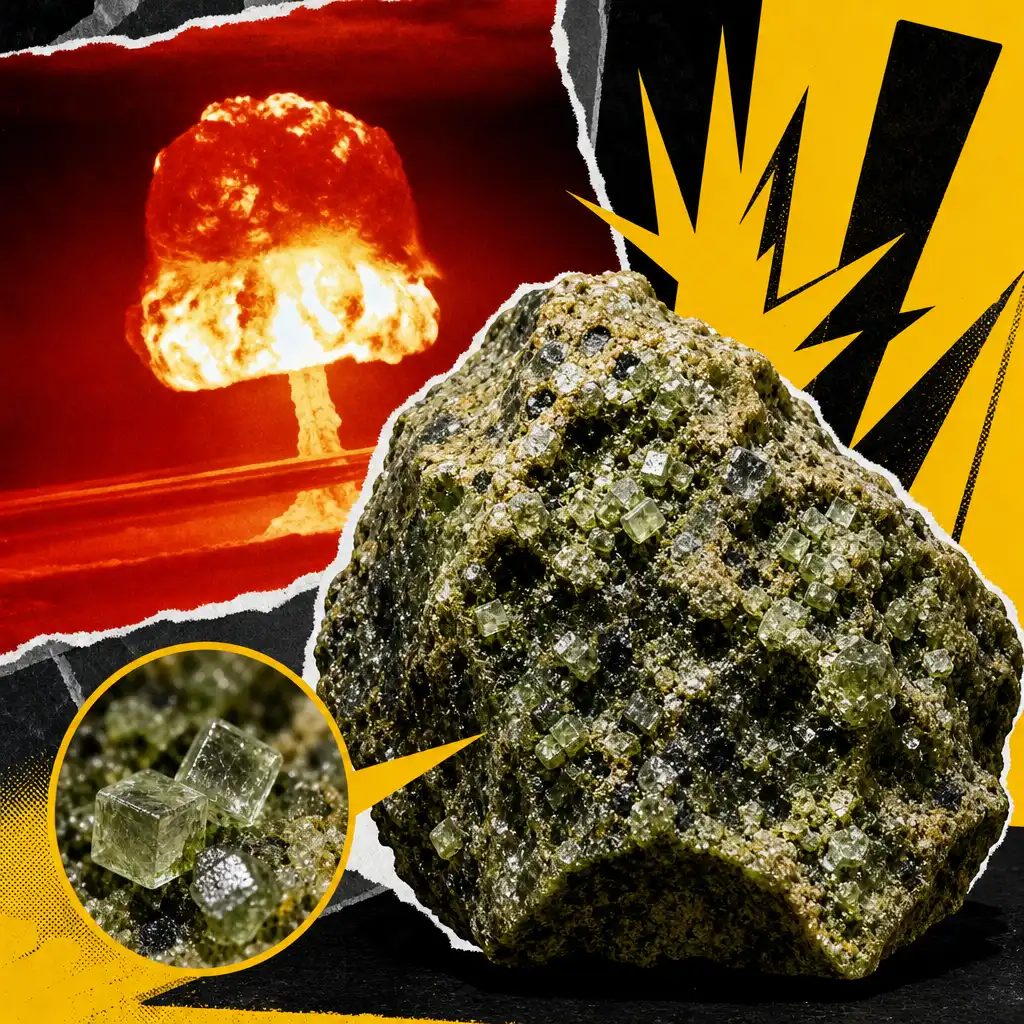
The new material from first nuclear explosion was not found in a dramatic new crater or a hidden government vault. It turned up inside trinitite, the glassy residue left behind after the United States detonated the first atomic bomb in the New Mexico desert on July 16, 1945.
That test, known as the Trinity Test, was carried out as part of the Manhattan Project. The plutonium bomb released an explosive force equivalent to about 25 kilotons of TNT, changing history in ways that hardly need extra decoration. It also, researchers now say, created something no one had previously seen in nature or made in a lab.
What the Trinity Test left behind
After the blast, the heat fused desert sand with vaporized sensor wires and other material from the test site. Scientists named the resulting glass-like substance “trinitite,” after the test itself.
For decades, trinitite has been studied as a physical remnant of the first atomic explosion. In this case, researchers examined a red trinitite sample about 1 centimeter wide. Hidden within it was a copper-rich metallic droplet, and inside that droplet they identified the newly described crystal.
The study was co-authored by Luca Bindi, a geologist at the University of Florence. The finding suggests that the extreme conditions produced by the blast did more than melt the landscape. They created a structure that had not been documented before, which is a very specific kind of scientific surprise, rather than the usual kind one hopes not to receive from a nuclear weapon.
Why the crystal is unusual
The material is described as a clathrate, a type of crystal known for cage-like structures. These cages typically have 12 to 14 sides and can trap atoms or molecules inside them.
In this case, the structure involves elements including silicon, calcium, copper and iron. That arrangement gives clathrates distinctive properties and makes this discovery especially notable because the crystal does not match anything previously observed in natural settings or produced in laboratory conditions.
Bindi described the find in plain terms: “It’s a completely new kind of clathrate crystal. Something never seen before in nature or in the products of a nuclear explosion.”
That last part matters. Scientists have studied the products of nuclear blasts before, but this particular crystalline structure appears to have formed spontaneously under the short-lived, extreme heat and pressure of the Trinity detonation.
What it says about extreme events
The researchers argue that the discovery adds to a broader scientific idea: rare, violent events can produce materials that ordinary conditions never would.
As the authors put it, “This work underscores how rare, high-energy events such as nuclear detonations, lightning strikes, and hypervelocity impacts, serve as natural laboratories for producing unexpected crystalline matter.”
That does not make nuclear explosions a research method anyone should be eager to repeat. It does, however, show why scientists keep returning to samples from historic events. Materials forged in those moments can preserve information about pressures, temperatures and reactions that are difficult, or unwise, to recreate.
Nearly eight decades after the Trinity Test, its residue is still yielding discoveries. The human history attached to that morning in 1945 remains grim and enormous. The science, meanwhile, keeps finding small, strange details inside the aftermath.