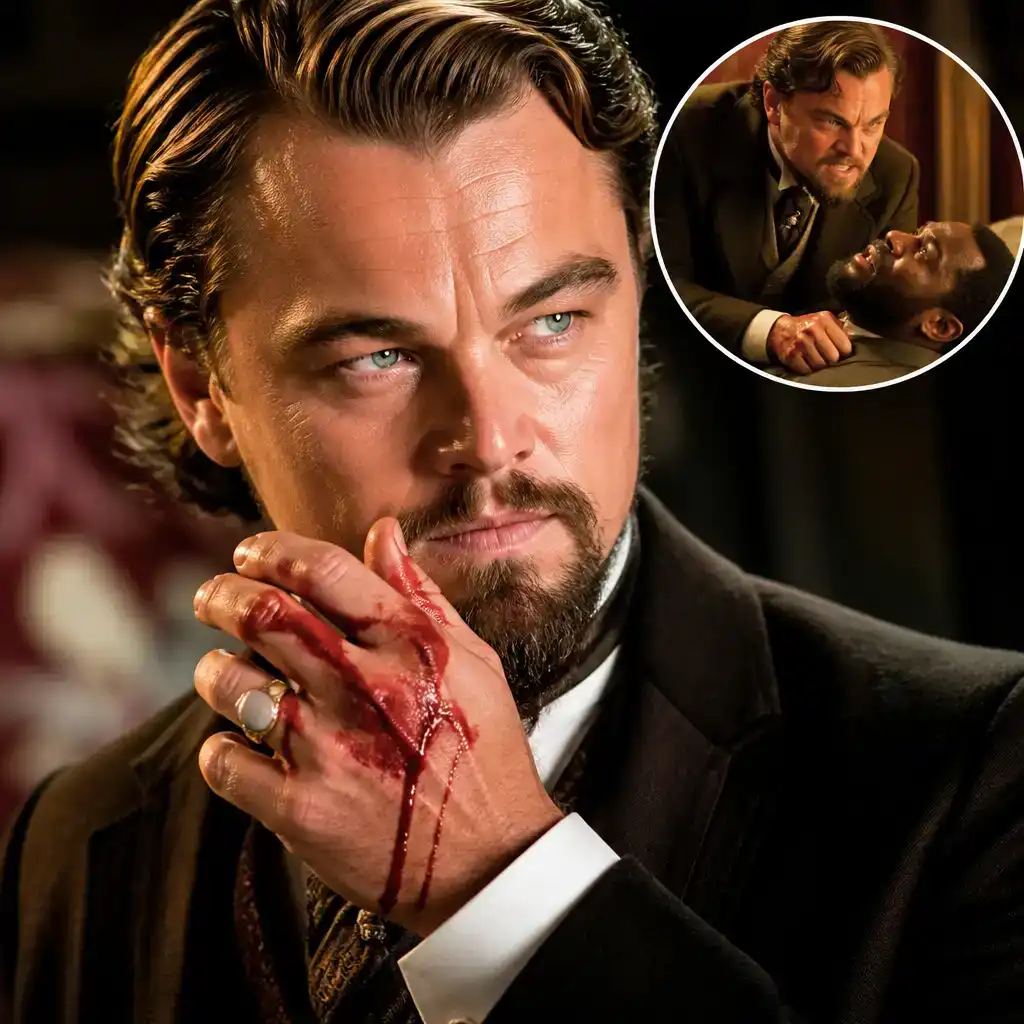
One of the most unsettling moments in Django Unchained was not entirely acting. During Leonardo DiCaprio's explosive dinner-table performance as plantation owner Calvin Candie, the actor struck the table, shattered a crystal glass and badly cut his hand — then carried on while the cameras kept rolling.
The blood visible during that part of the scene was real.
Rather than immediately breaking character, DiCaprio continued through Candie's furious monologue as his hand bled, turning an already uncomfortable sequence into something even more volatile. Quentin Tarantino ultimately kept footage from the accident in the finished film.
It has since become one of the most famous examples of an on-set accident unexpectedly strengthening a performance — although the scene hardly needed additional tension.
DiCaprio shattered the glass during Candie's dinner-table speech
The accident happened during the lengthy confrontation at Candie's plantation, Candyland, as Django, played by Jamie Foxx, and Dr King Schultz, played by Christoph Waltz, see their plan to rescue Broomhilda, played by Kerry Washington, begin to unravel.
DiCaprio's Candie has realised that his guests are not being honest about why they have come to his home. What follows is a threatening monologue delivered across the dinner table, with Candie increasingly using intimidation to reassert control over the room.
During the performance, DiCaprio slammed his hand down hard enough to break a crystal glass beneath it. The glass cut his palm and he began bleeding.
Stopping would have been the obvious response. DiCaprio did the opposite.
He continued the scene in character, incorporating the sudden injury into Candie's already escalating anger rather than allowing the accident to interrupt the take. The result is unusually difficult to separate from the fiction: Candie's physical aggression is performed, but the injury accompanying it is not.
DiCaprio later required treatment for the cut, but the footage survived the editing room.
The real injury made an already disturbing performance more unpredictable
The accident works on screen because it happens at precisely the point when Candie is supposed to appear most dangerous.
DiCaprio does not suddenly play the scene as an injured actor. He continues playing a man furious at losing control of a negotiation, allowing the bleeding hand to become part of the character's physical presence.
That distinction is important. The effectiveness of the sequence is not simply that an actor was injured while filming it; movie sets have produced more than enough injuries without improving the movies concerned. It is that the accident coincided almost perfectly with what the scene was already trying to achieve.
The viewer sees Candie becoming increasingly aggressive while something genuinely unexpected has happened to the performer playing him. That instability gives the sequence an uncomfortable immediacy that would have been difficult to manufacture deliberately.
There is also a possible physiological explanation for DiCaprio's ability to continue despite the injury. Acute stress and adrenaline can temporarily reduce the perception of pain, an effect sometimes described as stress-induced analgesia.
That does not establish exactly what DiCaprio experienced in the moment. But it offers a plausible explanation for how someone can sustain an obvious injury during an intense activity and only fully register the pain once the immediate situation has passed.
Candie's phrenology speech makes the scene darker still
The blood is only one reason the dinner sequence remains so uncomfortable.
Candie is also delivering an argument based around phrenology, the discredited belief that supposed aspects of intelligence, personality and behaviour could be inferred from the shape and physical characteristics of the human skull.
Within the film, Candie uses that pseudoscientific framework to rationalise racist ideas about slavery and obedience. Tarantino is not presenting the argument as credible science; the point is precisely the opposite. Candie's speech illustrates how claims dressed up as intellectual authority can be used to justify brutality.
The scene therefore operates on two levels at once. Candie is threatening the people sitting across from him while attempting to give his worldview the appearance of scientific legitimacy.
Then DiCaprio's hand begins genuinely bleeding in the middle of it.
The accident does not change what the sequence is about, but it intensifies its physical ugliness. A monologue built around violence, racial pseudoscience and control suddenly has an unscripted wound sitting in the centre of the frame.
Why Tarantino kept the moment in Django Unchained
Directors normally have several good reasons to abandon a take when an actor is injured. Safety tends to outrank dramatic authenticity, as it should.
In this case, however, the performance had continued through the accident, leaving Tarantino with footage that could still be used once DiCaprio had received medical attention.
Keeping it preserved something a recreated version would have struggled to reproduce: the instant in which neither DiCaprio nor the other performers could know exactly what was going to happen next.
That uncertainty is visible in the finished scene. DiCaprio remains forceful and controlled as Candie even while dealing with an injury that was never supposed to be part of the sequence.
More than a decade after Django Unchained was released, the story survives because it is the rare piece of movie trivia that genuinely changes the way a scene looks once you know it. The next time Candie brings his hand crashing down on the dinner table, there is no special effect to spot and no carefully rehearsed illusion to admire.
For a few moments, the violence on screen had produced a very real consequence — and DiCaprio simply kept performing.