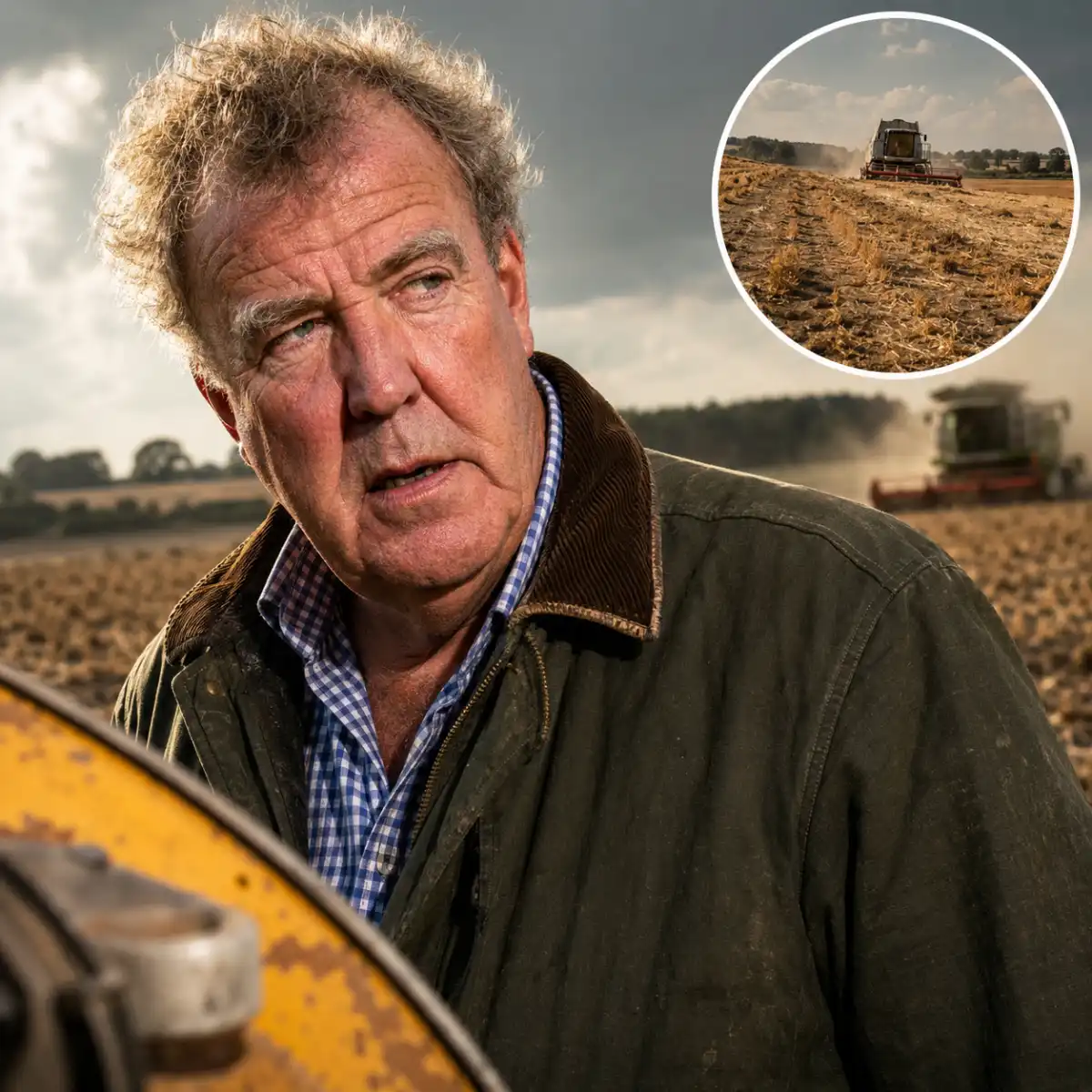
Jeremy Clarkson’s farm update has delivered a blunt assessment of the harvest at Diddly Squat after weeks of punishing heat and little rain. Sharing a weather forecast on Instagram, the 66-year-old said his crop was “already f***ed” and added: “May as well just enjoy it now.”
The screenshot showed temperatures reaching 29C in Chipping Norton on August 9, remaining at 28C at 5pm, with another warm week ahead. For most people, that means uncomfortable sleep and renewed negotiations with an electric fan. For farmers, it can mean smaller crops, lower-quality produce and serious financial losses.
Clarkson bought the 1,000-acre Oxfordshire farm in 2008 and began running it himself in 2019. Since then, Diddly Squat has expanded to include a farm shop and pub, while Clarkson’s Farm has turned difficult harvests, planning disputes and livestock emergencies into popular television.
How severe is the drought affecting British farms?
July 2026 was the driest July in England and Wales since records began in 1836, according to the Met Office. Across the UK as a whole, it was the third driest July, as well as the second warmest and sunniest on record.
By the middle of July, Britain had already recorded more days above 30C in 2026 than during the whole of 1976. That prolonged heat has dried soils, increased demand for irrigation and pushed some farms to harvest earlier than planned.
The Environment Agency said drought-related incidents had reached 61 during 2026. Seven water companies had either introduced or announced restrictions affecting 23 million customers, while National Drought Group chair Helen Wakeham warned that extreme weather was affecting both “water supplies and food production.”
The National Farmers’ Union has said the drought threatens farmers’ ability to provide food for 29 million households. Nationwide Produce has also reported slower vegetable growth, quality problems, pressure on irrigation systems and fewer hours when crops can be harvested safely.
Clarkson’s followers responded with sympathy. One wrote: “I have felt for all farmers this year. What an awful time you have all had.” Another said: “The whole country is thinking about your harvest.” Rain requests were also plentiful, although Instagram remains unable to arrange precipitation.
Is Britain really facing its worst harvest on record?
Some growers and suppliers have issued grim warnings, but the national picture is more uneven than Clarkson’s individual experience suggests.
Tim O’Malley, chairman of Nationwide Produce, told BBC Radio 5 Live’s Wake Up to Money that conditions were “as bad as it’s ever been.” He said heat stress and quality problems would leave shoppers facing smaller vegetables, potentially at higher prices.
“We’ve got crop with stress, or we’ve got quality issues. So you will see a smaller crop,” he said.
However, an Agriculture and Horticulture Development Board assessment published in June offered some grounds for caution before declaring agricultural disaster complete. It found that:
- 64% of winter wheat was rated good or excellent
- 62% of winter barley was rated good or excellent
- 78% of oilseed rape was rated good or excellent
Those ratings were all stronger than during the difficult 2025 season. The board said there was “reason for cautious optimism,” although it warned that later heat and limited soil moisture could still reduce yields.
Its analyst Helen Plant said results would depend heavily on local weather and soil conditions. Winter crops and farms in northern and western areas were generally in a better position than spring crops and much of England. In other words, Clarkson’s fields may be in serious trouble without every farm in Britain producing the same bleak result.
Why smaller vegetables could become more expensive
The effects may be most visible in supermarket vegetable aisles. Crops exposed to sustained heat can mature unevenly, remain smaller or develop cosmetic defects, even when they are still perfectly usable.
O’Malley has urged retailers to relax their rules on size and appearance rather than reject heat-affected produce. That could help prevent edible vegetables from being wasted simply because they fail the industry’s usual visual standards.
He also said British grocers were already importing broccoli and lettuce from Spain at a time of year when doing so would normally be “unheard of.” That fallback carries its own risk because France and Spain are also dealing with heat and pressure on water supplies.
Department for Environment, Food and Rural Affairs figures show that Spain supplied 84% of imported lettuce and 30% of fresh or chilled vegetable imports in 2023. If drought reduces domestic production while also damaging crops in Spain, Britain cannot simply order replacements from abroad and consider the matter solved.
Reduced supply, additional import costs and lower yields could all contribute to higher prices. Shoppers may also see a form of fresh-produce shrinkflation, with smaller vegetables sold for the same price or more. The carrot may be modest, but the bill could retain its confidence.
How farming changed Clarkson’s climate stance
Clarkson has previously acknowledged that working the land forced him to reconsider his dismissive comments about climate change. In a 2024 interview with The Guardian, he said remarks made during his Top Gear years had been “a joke” and part of the television “caricature” he played.
He has also repeatedly criticised government policy affecting farmers. In 2024, he challenged ministers over planning rules and supported making it easier to convert agricultural buildings into homes and shops.
Ahead of the fifth season of Clarkson’s Farm in 2026, he told The Independent that the work would be easier “if we had predictable weather and a sensible government.”
“But because we have neither, it isn’t,” he added.
Clarkson said farmers visiting his pub and shop from Australia, the United States, South Africa, Poland and Finland raised the same two concerns: weather and government.
Despite the latest crop damage, he has made clear that farming remains more than a television project. Writing in The Sun in July, he described harvesting as “an absolute joy,” even with 4am starts and no certainty about the final yield.
He wrote of watching sunrise from a tractor through dust left by the combine harvester, then ending the day with a cold beer after shutting down the machinery. It was an unusually contented account of farm work, especially from a man who has now concluded that the harvest may already be beyond saving.
For Diddly Squat, the immediate concern is what can still be recovered from this season. For British agriculture, the larger question is whether resilient winter crops can offset losses elsewhere, and whether supermarkets will accept smaller produce before passing the full cost of another extreme summer to shoppers.