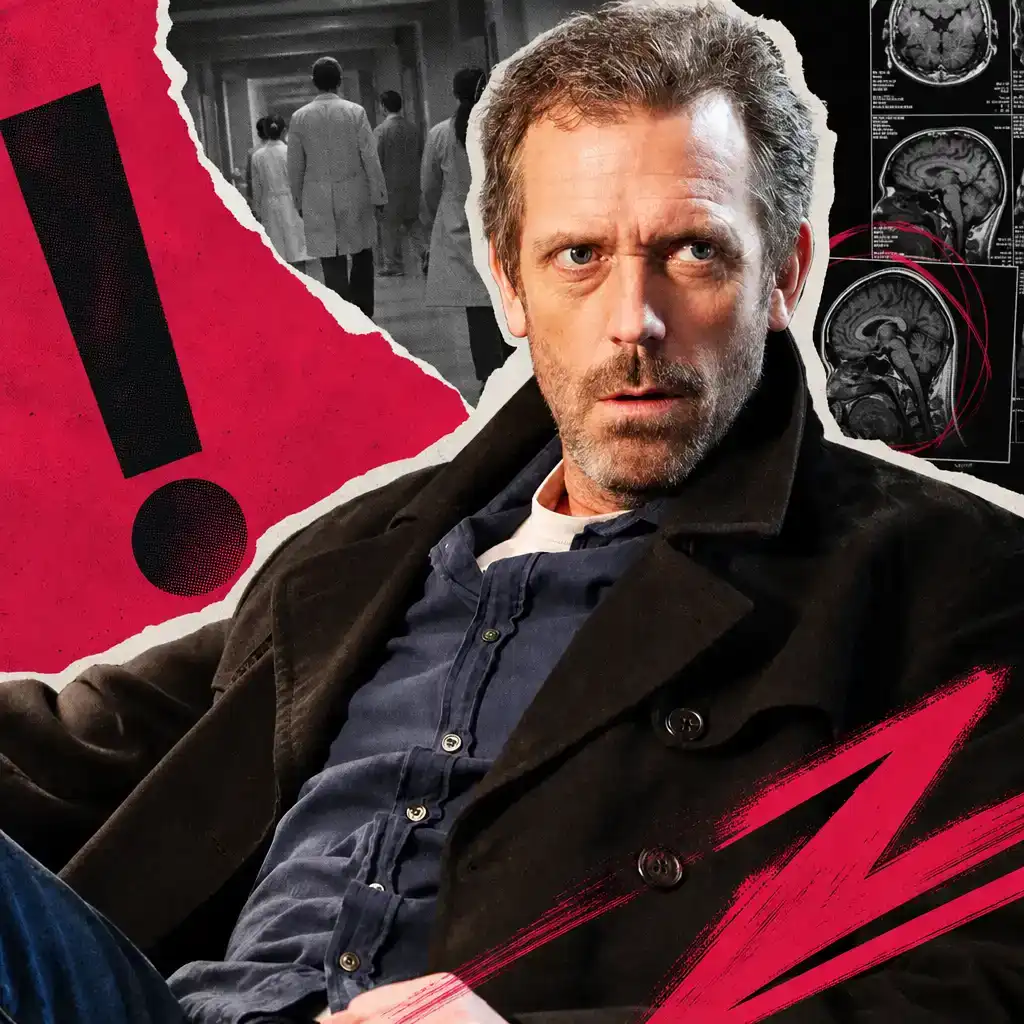
Hugh Laurie apologizes after a sharp reply to journalist Janet Murray’s critique of House went viral, drawing unwanted attention to her and a wave of abuse from some of his fans. The actor has now said the backlash was “not at all the plan,” which is the sort of clarification that tends to arrive after the internet has already found the matches.
What Started The House Back-And-Forth?
The exchange began earlier this week on X/Twitter, where Murray noted that many episodes of House followed a familiar structure. In broad terms: a patient arrives with baffling symptoms, Dr. Gregory House gets it wrong, professional disaster looms, and then he lands on a rare but correct diagnosis near the end.
It was a standard observation about a procedural drama. Television, inconveniently for everyone involved, often has a format.
Laurie, who played House across the medical drama’s run, responded with a pointed post that has since been deleted. “Thanks for your critique, Janet,” he wrote. “We actually tried a couple of episodes where House (Hugh Laurie) (please put the brackets in the right place) gets it right first time, but they were only six minutes long. NBC weren't happy. Then we tried some where House never gets it right and the patient dies. The audience wasn't happy.”
He then widened the argument, writing: “One could apply your trenchant analysis to other art forms: JS Bach wrote 30 Goldberg variations on the same chord structure.”
Why Janet Murray Said The Reply Became A Problem
Murray later described the reaction after Laurie shared her post with his large online following. According to her, the response included “fairly horrific trolling,” as users piled on after the actor’s criticism spread.
That point became the center of the story. The issue was no longer whether House used a repeatable plot engine. Plenty of successful shows use one. The question was what happens when a celebrity with millions of followers aims a cutting remark at someone whose platform is not comparable.
Murray’s original point was about structure, not a personal attack on Laurie or the writers. But online, scale changes everything. A joke from a famous person can quickly become an invitation for strangers to behave as if they have been personally assigned to defend a television drama from the mid-2000s.
Laurie Says He Was Defending The Writers
Laurie then posted a follow-up apology, saying he regretted the fallout Murray had faced.
“I'm sorry if people have been having a go at you because of my tweet,” he wrote. “Not at all the plan. I was very slightly drunk and already upset about something that had nothing to do with you. If it's any comfort, I got it in the neck too. I'm a thin-skinned t**t, apparently, even though it wasn't my skin.”
He also explained that his reaction came from affection for the people who made the show. “I was sticking up for the writers who I adored,” Laurie continued. “Obviously I shouldn't have cited Bach/Kahlo/Moore — asking for trouble — and would have done better to go for the 10,000 blues songs written around the same 12 bar chord structure. I've listened to most of them and will keep doing so. Because we love what we love.”
That last line gets at the human part of the flare-up. Laurie was defending colleagues and a body of work that still clearly matters to him. Murray, meanwhile, made a media observation and ended up taking the heat that comes when fandom, celebrity and algorithms crowd into the same small room.
Murray Accepted The Apology, With A Caveat
Murray responded to Laurie’s apology with measured appreciation. “Thank you,” she wrote. “‘Having a go’ is probably an understatement but I appreciate the apology and recognise you may have been sticking up for colleagues.”
For now, the exchange seems to have settled down. Laurie acknowledged the effect of his post, Murray accepted the apology while making clear the backlash was more severe than a few stray complaints, and the internet was briefly reminded that procedural television formulas are not usually worth a public pile-on.
The original debate over House is also not exactly mysterious. The show’s structure was part of its appeal: the puzzle, the wrong turns, the late revelation, the difficult genius at the center of it all. Viewers knew the rhythm. Many came back because of it.
The larger lesson is simpler and less medical: a famous actor can defend his writers without leaving a critic to deal with the waiting room full of angry strangers.