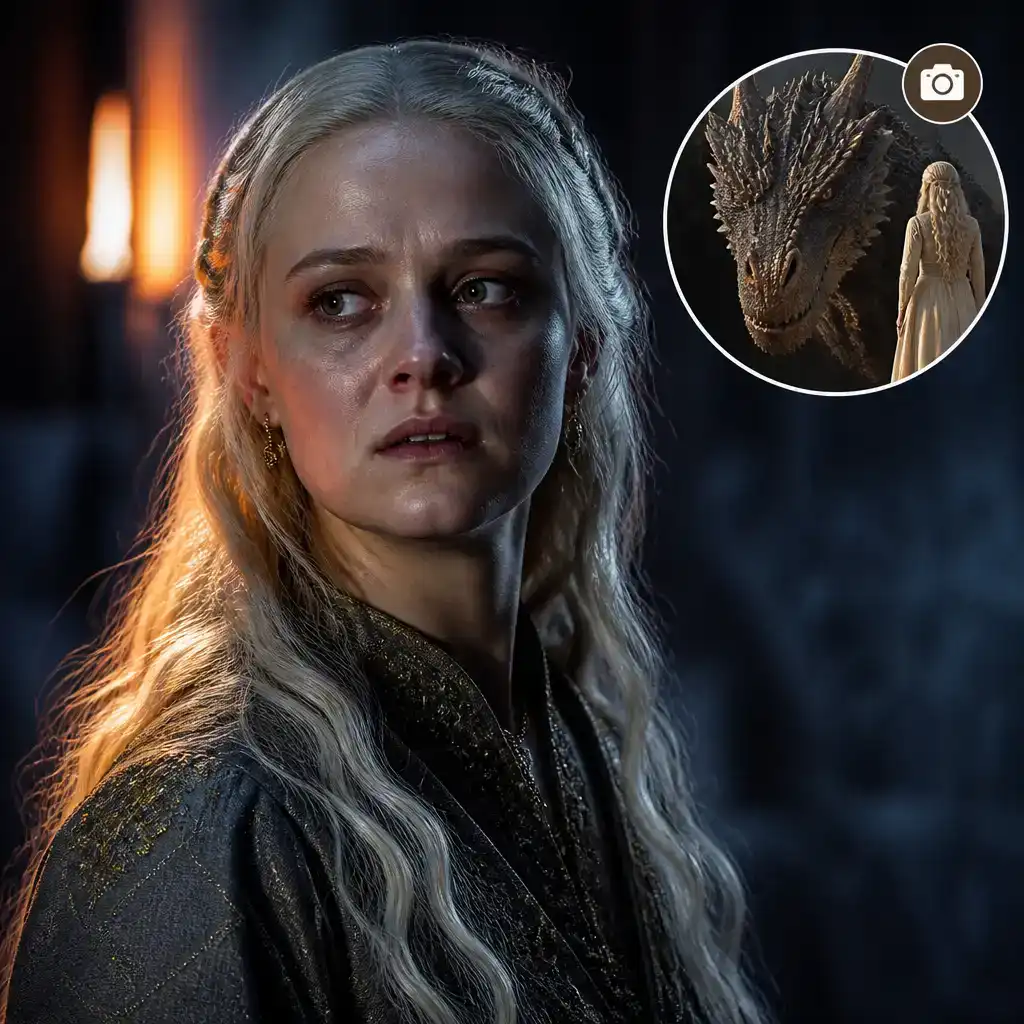
Full spoilers follow for Season 3, Episode 7.
House of the Dragon Season 3, Episode 7 finally treats dragons as more than airborne weapons with difficult parking requirements. As the people around them fracture, the dragons echo their riders’ fear, anger and pain. That emotional link gives the season’s penultimate chapter its strongest material, even as Rhaenyra Targaryen’s alliances begin to look dangerously negotiable.
The episode also pushes Helaena’s prophetic visions into new territory, reunites Aegon with Sunfyre and turns Ulf into the focus of Ormund Hightower’s latest bargain. Nobody is technically safe, but several people remain confident enough to behave as if they are.
What connects a dragon to its rider?
The series has often left the bond between dragon and rider frustratingly vague. Dragons clearly confer status and military power, while losing one can leave a Targaryen emotionally and politically diminished. That was true for the late Viserys and is now painfully visible in Aegon II.
This episode suggests the connection runs deeper. Rhaenyra discovers that Daemon has been lying to protect his daughter Rhaena, then flies with Addam to confront them. As the humans argue, their dragons roar, posture and threaten fire. The creatures do not simply stand nearby waiting for instructions. They appear to absorb and express the emotions of their riders.
That idea becomes even clearer when Aegon and Sunfyre reunite. Both are scarred, furious and unwilling to disappear quietly. Their screams align until rider and dragon seem to be sharing the same defiance, and possibly the same instability. Online discussion after the episode repeatedly singled out Aegon declaring himself before Sunfyre’s return as an unusually kingly moment for him.
The scene does not provide a tidy set of rules for dragon psychology. It does, however, make the bond feel personal rather than merely contractual. In a civil war built around inherited power, that distinction matters.
Helaena’s Dreamfyre vision rewrites history
The episode opens inside one of Helaena’s visions, and her Dreams continue to shape the story. She sees herself riding Dreamfyre above an angry crowd in the Dragonpit and shouting “Dracarys!” as the mob rushes toward them. Another vision offers a quieter possibility: life on a farm with her children, apparently including Jaehaera and the younger boy she is expecting, before an eclipse interrupts the peace.
Rhaenyra pressures her younger half-sister to explain what these images mean. She is not merely seeking intelligence. She wants Helaena to confirm that her choices have purpose and that the suffering around her leads somewhere defensible. Helaena cannot, or will not, provide that comfort.
The Dragonpit sequence is especially significant because it departs sharply from George R.R. Martin’s Fire & Blood. In the book, Helaena dies before the mob storms the Dragonpit and never rides Dreamfyre against it. The series has effectively placed her inside a catastrophe she did not witness in the written history, turning adaptation itself into prophecy.
That choice gives Helaena more agency while making the vision harder to interpret. It could be a warning, an alternate future or a symbolic expression of the violence closing around her. Viewers also responded strongly to seeing Dreamfyre given a prominent sequence after spending so much of the series at the edges of the action.
Aemond’s Harrenhal reunion becomes poisonous
Aemond’s subconscious is considerably less subtle. He dreams that his mother, Alicent, arrives at Harrenhal and falls into bed with him. He wakes to discover that she really has arrived, although reality is only marginally less uncomfortable.
Alicent talks nervously, Aemond remains guarded and Alys quickly suspects the newcomer. Aemond shares enough of that suspicion to kill Alicent’s travelling companion, who was helping her attempt to assassinate him. He does not, unfortunately for him, extend the same caution to the poisoned drink Alicent serves after an excruciating dinner.
Believing the job finished, Alicent slips out of the castle devastated by what she has done. Aemond soon feels the first stomach pains and makes his way to Alys, which gives him a plausible route to survival. His poisoning remains unresolved heading into the finale.
The sequence turns Alicent’s relationship with her son into another casualty of the war. She arrives prepared to kill him, yet the act visibly breaks something in her. Aemond, meanwhile, can identify the obvious assassin standing beside her but still misses the threat placed directly in his cup. Harrenhal continues to reward confidence with humiliation.
Rhaenyra loses control of her own court
Rhaenyra spends the episode being pulled between military, financial and personal crises without resolving any of them. Her uncertainty leaves space for resentment to grow at the center of her government.
Torrhen Manderly is furious about being left to manage the faction’s financial problems, despite that responsibility being central to his position. Mysaria is attempting to serve as a bridge between the crown and ordinary people, only to find herself distrusted by both sides.
By the end of the episode, Mysaria and Rhaenyra renew their physical intimacy. The connection gives Rhaenyra a moment of comfort but does little to solve Mysaria’s political problem. She remains trapped between royal authority and public anger, with neither side fully accepting her.
Rhaenyra’s requests for reassurance from Helaena reveal how badly the pressure is affecting her. She does not just need a strategy. She needs someone with prophetic authority to tell her she remains righteous. When Helaena cannot offer that verdict, Rhaenyra is left with the consequences of decisions she can no longer frame as inevitable.
That emotional erosion is the episode’s real danger. Her dragons still make her formidable, but power means less when allies are injured, divided or available to the highest bidder.
Daemon discovers fatherhood rather late
Daemon finally recognizes that Rhaena may genuinely need him. By the standards of this family, noticing a child’s emotional distress already places him above a very low bar.
His attempt to protect her still causes significant damage. He lies to Rhaenyra, separates Rhaena from her dragon and then returns home without securing much of anything. His intentions may have improved, but his methods remain recognizably Daemon’s.
The confrontation breaks Rhaenyra’s trust and exposes how badly both of them are struggling to separate private loyalties from wartime responsibilities. Daemon also appears increasingly ineffective in council, where his personal fixation on Rhaena prevents him from seeing the wider strategic picture.
Viewers broadly responded to his belated empathy for his daughter, but the scene does not excuse his choices. It makes them sadder. Daemon understands what Rhaena needs only after placing her, his marriage and their military position at greater risk.
Ormund turns people and dragons into currency
While Rhaenyra and Daemon unravel, Ormund Hightower is enjoying himself. The Rivermen may be approaching the makeshift walls at Tumbleton, but he still holds several valuable pieces.
Corlys Velaryon remains his prisoner. Ormund cuts off one of Corlys’s fingers as proof that he is alive, hoping to stop Velaryon forces from filling the policing vacuum in King’s Landing. He is also withholding his plans from his ward, Daeron, and his cousin Gwayne, increasing their frustration and resistance.
Benjamin Evan Ainsworth has described Gwayne and Ormund as contrasting parental figures for Daeron. Gwayne is “more brotherly,” while Ormund is “more domineering.” Ainsworth and James Norton have also called Ormund’s bond with Daeron “twisted,” which helps explain why the secrecy is becoming intolerable for both younger men.
Ormund’s largest move comes at the end, when he tries to buy Ulf’s loyalty. His offer includes control of Corlys’s seat at Driftmark and the freedom to drink whenever he likes. The scene links three of Ormund’s tactics: Corlys’s body, his ancestral home and Ulf’s dragon are all treated as assets that can be traded.
The proposal is rooted in Fire & Blood, where Ulf and Hugh Hammer change sides at Tumbleton. The show has added Ormund’s personal recruitment effort. The book also has Ulf incapacitated by alcohol during part of the battle, making unlimited drink a particularly questionable employment benefit.
Where the dragon count stands before the finale
Rhaenyra entered this stage of the war with six dragons firmly associated with her faction:
- Syrax
- Caraxes
- Vermithor
- Silverwing
- Moondancer
- Seasmoke
She also had Sheepstealer as an uncertain potential ally. The Greens had Vhagar missing and Dreamfyre out of active combat.
By the end of Episode 7, Rhaenyra appears to have five dragons remaining in her camp, with two possibly injured. The Greens may now count Silverwing, if Ulf accepts Ormund’s terms, alongside the resurgent Sunfyre. Sheepstealer and Vhagar remain missing variables capable of changing the balance again.
HBO’s eight-episode season concludes on August 9. Episode 7 aired on August 2 in the United States, although some international schedules list it as August 3. No later episode has yet resolved Ulf’s agreement, Aemond’s poisoning or Corlys’s captivity.
Verdict
This is an engaging penultimate episode that holds back from full-scale dragon warfare while making the creatures more emotionally important than they have been for much of the series. Helaena and Aegon receive the standout dragon moments, while Rhaenyra’s need for validation exposes how isolated she has become.
Ormund currently has the momentum because he understands that this war is fought through leverage as much as flame. The finale now has to decide whether his bargains survive contact with the people, and dragons, he assumes can be owned.