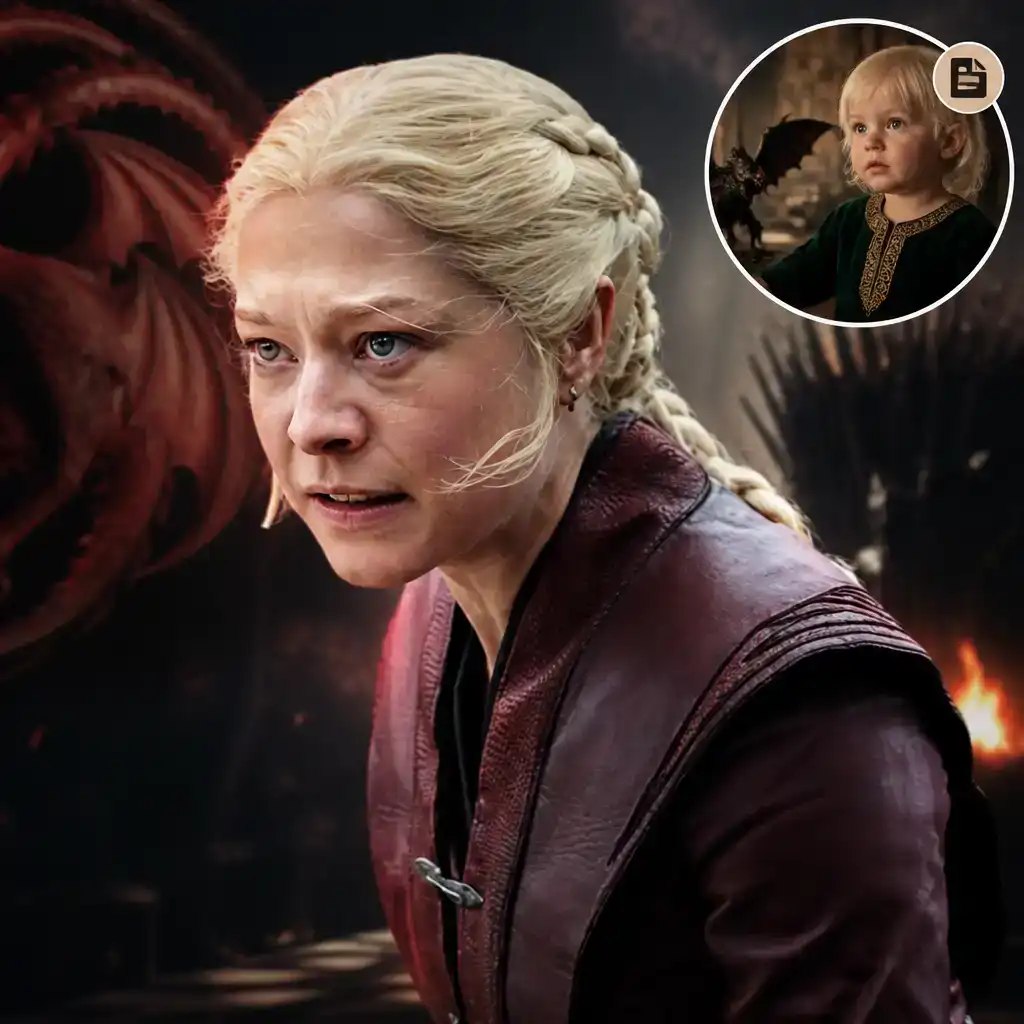
The House of the Dragon season 3 ending turns Helaena Targaryen’s death into the clearest evidence yet that HBO’s adaptation is no longer merely filling gaps in Fire & Blood. It is building a substantially different version of the Dance of the Dragons, with Rhaenyra directly implicated in Helaena’s collapse and George R.R. Martin’s missing-Maelor complaint now looking rather less theoretical.
Major spoilers for the Season 3 finale follow.
Why does Helaena take her own life?
Rhaenyra Targaryen begins the finale under pressure from almost every direction. Ormund Hightower is damaging her reputation from captured Tumbleton, while confirmation that Aegon II and Sunfyre survived adds another living claimant and one particularly angry dragon to her problems.
She is also grieving Jacaerys and losing control of King’s Landing. Her earlier effort to present herself as a ruler concerned with ordinary people has given way to something harsher. Apparently the public-relations phase of civil war has ended.
Baela Targaryen confronts Rhaenyra over her treatment of allies, especially the dragonriders. Baela argues that the queen regards them as pieces to move around the board, with little concern for whether they survive once they have served their purpose.
Helaena, meanwhile, is pregnant and refusing food. When Rhaenyra tries to persuade her to eat, Helaena condemns the throne and everything her half-sister wants from it as ugly and worthless. She also tells Rhaenyra that their father, Viserys, would disapprove of what she has become.
Rhaenyra responds by forcing food into her mouth. It is not her first attempt to control Helaena this season. She has repeatedly demanded access to Helaena’s prophetic visions, hoping they might reveal whether her campaign succeeds. The force-feeding makes the relationship unmistakable: Helaena is not being protected. She is being used.
How does Mysaria’s warning affect Helaena?
Before the confrontation, Mysaria warns Helaena that neither she nor her unborn child will ever be safe with Rhaenyra. They will remain hostages because of their bloodline, whatever promises the queen makes.
Mysaria had been sent to Pentos, but escaped during the disorder in King’s Landing. Her warning confirms what Helaena has already begun to understand through Rhaenyra’s treatment and, possibly, through her visions. There is no peaceful future waiting for her inside the Red Keep.
Helaena later jumps from a window and is impaled on the battlement spikes below. The finale briefly follows Alicent Hightower on her return toward King’s Landing, where a cloud of blue butterflies rises in front of her. Helaena has been associated with insects since Season 1, particularly caterpillars, making the transformation a blunt but effective symbol of her death.
A servant then alerts Rhaenyra, who discovers Helaena’s body and closes the window. That final gesture can be read as shock, denial or another attempt to contain a disaster she helped create. None is especially flattering.
Helaena’s unfinished tapestry offers one further warning. It depicts a bloodied Rhaenyra on the Iron Throne, flames behind her and a disfigured Sunfyre raging nearby. Helaena knew more about Rhaenyra’s future than Rhaenyra realized. As usual, obtaining a prophecy does not make anyone better at handling it.
Why did George R.R. Martin object to the Maelor change?
Martin publicly raised his concerns in a September 2024 blog post titled “Beware the Butterflies.” The post was deleted soon afterward, though copies circulated widely.
His central objection was the adaptation’s treatment of Maelor Targaryen, Helaena’s youngest child in Fire & Blood. Martin argued that removing Maelor would trigger a chain of damaging changes. In the book’s disputed historical accounts, Maelor is killed by a crowd at Bitterbridge, and the news is presented as a major possible reason for Helaena’s suicide. His death also contributes to the unrest that follows.
Martin wrote that Ryan Condal’s early Season 3 outline had Helaena kill herself “for no particular reason.” He warned that without Maelor:
- The Bitterbridge sequence would lose its central victim.
- Helaena’s suicide would have a weaker motivation.
- The popular uprising after her death would become harder to explain.
- Later events would have to be rewritten to compensate.
The televised finale does not follow that outline exactly. It gives Helaena several new motives: her pregnancy, her visions, Mysaria’s warning and Rhaenyra’s escalating abuse. That is more than “no particular reason,” but it still replaces the cause-and-effect structure Martin defended.
Season 3 also complicates the claim that Maelor simply never existed in the adaptation. Helaena’s pregnancy may have been Condal’s attempt to delay Maelor’s arrival rather than erase him from the story. Her death while still pregnant, however, appears to close that possibility in the bleakest way available.
How does the finale change Rhaenyra’s story?
In Fire & Blood, Helaena’s death is deliberately uncertain. Some accounts connect it to grief over Maelor. Others spread the allegation that Rhaenyra ordered her thrown from the window to remove a rival royal bloodline. The book never settles the matter because it is written as a contested history assembled from biased sources.
The series chooses a third path. Rhaenyra does not physically kill Helaena, but her actions help push her toward death. The result preserves enough ambiguity for political propaganda while making the audience witness Rhaenyra’s cruelty directly.
That is a significant shift for Emma D’Arcy’s character. Earlier seasons often softened or redistributed Rhaenyra’s responsibility compared with the most hostile book accounts. The finale moves in the opposite direction, showing her becoming controlling, suspicious and willing to harm a vulnerable prisoner for information.
Audience reaction was divided after the episode. Some viewers praised the finale’s performances and darker turn, while others argued that Helaena’s death and Rhaenyra’s transformation still lacked enough development. Condal had said before the season that criticism of Season 2 did not alter his plans. He described the show’s structure as a “slow build” followed by an explosion around the middle or end. Season 3 certainly reaches the explosion. Whether every fuse was properly laid is another matter.
What happens to Alicent, Aegon and Aemond next?
Alicent was sent to Harrenhal by Rhaenyra to kill her son Aemond. She now returns to King’s Landing without knowing that Helaena has died under Rhaenyra’s control. The butterflies signal what she is about to discover.
In Fire & Blood, Alicent survives all her children and eventually dies from Winter Fever in 133 AC after a period of confinement. The show has not yet explained how she reaches that imprisonment. Helaena’s death gives her an immediate reason to turn against Rhaenyra again, assuming the adaptation follows even the broad outline of her later fate.
Aegon and Aemond also remain unresolved. Aegon appears at Harrenhal and confronts his brother over Aemond’s attempts to kill him. He says forgiveness may be possible once they recover Vhagar and retake King’s Landing.
That appears to set up a search for Vhagar before Aegon moves toward Dragonstone, which has been left comparatively exposed by Rhaenyra’s departure. Sunfyre’s appearance in Helaena’s tapestry suggests that the injured dragon still has an important role to play. Readers of Fire & Blood will know that this is not decorative background material.
What became of Ulf and Hugh at Tumbleton?
The Battle of Tumbleton delivers another major departure from the book. Ulf the White keeps his promise to betray Rhaenyra’s Black Council, but then attacks Greens, enemies and civilians alike. His loyalty is effectively to destruction, a position requiring very little administrative work.
Hugh Hammer does not join Ulf in turning against the Blacks. Instead, he concentrates on finding his wife, Kat, amid the fighting. In Fire & Blood, Ulf and Hugh become known together as the Two Betrayers, so separating their decisions changes both Hugh’s motivation and Rhaenyra’s response.
If Hugh remains missing while Ulf openly defects, Rhaenyra may still brand both men traitors. Alternatively, the final season could delay Hugh’s betrayal or discard it entirely. Either choice will affect the balance of dragon power as the war narrows toward its end.
Can Season 4 finish the entire war?
HBO has renewed House of the Dragon for Season 4, and Condal has confirmed it will be the last. A 2028 premiere may be more likely than 2027 if filming starts early next year, which is understandable. Dragons remain inconveniently slow to manufacture.
The final season now has a crowded list of obligations. It must address the fallout from Helaena’s suicide, unrest in King’s Landing, the dragonpit, Alicent’s confinement, the fates of the remaining dragonriders and the eventual resolution of the war. It must also explain whether Helaena’s unborn child was intended as a partial restoration of Maelor or simply another casualty of the adaptation’s rewritten timeline.
The scale of the audience makes those choices consequential. Season 3 ran for eight episodes, with its premiere drawing nearly 22 million viewers across its initial measurement period. For comparison, the Season 2 finale attracted 8.9 million viewers on its first night.
Martin’s warning was never only about one absent child. His argument was that changing Maelor would force changes to Helaena, Bitterbridge, the uprising and everything that followed. The Season 3 finale effectively proves the structural point, even while inventing a more developed reason for Helaena’s death than the outline he criticized.
The question for Season 4 is no longer whether the series will depart from Fire & Blood. It already has. The question is whether its new version can bring all those altered consequences to a coherent ending before the dragons, the city and nearly everyone involved run out of time.