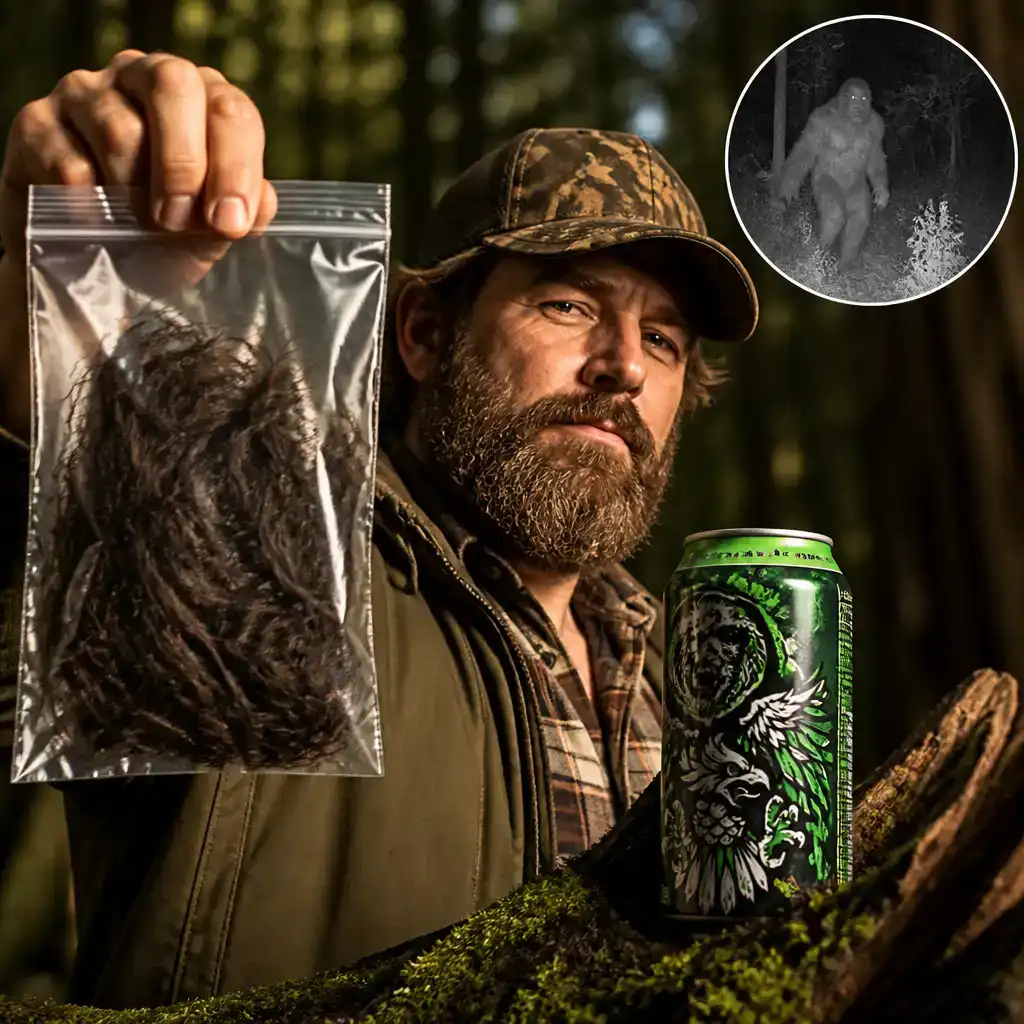
Hard Mountain Dew is offering $1 million for verified proof that Bigfoot exists, which should finally motivate the famously elusive creature to improve its media strategy. The nationwide Hard Mountain Dew Bigfoot Bounty opens September 15 and accepts submissions through November 30.
Anyone aged 21 or older can enter, but a vague shadow beside a tree will not unlock the seven-figure prize. Entrants must provide an essay and evidence covering at least four of the company’s seven approved categories.
What evidence does the Bigfoot challenge require?
Hard Mountain Dew has set unusually precise standards for a competition involving an animal whose existence remains unproven. Accepted evidence can include:
- A footprint measuring between 37 and 38.5 inches long, pressed six inches into solid gravel
- A documented 13-inch handprint with unusual characteristics
- Thermal footage showing a seven-to-nine-foot heat signature moving through dense forest at 20 to 25 mph
- Hair samples containing unknown DNA markers
- Unexplained audio consistent with previously reported Bigfoot activity
- Environmental remnants with no evidence of machinery or storm damage
- A photograph that appears to show Bigfoot photobombing the entrant
Meeting four of those requirements only makes a submission eligible for consideration. It does not automatically earn the money. The company says it will award the $1 million only if the material provides genuine, independently verified proof of Bigfoot.
In other words, assembling a very large footprint, a strange noise and an uncooperative wig will not be enough. Probably.
Who will decide whether Bigfoot is real?
The company developed its judging standards with Bigfoot researcher Bryce Johnson. Johnson has starred in and produced a documentary series following Sasquatch investigators as they search for evidence of the creature.
That expert involvement is intended to separate potentially meaningful findings from the traditional collection of indistinct images, distant howls and people in costumes. The central condition remains simple, even if achieving it is not: the evidence must prove Bigfoot exists.
Hard Mountain Dew has also prepared for the more statistically familiar outcome in which nobody resolves one of America’s longest-running mysteries. If the main bounty goes unclaimed, 100 entrants will still receive the cash equivalent of a free 12-pack for submitting their best material.
Senior brand director Erica Taylor said the campaign builds on the brand’s focus on “chasing bold experiences.” She added that autumn regularly brings reports of unexplained shapes among trees and mysterious sounds, whether or not any of them lead to an actual Sasquatch.
A recent sighting ended with a costume
The promotion arrives only weeks after reported Bigfoot sightings caused a stir in Damariscotta, Maine. Local police investigated after residents spotted what appeared to be the creature around town.
Officers eventually found the supposed Bigfoot sitting on Main Street. It was a man wearing what police called a “very convincing costume.” Convincing enough to attract attention, yes. Convincing enough for scientific verification and a $1 million payment, apparently not.
Prospective bounty hunters will therefore need considerably stronger material before November 30. Four categories of evidence, an accompanying essay and expert scrutiny stand between them and the prize. Bigfoot, meanwhile, remains under no obligation to cooperate.