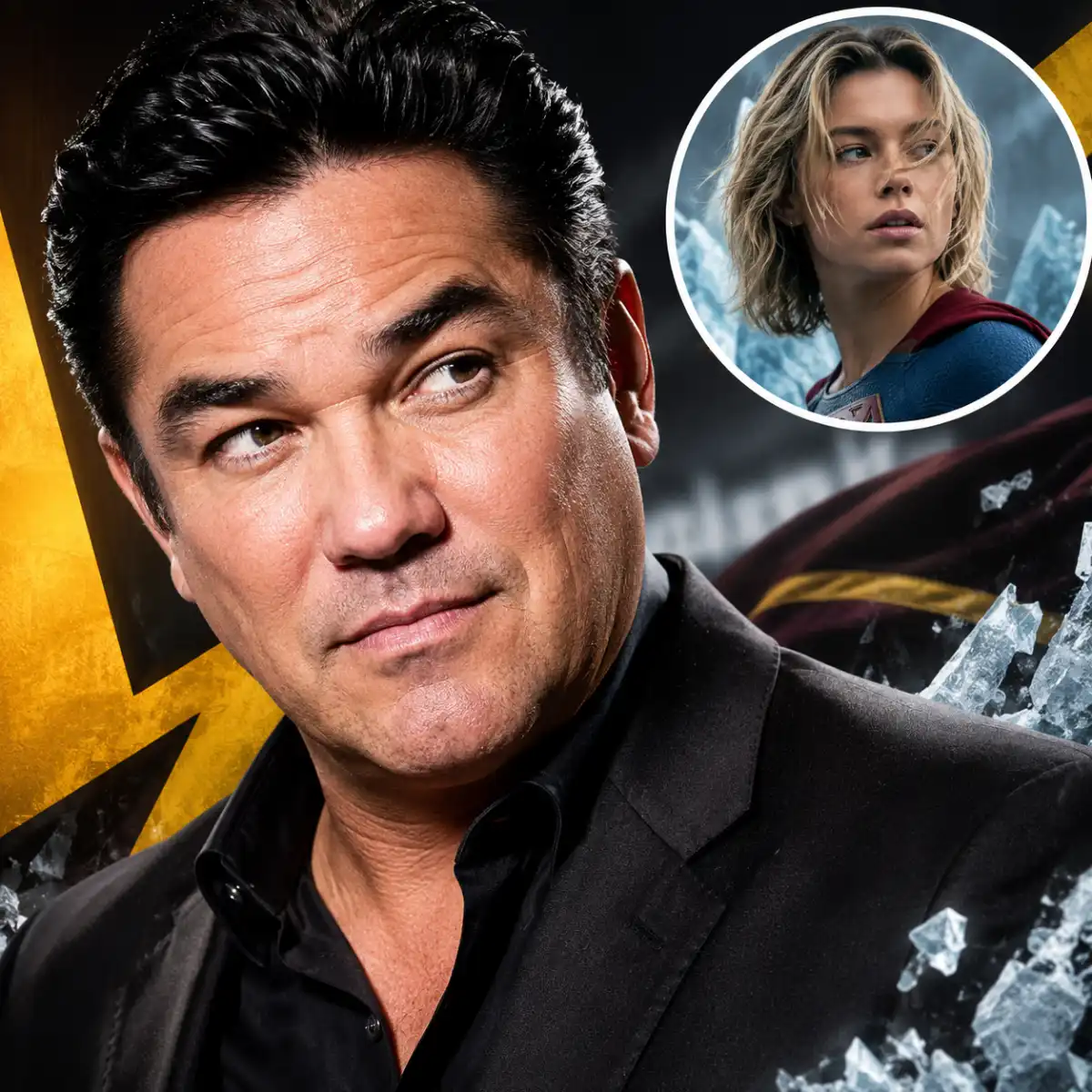
For viewers who met him in the 1990s, Dean Cain was once the reassuring face of television Superman: polished, charming, and reliably framed by soft lighting. The Dean Cain Supergirl controversy now surrounding him is a very different kind of spotlight, after the former Lois & Clark star appeared to approve of a joke aimed at Milly Alcock, the 26-year-old actor preparing to play Kara Zor-El.
The backlash has been swift because this is not happening in isolation. Cain’s recent public life has increasingly been defined by politics, culture-war arguments, and a steady drift away from the broad affection he enjoyed at the height of his fame.
What did Dean Cain say about Milly Alcock?
The latest backlash began on X, where one user questioned how Supergirl could have pierced ears if her skin is supposed to be bulletproof. Another user replied with an image comparing Milly Alcock to Cha-Ka, a character from the 1970s series Land of the Lost.
Cain responded: “Dang it… I laughed.”
That short reply was enough to draw criticism from fans who saw it as a former Superman actor joining in with an appearance-based joke about a younger actor taking on one of DC’s most recognizable roles. Which is certainly one way to welcome someone into the franchise.
Critics accused Cain of endorsing misogynistic mockery rather than showing basic professional grace. On Reddit, one user wrote: “She is like the most conventionally attractive woman ever. We can’t win.” Another replied: “THIS. RIGHT. HERE. They just hate women. Period.”
How did Cain respond to the backlash?
Since Sunday, Cain has replied to or reposted at least 30 posts connected to the Supergirl dispute, while also sharing messages attacking Maine Democratic Senate candidate Graham Platner and praising President Donald Trump’s appearance at Monday’s NBA Finals game at Madison Square Garden.
For many observers, the volume of posts made the incident feel less like a stray bad reaction and more like another step in Cain’s public transformation. The actor who once played a version of Superman built around warmth and restraint is now often discussed in connection with partisan social media fights.
That contrast is part of why the story has traveled so widely. Cain is not just any actor weighing in online. He is a former Clark Kent commenting on the next generation of DC performers, and audiences tend to remember when people who once represented decency on screen seem less interested in practicing it off screen.
How did Dean Cain become famous?
Dean Cain was born Dean George Tanaka in 1966 and seemed, for a time, headed toward a career in sports rather than acting. He studied at Princeton University, where he played football, and later briefly signed with the Buffalo Bills.
A knee injury ended his football plans, redirecting him toward entertainment. After commercials and guest roles, he landed the part that would define him: Clark Kent in Lois & Clark: The New Adventures of Superman, opposite Teri Hatcher, in 1993.
The series gave audiences a more romantic, approachable Superman, and it worked. At its peak, Lois & Clark drew more than 15 million viewers per episode. Cain became a household name, a magazine-cover regular, and one of the decade’s major television heartthrobs.
His personal life also drew tabloid attention. He dated Brooke Shields while at Princeton, and later had a six-month relationship with Pamela Anderson near the beginning of her Baywatch era.
Cain continued working after Lois & Clark, including hosting Ripley’s Believe It or Not! and later appearing in Supergirl. Still, for most viewers, his signature role remains the Man of Steel.
What are Dean Cain’s political views?
In recent years, Cain has become nearly as visible for his politics as for his acting. He has publicly supported Donald Trump and has frequently used television appearances and social media to comment on conservative and culture-war issues.
In an interview with Variety, Cain said: “I love President Trump. I’ve been friends with him forever. Trump is actually one of the most empathetic, wonderful, generous people you’ll ever meet.”
He also joined the board of the National Rifle Association, the pro-gun lobbying organization long criticized by gun-control advocates who argue it has helped block legislation intended to reduce school shootings.
His presence in conservative media circles has grown alongside that activism. For supporters, this is Cain being clear about his values. For critics, it has made him a symbol of a familiar celebrity shift: beloved screen figure becomes online political combatant, and the nostalgia starts to curdle.
Did Dean Cain really join ICE?
One of Cain’s most controversial moves came in 2025, when he announced that he was joining U.S. Immigration and Customs Enforcement, widely known as ICE.
In a social media video, he said he wanted to support immigration enforcement and encouraged others to sign up as well.
“I am a sworn law enforcement officer, as well as being a filmmaker, and I felt it was important to join with our first responders to help secure the safety of all Americans, not just talk about it. So, I joined up,” he said.
Cain added: “Since President Trump took office, ICE has arrested hundreds of thousands of criminals, including terrorists, rapists, murderers, paedophiles, MS-13 gang members, drug traffickers…you name it. Very dangerous people who are no longer on the streets.”
He then promoted recruitment benefits, saying people could “earn lots of great benefits and pay.” With Superman’s theme music playing, he told followers: “You can defend your homeland for great benefits.”
He cited:
- A $50,000 signing bonus
- Student loan repayment
- Enhanced retirement benefits
- Special pay
Cain said ICE was “helping save America and remove the worst of the worst from America’s streets,” adding: “I like that, and I voted for that. They need your help to protect our homeland and our families. Join today if that’s something that’s tickled your fancy…because we need you.”
Why did the ICE announcement hit a nerve?
The ICE announcement drew heavy criticism online, especially from people who saw a contradiction between Superman’s long history as an outsider seeking acceptance and Cain’s support for an agency frequently condemned by immigration advocates.
Some critics also pointed to Cain’s own experience with racism after he was cast as Superman in the 1990s. In a previous Variety interview, he recalled hearing racist abuse linked to his Japanese heritage.
“It was 1993 and I remember a fan going, ‘We wanted Superman, not Sushi Man,’” Cain said.
Cain’s biological father was a Japanese-American serviceman, and the actor has spoken before about facing prejudice in his career. In that interview, he said he was not offended by the remark.
“For the love of God, he’s a Kryptonian. He could be green. Does it matter,” he said.
For some former fans, that history made his ICE stance feel especially jarring. One social media user wrote: “To make it worse, he’s literally talked about receiving backlash and being given racist nicknames for being a half-Asian Superman actor. And yet here he is endorsing and actively participating in those same systems of bigotry and shaming.”
What did Cain say about James Gunn’s Superman?
Cain has also drawn criticism for comments about James Gunn’s Superman reboot. Ahead of the film’s release last year, he objected to Gunn describing the character through the lens of an immigrant story and accused Hollywood of making Superman “woke.”
Speaking to TMZ, Cain asked: “How woke is Hollywood going to make this character?”
He continued: “How much is Disney going to change their Snow White? Why are they going to change these characters [to] exist for the times?”
Gunn had described Superman as “the story of America” and “an immigrant that came from other places and populated the country.”
Cain acknowledged the basic point, but argued the comparison had limits.
“We know Superman is an immigrant – he’s a freaking alien,” he said.
“The ‘American way’ is immigrant friendly, tremendously immigrant friendly. But there are rules.”
He added: “There have to be limits, because we can’t have everybody in the United States. We can’t have everybody, society will fail.”
Those remarks frustrated many comic-book fans, who noted that Superman has long been read as a metaphor for immigration. The character was created in the 1930s by the sons of Jewish immigrants, and he is, in the most literal possible sense, an alien who arrives from another world.
Why this controversy is bigger than one post
The argument over Milly Alcock arrives just as attention is turning toward her debut as Kara Zor-El in the upcoming Supergirl. That timing matters. Cain’s comment did not land as an isolated laugh at a random meme. It landed as part of a longer pattern: support for ICE, sharply partisan messaging, attacks on Hollywood’s supposed “woke” direction, and now a public jab adjacent to a young actor stepping into a major superhero role.
For people who grew up watching Cain’s Clark Kent, the disappointment is partly about memory. Lois & Clark offered a Superman who felt decent, romantic, and unusually human. The actor behind him now appears more comfortable provoking the audience that once embraced him.
That does not erase Cain’s place in 1990s television history. It does, however, change how that history feels to some viewers. Yesterday’s Superman laughing along at tomorrow’s Supergirl is not the crossover anyone asked for.